Where this stood in April, and where it stands now
This piece was written when the crisis was eight weeks old and the working assumption across most of the market was that it would resolve within months. It did not. Four months on, the shape of the disruption has changed in ways that matter for routing.
The strait has not reopened. Transit volumes remain a fraction of normal — around fifteen movements were recorded on 19 July against a pre-crisis norm near eighty-eight a day. The Joint Maritime Information Center advisory sits at Severe, its highest level. Roughly six thousand seafarers remain in the region.
War risk cover repriced rather than tightened. Hull war risk has moved into a range of three to ten percent of hull value, against a pre-crisis quarter of one percent. Several P&I clubs have withdrawn from the trade altogether. For most operators the constraint is no longer whether transit is physically possible but whether it can be insured at a price the voyage supports.
A ceasefire was attempted and failed inside three days. Iran signalled on 27 July that it would suspend attacks while a US pause held. Brent fell sharply on the news. Fresh US strikes by 30 July ended the pause, and Tehran has since restated that it will not agree to reopen the strait.
The Red Sea reopened as a second front, and the workaround closed with it. Houthi forces declared a maritime embargo on Saudi Arabia in late July and struck two Saudi crude tankers on 22 and 23 July. That corridor had been carrying Saudi crude around the Hormuz closure through the Yanbu terminal — roughly 3.5 million barrels a day in June against 240,000 a year earlier. Saudi Arabia has since joined US operations against Iran-linked targets in Iraq, moving from target to combatant.
Transit feasibility is now contested rather than settled. On 31 July Iranian state media claimed the Revolutionary Guards had stopped two tankers transiting under US military escort and forced four others to alter course. Western maritime authorities have not confirmed the incident, and ship-tracking data showed two very large crude carriers completing outbound transits the same day. Planners should treat the corridor as uncertain in both directions rather than assume either a hard closure or a working route.
The April analysis below holds up on structure — the routing arithmetic, the case for multi-route comparison, the argument that disruption is now permanent rather than episodic. Where it has dated is on timing and on price levels, and those are marked in place.
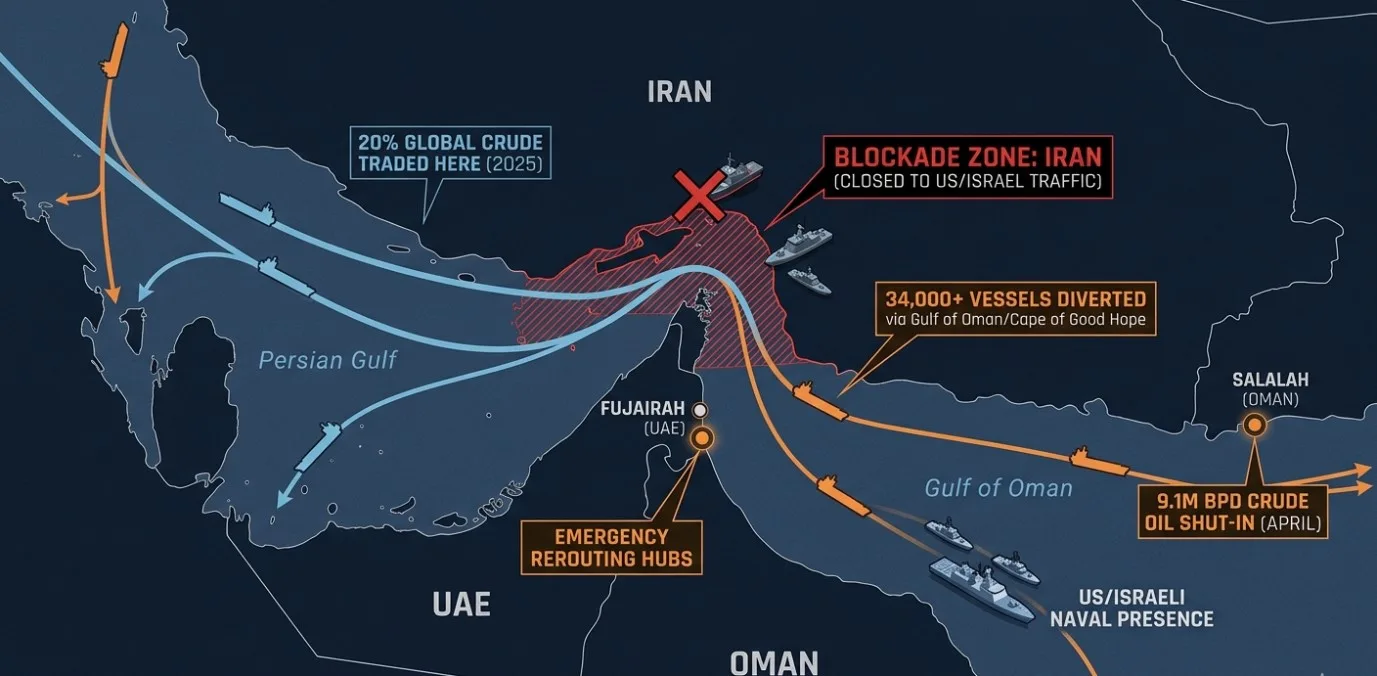
The 2026 conflict between the United States, Israel, and Iran has transformed the Strait of Hormuz from a theoretical risk scenario into an active shipping crisis. Within the first month of the crisis, hundreds of vessels had been diverted around the Cape of Good Hope, with all major container lines (Maersk, MSC, CMA CGM, Hapag-Lloyd) suspending Gulf transits, and the disruption shows no sign of normalizing.
For voyage planners, chartering desks, and fleet operators, the crisis has changed how routes are calculated, fuel is budgeted, and ETAs are forecasted.
What Happened at Hormuz
On February 28, 2026, the United States and Israel launched military strikes against Iran. In response, Iran restricted vessel traffic through the Strait of Hormuz — the narrow waterway between Iran and Oman that connects the Persian Gulf to the Gulf of Oman and the wider Arabian Sea.
The strait carries approximately 20% of global crude oil and a significant share of LNG exports. Iran has permitted only a trickle of non-U.S.-connected vessel traffic through the waterway, effectively blocking thousands of tankers, bulkers, and container ships.
The immediate consequences were severe. Roughly 150 vessels were stuck or rerouted in the first days. Gulf states including Iraq, Saudi Arabia, Kuwait, UAE, Qatar, and Bahrain collectively shut in an estimated 7.5 million barrels per day of crude oil production by March, rising to 9.1 million barrels per day by April.
Brent crude surged past $82 per barrel — a 13% jump — with projections reaching $115 per barrel in Q2 2026 before gradually falling to $88 by Q4.
Impact on Shipping Routes
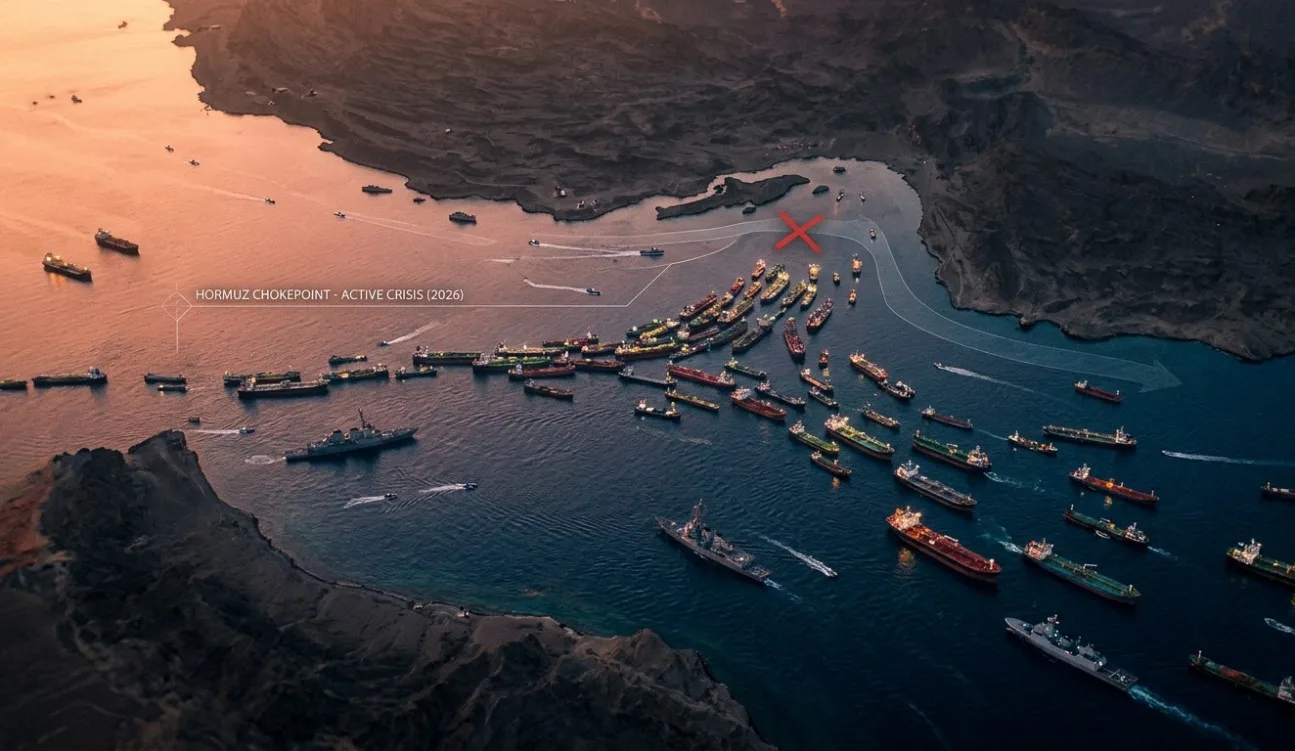
The disruption extends far beyond tanker traffic. Container lines, bulk carriers, and LNG carriers have all been affected. The key routing changes include:
Persian Gulf avoidance: vessels that previously loaded or discharged in Gulf ports are now diverting to alternative destinations. Saudi Arabia and Singapore have emerged as key diversion hubs.
Extended Red Sea uncertainty: the Houthi crisis in the Red Sea had already pushed most container traffic to the Cape of Good Hope route since late 2023. The Hormuz crisis has eliminated any remaining prospect of Red Sea services normalizing in 2026. Industry analysts in April estimated at least six more months before carriers would even consider Suez resumption, on the assumption that the Iran conflict ended immediately. It did not, and the Red Sea has since deteriorated rather than recovered — see the current-state section above.
Indian Ocean restructuring: cargo flows are shifting east into new routing structures across the Indian Ocean and Asia, creating congestion at ports that weren't designed for this volume.
Insurance and risk premiums: war-risk insurance for Hormuz transit has spiked, making the route economically unviable even for vessels technically permitted to transit.
| Scenario | Route Change | Transit Impact | Cost Impact |
|---|---|---|---|
| Gulf → Europe | Hormuz blocked → Cape route | +8–12 days | +$500K–1.2M |
| Gulf → East Asia | Hormuz blocked → East via Oman | +3–5 days | +$200K–400K |
| Asia → Europe | Red Sea still closed → Cape | +14 days | Elevated since 2024 |
Bunker Price Shock
The Hormuz crisis hit an already volatile bunker market. With 20% of global crude supply disrupted, fuel prices surged across all grades.
Major carriers have requested emergency fuel surcharges, though regulators have resisted waiving standard waiting periods for surcharge implementation — even as bunker prices swing by $50–100 per metric ton within single weeks.
For voyage planners, the practical impact is stark: a voyage that was profitable at $600/mt VLSFO may become loss-making at $800/mt — a threshold Singapore crossed in late July. This makes accurate fuel cost projection more important than ever. A voyage planner who doesn't factor in current bunker prices and ECA zone exposure is essentially guessing at profitability.
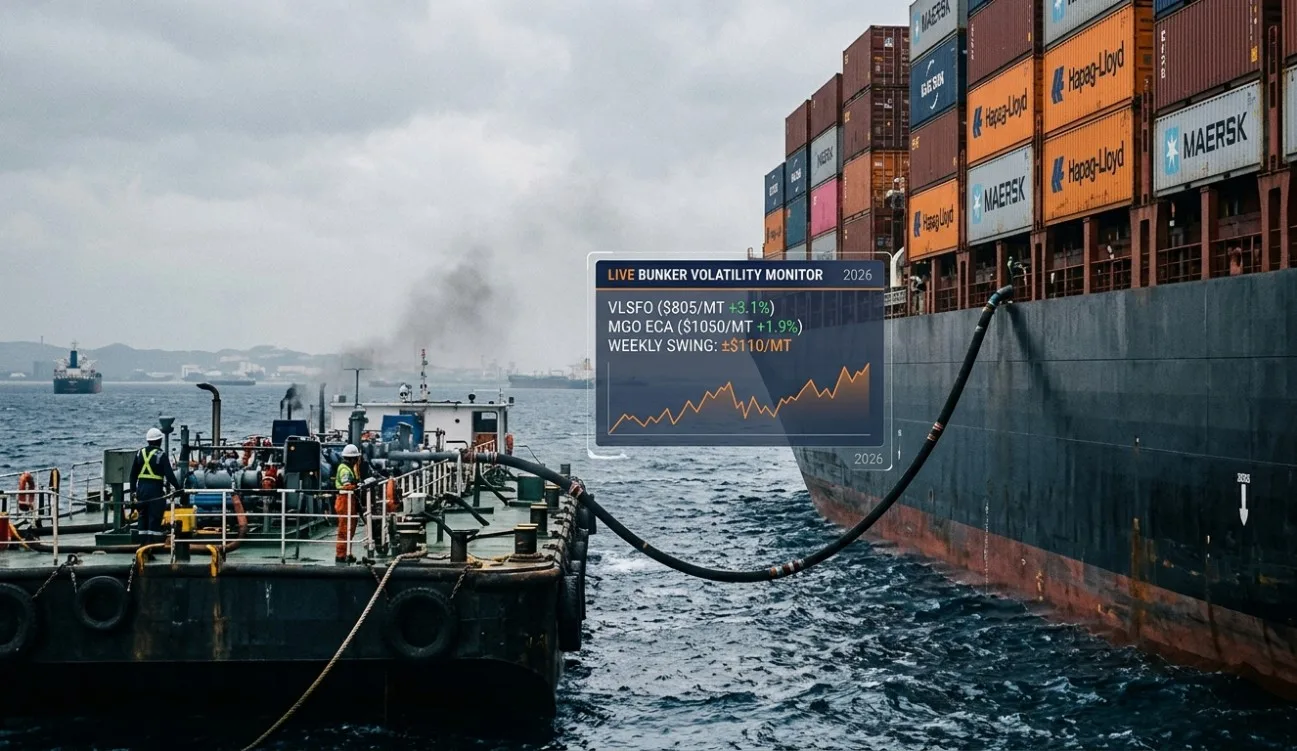
Forecasts are kept in place rather than revised after the fact. The gap between the projection and the outcome is the useful part. Current crude and bunker levels are on the Data Hub.
What This Means for Voyage Planning
Since 2023, the industry has been learning that single-route planning is obsolete. The Hormuz crisis confirms it.
Three years ago, most voyage calculations assumed Suez was open, Panama had capacity, and Hormuz was stable. In 2026, none of these assumptions hold reliably. Operators planning around one default route are now mispricing voyages.
Modern voyage planning has moved past single-route default assumptions. Operators now run multi-route comparison as standard practice, factor real-time bunker spreads into cost modeling, and treat chokepoint risk as a routing variable rather than a tail risk. Most major shipping desks have made this shift quietly over the past two years; the Hormuz crisis has accelerated it to a hard requirement.
The Structural Shift
Disruption is no longer episodic. It is structural. The industry is not waiting for conditions to "return to normal." Instead, carriers and operators are planning for disruption as an ongoing reality.
The congestion appearing at alternative ports isn't a temporary backlog. It's the result of carriers rebuilding routing structures faster than port infrastructure can absorb the resulting traffic.
For voyage planners, this means the tools and methods that worked in 2019 are not sufficient for 2026. Route comparison, fuel flexibility, and scenario modeling are no longer premium features — they're baseline requirements.
Planning Your Next Voyage
The structural shift has commercial implications across three layers.
First, in chartering decisions. Voyages routed through the Gulf now carry a risk premium that depends on flag, owner profile, and the state of hostilities at the time of fixing. The Hormuz crisis has made flag risk a first-order chartering variable, not an after-the-fact concern.
Second, in voyage cost modeling. The Cape of Good Hope rerouting that absorbed displaced Asia–Europe container traffic adds 10–14 days per voyage and an additional bunker burn of hundreds of tonnes. Cost models calibrated against pre-2024 fuel and route patterns are systematically underestimating current voyage economics.
Third, in commercial intelligence. The spread between Singapore and Fujairah VLSFO is now a real-time read on Hormuz uncertainty in a way it was not before 2024, and it does not always point the way intuition suggests. On 20 July Fujairah traded roughly twenty dollars above Singapore. Two weeks later it sat close to thirty dollars below. A discount at the port nearest the disruption is worth pausing over rather than assuming a stress premium that is not there. Both ports are updated on the Data Hub.
For side-by-side multi-route comparison across Suez, Panama, Cape of Good Hope, and the Northern Sea Route, see the Calculator. For daily bunker and freight indices feeding these decisions, the Maritime Data Hub.