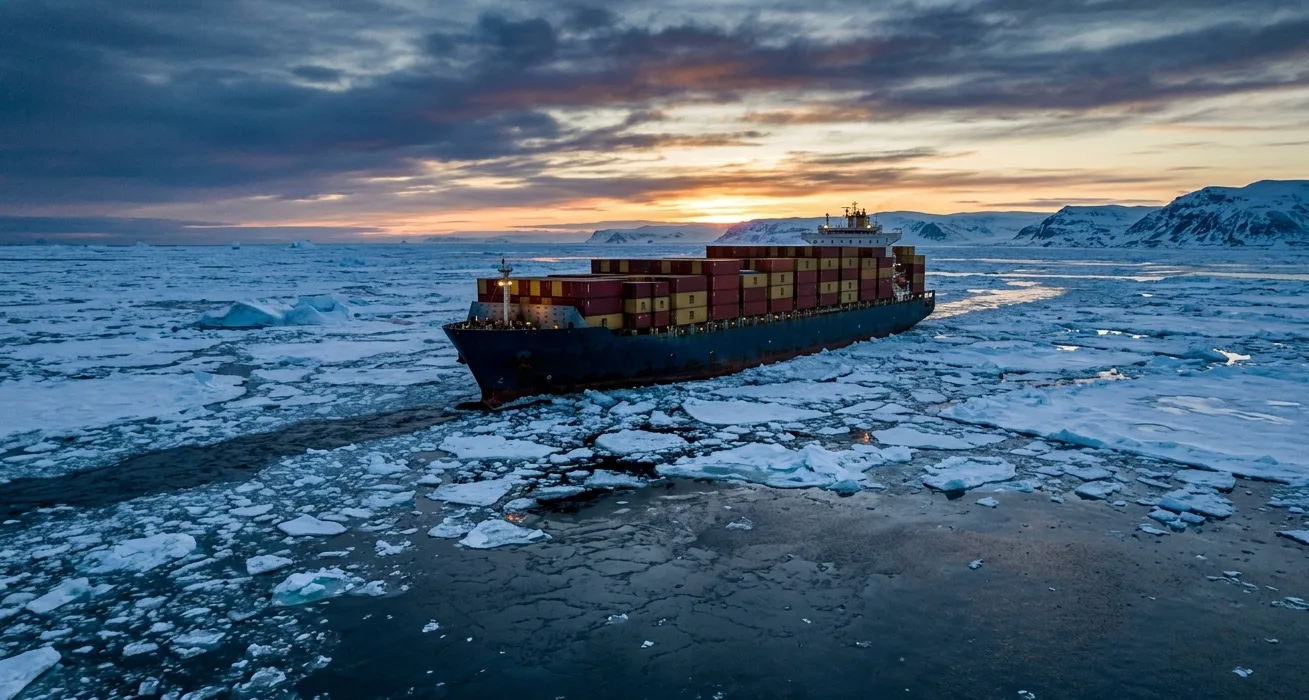
On a map, the Northern Sea Route is irresistible. Yokohama to Rotterdam via the Arctic is roughly 7,300 nautical miles — about 35% shorter than going through Suez and nearly half the distance of the Cape of Good Hope route that most operators have defaulted to since 2024. With Hormuz tensions still elevated and EU carbon costs climbing, the case for cutting 4,000 nautical miles off a voyage looks stronger than it has in a decade. Yet most of the world's container fleet still doesn't go near it. Why?
The answer isn't mystery or inertia. It's economics — and a stack of hidden costs that don't appear on the distance chart. For voyage planners weighing alternatives in 2026, understanding when the NSR actually beats the southern routes matters more than ever. The honest answer is: rarely, but the "rarely" window is widening.
The Distance Argument
Start with the geography that makes operators look north in the first place. The three main Asia-Europe corridors deliver wildly different distances for an identical origin-destination pair.
A 14-knot service speed translates the NSR's distance advantage into roughly 12 days saved versus Cape of Good Hope, 10 days versus Suez.
At 14 knots service speed, those distance differences are 22 days for the NSR, 33 days for Suez, and 43 days for the Cape. Saving 10-12 sailing days at $30,000 to $50,000 per day in time charter equivalent is real money — between $300,000 and $600,000 per voyage in pure time savings, before counting fuel.
Fuel savings compound the case. A neo-Panamax container ship burning roughly 100 tonnes per day at service speed saves about 1,000 to 1,200 tonnes of bunker on a one-way NSR voyage versus the Cape. At mid-2026 VLSFO levels that is another $750,000 to $900,000 in fuel avoided, though the figure moves with the bunker market — current prices across 45 ports are on our Data Hub. The headline math says NSR should win by over a million dollars per voyage. The reality is messier.

The Hidden Costs That Erase the Advantage
The reason most container lines still choose the Cape over the NSR isn't blindness to distance. It's a stack of cost layers that don't exist on southern routes.
Ice-class capital cost. Operating in Arctic waters during the transit season typically requires at least a Polar Class 6 (PC6) hull — or its Russian-rules equivalent in the Arc4 to Arc5 range — while year-round Northern Sea Route service demands Arc7 or higher. Building a new ice-class container ship costs roughly 10-25% more than an equivalent conventional vessel, depending on the rating and the yard, and the additional steel and reinforcement carries fuel-efficiency penalties year-round. For an operator running a vessel 30 years, the ice-class premium amortizes to roughly $500,000 to $1 million per year in capital cost difference — a tax paid even when the ship is in the South China Sea.
Russian transit fees and pilotage. The NSR runs through Russian Exclusive Economic Zone waters. Permits from Rosatomflot, mandatory pilotage, certification fees, and per-hour icebreaker escort charges together typically run roughly $300,000 to $700,000 per transit for a large vessel, depending on size, season, escort hours, and ice conditions. Tariffs can escalate quickly if ice conditions worsen or the schedule slips.
Insurance and war-risk premiums. Arctic war-risk insurance premiums spiked dramatically after February 2022 and remain elevated. Hull and machinery underwriters, by industry estimates, typically charge 30-50% premiums for NSR transits over equivalent southern voyages, reflecting both ice damage risk and limited salvage options. For a vessel and cargo with a combined insured value of $200 million, that premium can add $150,000 to $300,000 per voyage.
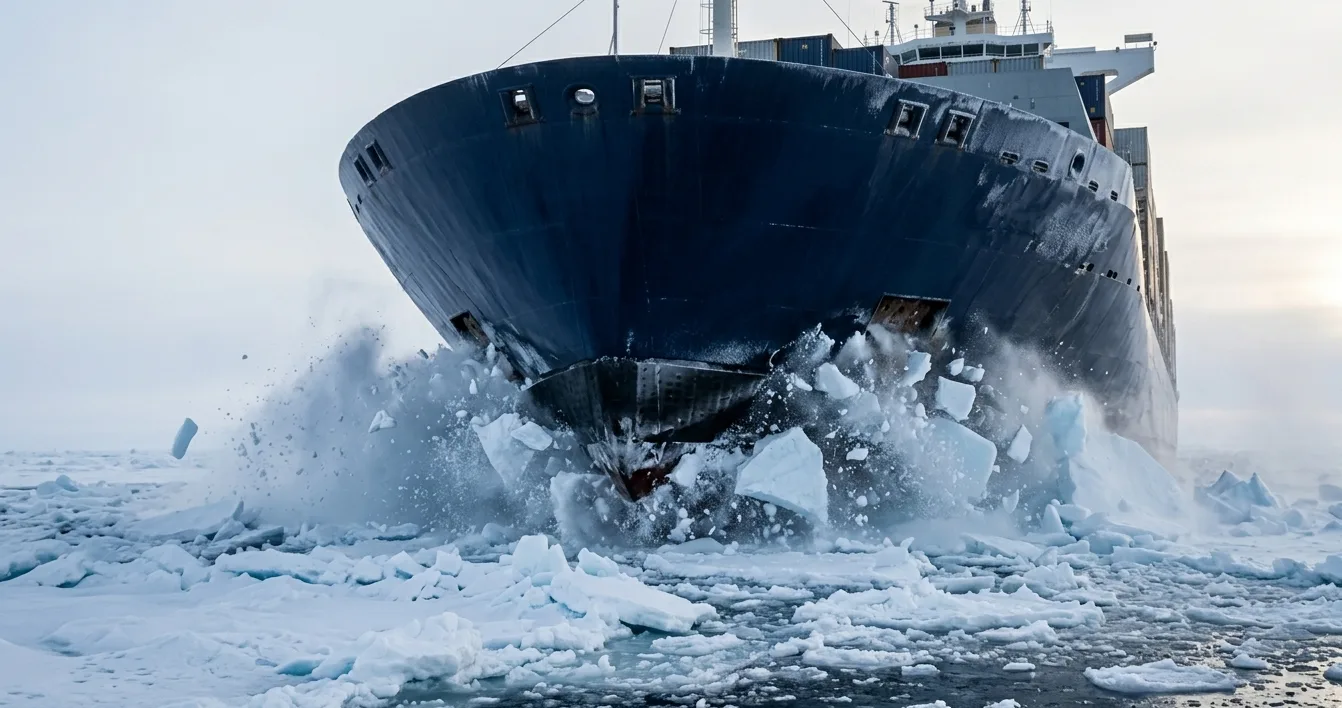
Sanctions and payment friction. Western sanctions on Russia have made paying NSR fees genuinely difficult for Western-flagged operators. Some banks will not process payments to Rosatomflot or related entities. Even when payments clear, reputational and compliance risk steers most major liners away. This is why the 2025-2026 NSR transit list is dominated by Russian-flagged tankers, Chinese liners, and a handful of Indian operators — not the global container majors.
Cargo sensitivity. Container shipping runs on schedule reliability. The NSR cannot match Suez or even Cape predictability. Ice conditions, weather windows, and escort availability create variance of 3-7 days on transit time. For containers carrying time-sensitive electronics or fashion, that variance is unacceptable. NSR cargo skews heavily toward bulk and project cargo — commodities where 5-day variance doesn't kill the trade.
Layering the True Cost
When you stack the savings against the hidden costs, the picture looks different from the headline distance comparison.
Ranges reflect operating conditions. The NSR advantage shrinks dramatically — and can flip negative — under heavy ice years, sanctions exposure, or ice-class newbuild premium amortization.
The honest analysis: in a good ice year, with an already-owned ice-class vessel, with sanctions exposure managed, the NSR delivers a modest per-voyage advantage. In a bad year, with newbuild ice-class capital costs to recover, with payment friction and reputational risk priced in, the Cape route is the rational choice. The headline million-dollar savings collapses to break-even or worse once reality is layered in.
Who Actually Uses the NSR Today
The 2024 and 2025 NSR transit numbers tell the story directly. Total cargo on the NSR reached roughly 37.8 million tonnes in 2024 and 37.0 million in 2025 — most of it regional Russian Arctic trade rather than end-to-end transits, and essentially flat between the two years. The transit subset, the voyages that actually cross the route boundary to boundary, moved the other way: 92 transits in 2024 carrying about 3 million tonnes, then a record 3.2 million tonnes of transit cargo in 2025. Total volume stalled while through-traffic grew, which is the more telling of the two numbers. Chinese-flagged container traffic in particular has grown each year — seven transits in 2023, eleven in 2024, and around fifteen in 2025 according to Centre for High North Logistics data. In August 2026 that pattern changed shape: rather than a rising count of individual voyages, a scheduled weekly service. Russian Arctic LNG and crude oil exports still dominate the overall list. The global container majors do not appear: in 2023 MSC, Maersk, and a group of major retail customers including Nike, H&M, and IKEA publicly committed not to use the NSR, and the post-2022 sanctions environment has hardened that stance.
That dominance has deepened sharply this summer. By early August 2026 an unprecedented tanker fleet had assembled in the Arctic, with roughly eight million barrels of crude either transiting or waiting to enter the route — more than half of what moved across the whole of the previous summer season, concentrated into a few weeks. The driver is the same one pushing container traffic north: with Hormuz effectively closed, cargo that would have gone south is looking for another way east.
The largest container lines — Maersk, MSC, Hapag-Lloyd, CMA CGM — have not made meaningful NSR investments. Their fleets are not ice-class. Their customers demand schedule reliability. Their compliance teams are reported to avoid Russian payments entirely. They are not waiting for the math to improve — they are waiting for the geopolitical environment to change.
The Climate Wildcard
The one factor that could rewrite this analysis is global carbon pricing. EU ETS already taxes the long Cape route more heavily than the short NSR — an extra 7,200 nautical miles burned at roughly 100 tonnes of VLSFO per day translates to about 2,100 tonnes of additional bunker and roughly 6,700 tonnes of CO₂. With EU ETS now at full phase-in (100% applied from 2026), compliance on the EU-leg portion of an Asia–Europe voyage typically adds in the range of $250,000 to $500,000 to the Cape route's bill, depending on routing and where the voyage is judged to begin and end.
If the IMO Net-Zero Framework is adopted at the resumed Extraordinary Session on 4 December 2026 — after the October 2025 session voted 57 to 49 to adjourn the decision by a year — and enters force around 2028, that carbon penalty broadly doubles. The Cape route's carbon footprint becomes a meaningful operational tax. At carbon prices over $200/tonne CO₂ — a level some 2030 forecasts already incorporate — the NSR's carbon advantage starts to materially close the cost gap, even before considering further sea ice retreat extending the navigable season.
This is the strategic question for fleet planners: do you bet on a 2030s where Arctic shipping is normalized — by climate change, by carbon pricing, by geopolitical realignment — and start commissioning ice-class tonnage now? Or do you bet on the southern routes remaining dominant for the next decade and avoid the capital commitment?
What Voyage Planners Should Do Right Now
For most operators, the NSR is not a 2026 routing question. It is a 2028-2030 fleet strategy question. But there are practical actions that make sense today.
Model NSR as an option, not just a curiosity. Even if your fleet won't use the NSR this year, including it in voyage estimates clarifies what carbon prices, fuel prices, or geopolitical shifts would actually change the calculus. Our Voyage Calculator includes NSR as a routing option for exactly this reason — to make the comparison concrete rather than theoretical.
Track the IMO Net-Zero adoption timeline. If the framework is adopted on 4 December 2026 and enters force in 2028, the Cape route's carbon cost rises sharply. That is the single largest variable that could shift NSR economics. Watch the political dynamics inside MEPC.
Consider tonnage planning for the long view. Newbuild orders placed in 2026 deliver in 2028-2029. If you are ordering a vessel that will operate through 2055, ice-class specification is a real decision today, even if the Arctic case looks weak right now.
Don't buy the headline distance argument. Anyone telling you the NSR saves a million dollars per voyage is selling something. The honest answer is closer to break-even after all costs are accounted for, with significant downside risk. The route exists, the math is interesting, and the future may belong to it — but 2026 is not when most operators should switch.
The Bottom Line
The Northern Sea Route is the world's most geographically rational answer to the Asia-Europe trade — the shortest path nature provides. It is also one of the world's most economically irrational shipping options for most operators in 2026, because nature's geography is overlaid by physical, political, and financial costs that the southern routes don't carry.
That gap between geographic logic and economic reality is closing. Climate is extending the season. Carbon pricing is taxing the alternatives. Geopolitical pressure on Suez and Hormuz keeps making operators look at the map differently. Sometime in the next decade, the math will flip for a meaningful share of Asia-Europe trade. Whether that's 2030 or 2035 or 2040, every voyage planner with a horizon longer than next year's charter renewal should be paying attention.
For now, the NSR is a strategic option, not a tactical one. Run the numbers honestly. Model it. Don't romanticize it. And be ready when the answer changes.
Compare NSR, Suez, and Cape of Good Hope routing for any port pair on the Voyage Calculator. Track bunker prices, EU ETS compliance costs, and route-specific economics on the Fairway ETA Data Hub.