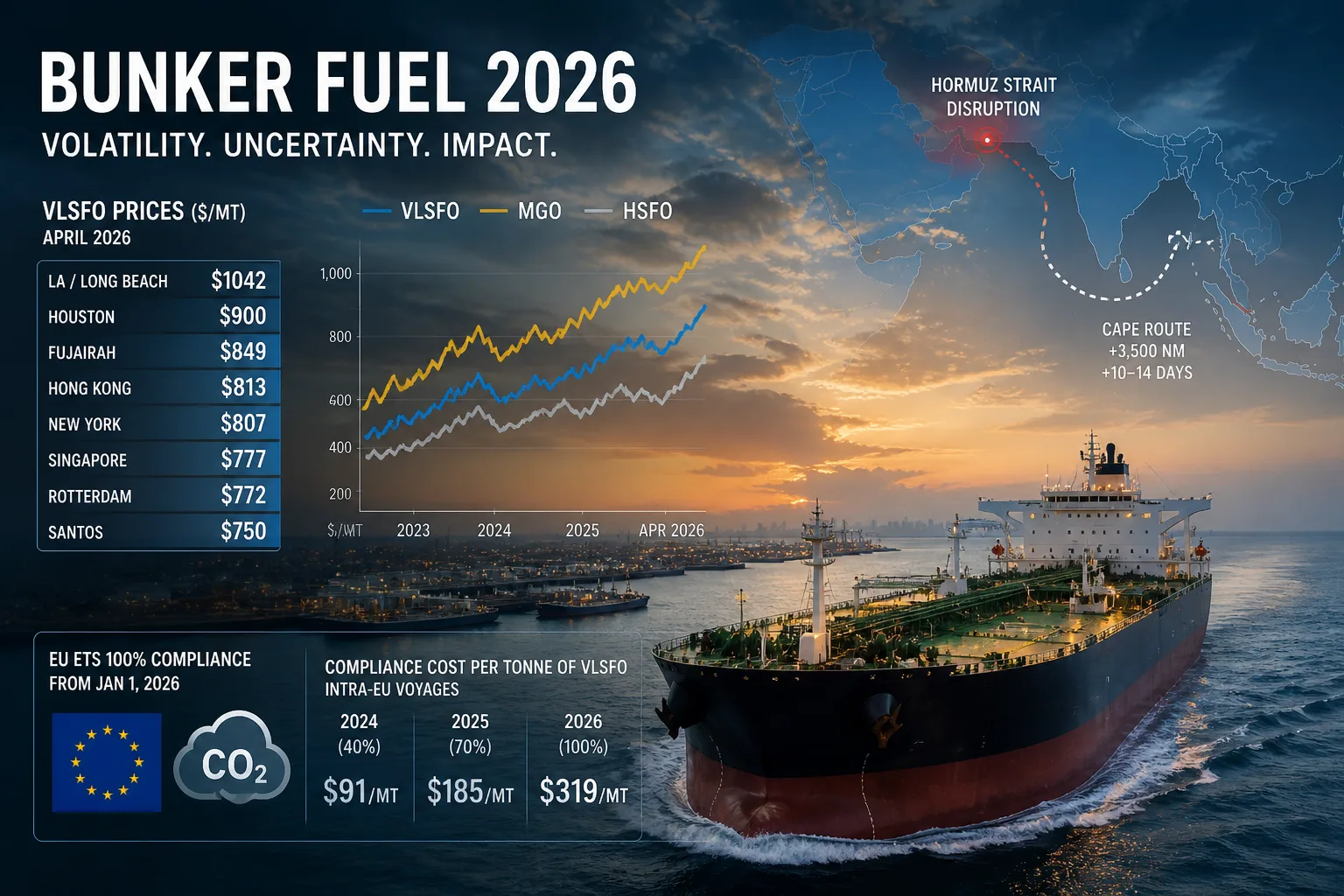
2026 is shaping up to be the most volatile year for bunker fuel prices in a decade. A combination of Hormuz Strait tensions, EU ETS reaching full compliance, and persistent refinery constraints has pushed VLSFO prices above $800/mt in key Asian hubs while creating unprecedented regional spreads. For voyage planners, understanding what drives these swings is no longer optional — it directly determines whether a voyage is profitable or not.
Why the Same Fuel Costs Different Money in Different Places
The headline number matters less than the spread behind it. VLSFO is a global product with a global crude input, and yet the price at two hubs on the same trade lane can differ by more than a hundred dollars a tonne. MGO sits well above it — in Fujairah the distillate has been running close to double the residual — and the gap between VLSFO and HSFO, the scrubber spread, decides whether an exhaust gas cleaning system pays for itself. All three move independently, and none of them move for the same reason.
What makes 2026 different from previous volatile years is that prices are not just high — they are unpredictable across regions. In late April a vessel bunkering in Houston paid roughly $130/mt more than one bunkering in Rotterdam. By early August the gap had closed to around $55, and Rotterdam had become the cheapest of the eight hubs above rather than the second cheapest. On a 2,000 tonne stem that is the difference between a $260,000 decision and a $110,000 one — the decision is still worth making, but the number attached to it will not be the number you remember.
Ship & Bunker, 3 August 2026. A snapshot, not a live feed — current values across 45 ports are on our Data Hub.
The ranking is not stable. In late April, Los Angeles was the most expensive of these eight hubs and Singapore the sixth. Three months later Singapore is first and Los Angeles fourth. Fujairah traded above $1,080 at the March peak and sits near $810 now. Any bunkering decision built on last quarter's ranking is built on a ranking that no longer exists.
Driver #1: The Hormuz Effect
The ongoing Strait of Hormuz crisis has disrupted crude oil flows from the Persian Gulf, tightening feedstock supply for refineries across Asia and Europe. With approximately 20% of the world's oil passing through Hormuz under normal conditions, any sustained disruption ripples through every downstream product — including marine fuels.
Fujairah, traditionally the Middle East's primary bunkering hub, has seen supply intermittency that was unthinkable two years ago. Vessels that previously planned Fujairah stems as a routine stop on Asia-Europe voyages now need contingency plans — and those contingency stops in Singapore or Colombo add both time and cost.
The crisis has also driven a structural shift in bunker procurement patterns. More operators are pre-purchasing stems or locking in supply contracts rather than relying on spot market availability, which in turn reduces spot liquidity and amplifies price spikes when demand surges.
Driver #2: EU ETS at 100% — The Carbon Premium
From January 1, 2026, shipowners pay 100% of EU Emissions Trading System costs for emissions on covered voyages — up from 70% in 2025 and just 40% in 2024. This single regulatory change has fundamentally altered the cost structure of European shipping.
In practical terms, one metric tonne of VLSFO burned on an intra-EU voyage generates around $300 in EU ETS compliance costs at current allowance prices, with HSFO slightly below and MGO slightly above. These are not small numbers — on a Northern Europe round trip burning 500 tonnes of VLSFO, the ETS bill alone runs to roughly $150,000, and it moves with the allowance price rather than with the fuel price.
VLSFO emission factor of 3.2 tCO₂e per tonne burned, at each year's prevailing allowance price. The 2026 figure reflects an EUA near €82; a move to €100 would push it past $360.
The implication for voyage planning is clear: EU ETS costs now rival bunker costs themselves on short European routes. A vessel burning MGO in ECA zones within the EU effectively pays a 40% carbon surcharge on top of fuel costs. This makes slow steaming on European legs even more attractive and is driving renewed interest in scrubber technology for vessels with heavy EU exposure.
From 2026, methane and nitrous oxide are also factored into emission calculations. This is particularly significant for LNG-powered vessels, whose carbon advantage has been partially eroded by methane slip accounting.
Driver #3: Refinery Constraints and the Diesel Squeeze
Global refinery capacity has not kept pace with the post-IMO 2020 demand shift toward middle distillates. The retirement of older, simpler refineries — particularly in Europe and Australia — has reduced the pool of facilities capable of producing compliant marine fuels. Meanwhile, demand for diesel and jet fuel competes directly with MGO production, creating a structural tightness in distillate markets.
This is why the VLSFO-MGO spread has widened dramatically in 2026. In Fujairah, MGO trades at nearly double the VLSFO price. For operators running vessels through ECA zones (where MGO is required unless equipped with scrubbers), this spread directly impacts voyage economics.
Driver #4: Cape Route Demand Surge
The continued Red Sea avoidance and Hormuz disruption have kept Cape of Good Hope rerouting as the default for Asia-Europe traffic. This adds roughly 3,500 nautical miles per voyage — and with it, significantly higher fuel consumption. The sustained Cape rerouting has tightened fuel availability at South African and West African bunkering ports, which were never designed for current demand levels.
Durban and Las Palmas have seen intermittent supply constraints and price premiums that reflect their new status as critical waypoints on the world's busiest shipping lane.
What This Means for Voyage Planning
In a volatile bunker market, fuel procurement is no longer a back-office function — it is a strategic decision that can make or break voyage profitability. Here are the key considerations for 2026:
Optimize bunkering location: A $130/mt spread between Houston and Rotterdam on VLSFO means bunkering strategy is worth more than speed optimization on many routes. Compare stem costs across hubs before finalizing voyage plans — our Data Hub tracks daily prices across 45 ports.
Factor in EU ETS from day one: Any voyage touching EU ports must include carbon compliance costs in the voyage estimate. At around $300/mt for VLSFO on intra-EU routes, ignoring ETS distorts profitability calculations by thousands of dollars.
Reconsider scrubber economics: With the scrubber spread (VLSFO minus HSFO) widening again, vessels with scrubbers regain their cost advantage. On a 30-day round trip burning 1,500 MT, a $100/mt spread saves $150,000.
Build contingency into stems: Fujairah supply reliability is no longer guaranteed. Build alternative bunkering stops into voyage plans, especially for Middle East and Indian Ocean routes.
Slow steaming pays more than ever: With combined fuel + carbon costs exceeding $1,100/mt on some European routes, the cube law effect of speed reduction delivers outsized savings. Even a 1-knot reduction on a 14-knot service speed cuts consumption by roughly 20%.
Price Outlook, as Written in May — and What Happened
Four factors were set out in May as the ones that would decide whether prices climbed further or stabilised. Three months in, two have answers.
Hormuz resolution: Any de-escalation in the Strait of Hormuz would immediately ease crude supply and bring Fujairah back to full reliability. This remains the single largest downside risk to prices.Unresolved. The strait remains effectively closed, now past five months.
EUA price trajectory: The EU Allowance price has been volatile, trading between €60 and €85 in 2025. If EUA prices push above €100, EU ETS compliance costs could exceed $375/mt — making carbon cost nearly equal to the fuel cost itself.Did not happen. EUA has traded near €82 through the summer, short of the €100 threshold.
OPEC+ discipline post-UAE exit: The UAE's departure from OPEC removes a major voice for production restraint. If Abu Dhabi ramps production as promised, crude supply — and by extension bunker feedstock — could ease in Q3-Q4 2026.Did not happen. UAE output ran near 2.4 million bpd through the spring, held down by the same blockade the exit was meant to escape.
FuelEU Maritime: the first compliance cycle closed on 30 June 2026. The initial 2 percent intensity reduction was modest enough that most operators met it through pooling rather than fuel switching, but the target steps up to 6 percent in 2030 and the pooling market that absorbed year one will not absorb a 14.5 percent cut. We cover the first-year outcome in detail separately.
The Bottom Line
Bunker fuel in 2026 is not just expensive — it is expensive in complicated, location-specific ways that demand more sophisticated voyage planning than ever before. The days of treating bunkering as a simple logistics task are over. Fuel procurement, carbon compliance, route selection, and speed optimization are now a single integrated decision.
The operators who will come out ahead are the ones who model total voyage cost — fuel, carbon, time, and risk — before committing to a route or a bunkering plan. The data exists. The question is whether your planning tools can use it.
Track real-time bunker prices across 45 ports, BDI movements, and crude oil benchmarks on the Fairway ETA Data Hub. Model fuel-optimized voyages with automatic ECA detection and EU ETS cost estimation on the Voyage Calculator.