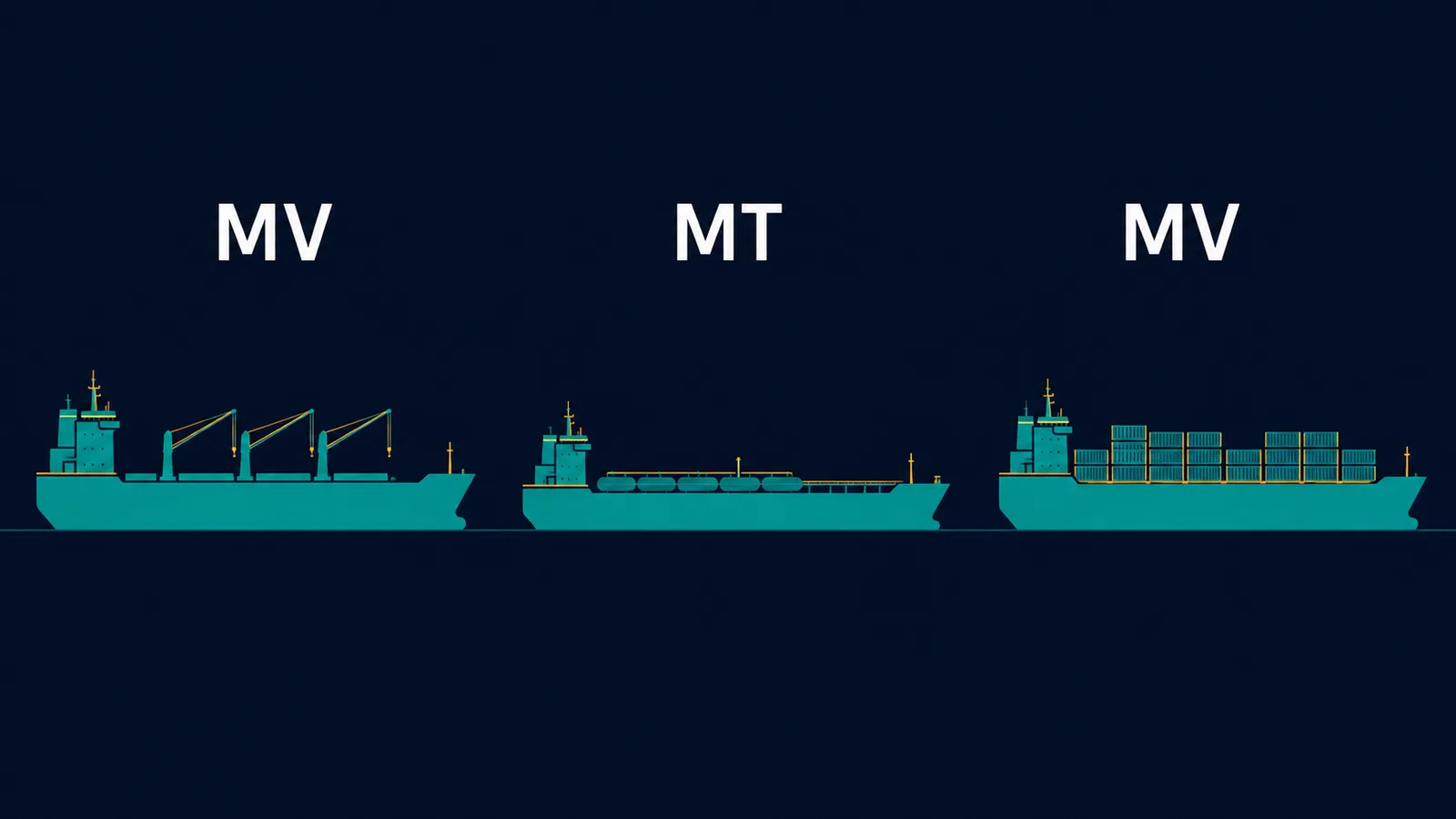
You've seen it in a fixture recap: "MV Ever Ace" or "MT Advantage Sky." The two letters before the ship's name aren't decoration. They're a compact code for what the ship is and how it moves — and they matter because charter contracts, Bills of Lading, and Notices of Readiness all still use them.
Yet most explanations get it wrong in one of two ways. Either they treat these prefixes as ancient formalities with no modern use, or they mix in naval prefixes (HMS, USS) that don't apply to commercial shipping at all. This piece keeps it strictly commercial and current: what these letters actually mean in 2026 fixture desks and BL documents, and where the conventions are shifting as new fuel types arrive.
The two letters carry two pieces of information
Every commercial ship prefix combines two things: propulsion type and ship type.
- The first letter tells you what pushes the ship. M stands for Motor (internal combustion engine, most commonly diesel).
- The second letter tells you what kind of ship it is. V for Vessel (general), T for Tanker, S for Ship (functionally identical to V, regional preference).
That's the whole system. When you see "MT," you know it's a motor-driven tanker without reading further. When you see "MV," you know it's a motor-driven vessel of some other type — bulker, container, general cargo, or car carrier.
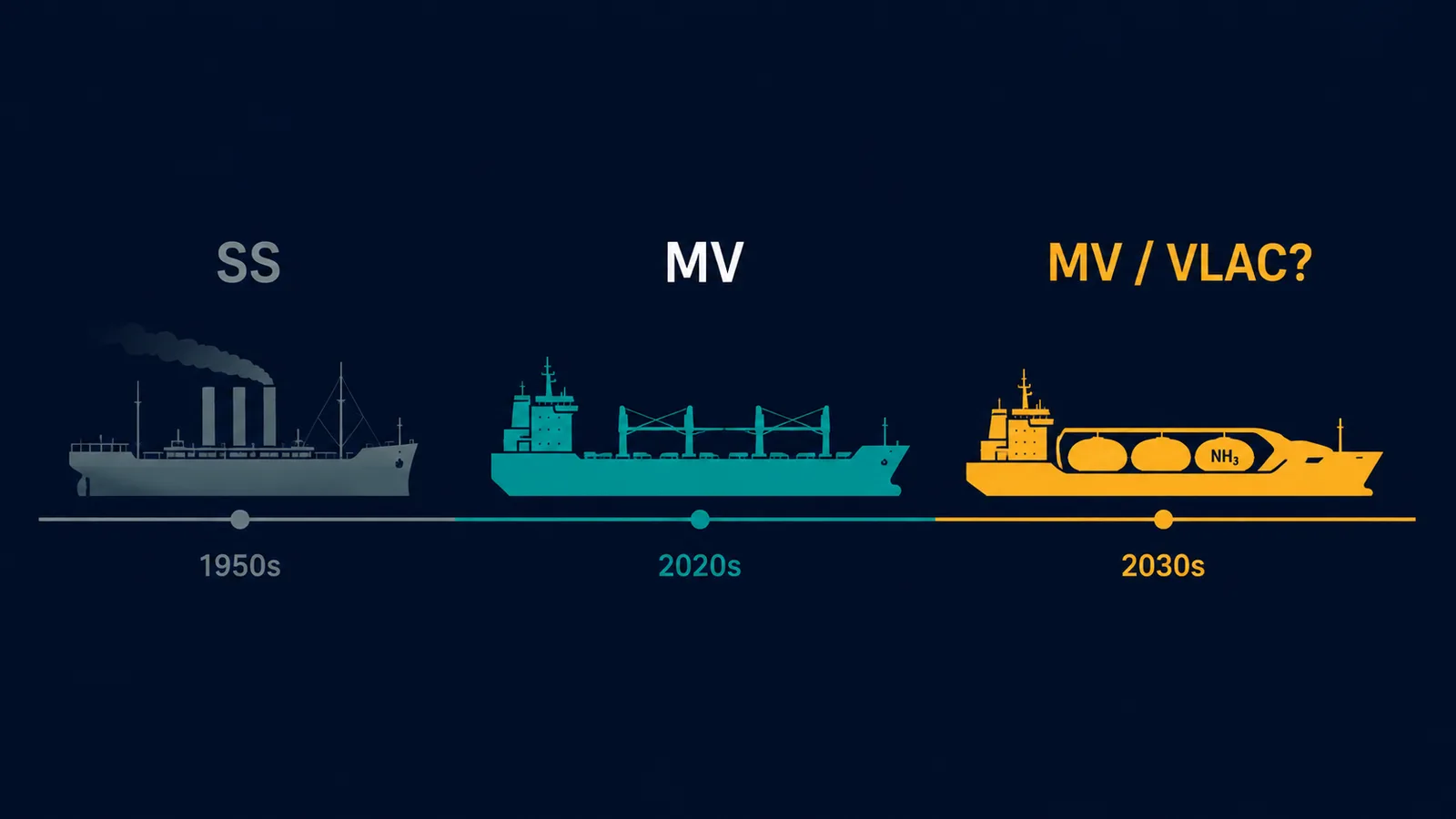
There used to be an "S" first letter — for Steam. Steam Ships (SS) were widely used for commercial vessels through the 1960s, until diesel engines proved more economical and reliable. Since then, virtually every new commercial ship has been a Motor Vessel of some kind. SS still appears on a small number of preserved historic vessels and a handful of steam-turbine LNG carriers, but you will not see it on any newbuilding today.
That's why nearly every prefix you meet today starts with M.
The three prefixes you'll actually see
MV — Motor Vessel
The workhorse. If a ship isn't specifically a tanker, it's usually MV.
Bulk carriers, container ships, general cargo ships, heavy lift ships, car carriers (PCTCs), and refrigerated cargo (reefer) ships — all typically prefixed MV in commercial documents.
Recent examples visible on fixture desks and AIS trackers:
- MV Ever Ace (24,000 TEU containership, Evergreen)
- MV Iron Chieftain (Panamax bulker)
- MV Höegh Target (car carrier / PCTC)
If someone hands you a fixture recap and it says MV Xxxxx, you're looking at general cargo capacity of some kind. The rest of the recap will specify further — DWT, gear configuration, holds, hatches.
MT — Motor Tanker
Anything that carries liquid in bulk gets MT: crude oil, refined products, chemicals, edible oils, molasses. Gas carriers technically fall under a different naming convention (more on this below), but for wet cargo generally, MT is standard.
Recent examples:
- MT Advantage Sky (VLCC, Advantage Tankers)
- MT NCC Danah (product tanker, National Chemical Carriers)
- MT Front Force (VLCC, Frontline)
In fixture documents, MT flags immediately that you're dealing with tank cleaning requirements, previous cargo history, and coating specifications — considerations that don't apply to MVs.
MS — Motor Ship
Functionally identical to MV. Same engine type, same categorization principle. The distinction is regional preference: MS is more common among German, Dutch, and Scandinavian operators; MV dominates in British, American, and Asian usage.
You'll see MS on ships operated out of Hamburg or Rotterdam, MV on ships out of Singapore or London. Neither is more correct. Fixture desks read them interchangeably.
MS is commonly used by German operators such as Hapag-Lloyd and Hamburg Süd, and by Dutch operators like Spliethoff and JR Shipping. Fixture desks read MS and MV without distinction.
Special-purpose commercial prefixes worth knowing
Beyond MV/MT/MS, a handful of specialized prefixes show up in cargo shipping documents.
LNG/C — LNG Carrier. Sometimes written as LNGC without the slash. LNG carriers occasionally get prefixed MV too, but the LNG/C convention is more common in trade press and charter documents where cargo type matters more than propulsion.
VLGC — Very Large Gas Carrier. Used for LPG carriers above 70,000 cubic meters. Not strictly a prefix; more a ship class designator that appears in the same position.
VLCC / ULCC — Very Large / Ultra Large Crude Carrier. These are size classes, not prefixes in the technical sense, but you'll see them appear where prefixes usually sit: "VLCC Advantage Sky" or "MT Advantage Sky, VLCC."
VLEC — Very Large Ethane Carrier. Newer designation, gaining visibility as the ethane trade grows.
VLAC — Very Large Ammonia Carrier. This is where 2026 gets interesting. Several major operators are ordering VLACs to prepare for ammonia as a marine fuel and as cargo. The prefix convention around these hasn't fully settled yet — you'll see both "MV" and "VLAC" used, sometimes together.
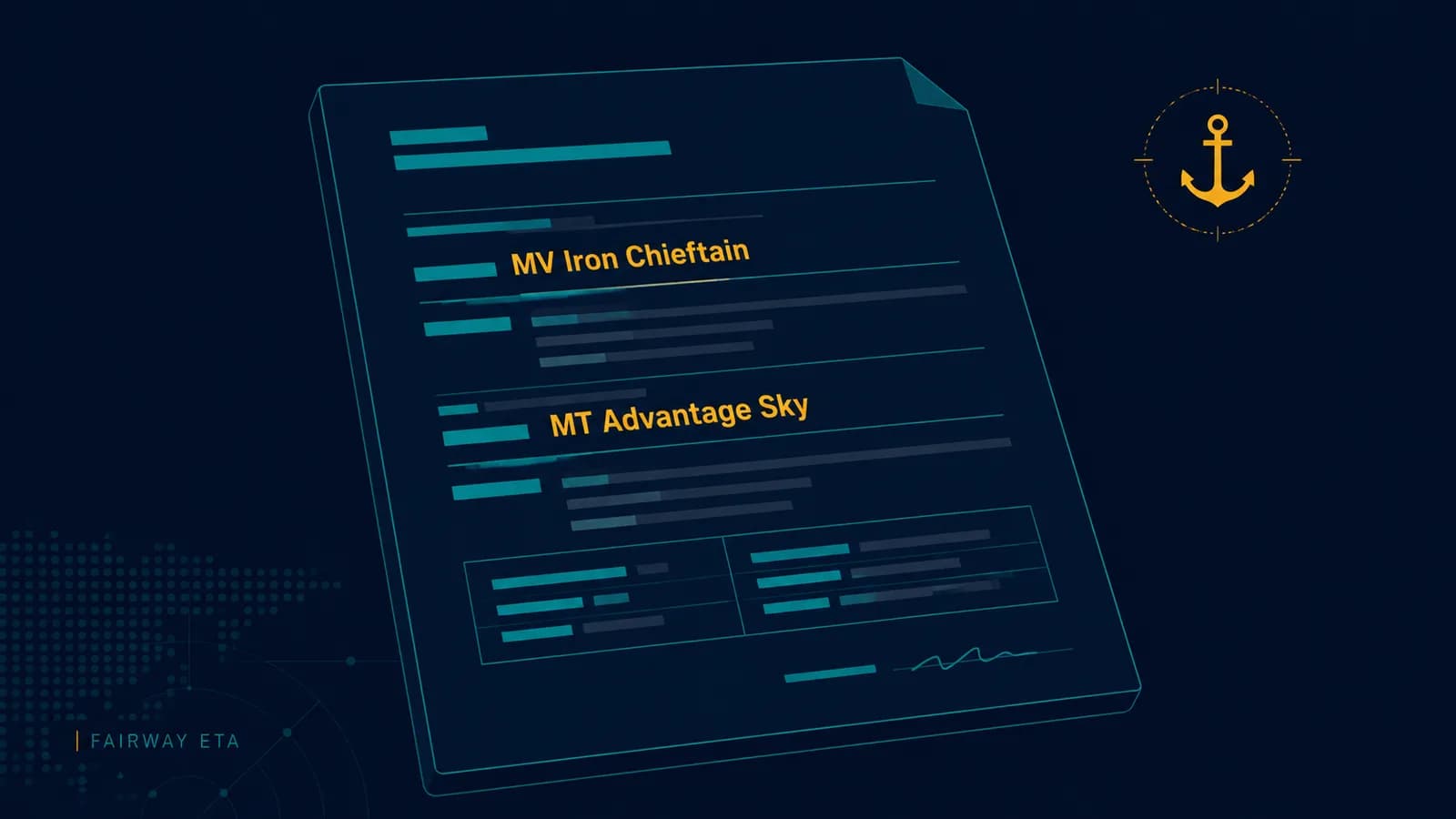
What fixture recaps and BLs actually look like
Real commercial documents don't use prefixes as decoration. They use them for legal identification.
In a fixture recap, you might see:
MV Iron Chieftain / 82,000 DWT / Panamax bulker / built 2012 Tsuneishi / gear 4x30t
The MV is doing legitimate work here: it confirms propulsion type for insurance and safety documentation. The IMO number is the actual unique identifier, but the prefix appears first because it's the traditional convention.
In a Bill of Lading:
Shipped in apparent good order and condition on board the MT Front Force...
The prefix again marks the ship class for legal and regulatory purposes. Removing it would cause no confusion in most cases, but the convention persists because it's cheap to maintain and useful when documents are read years later, potentially in disputes.
In casual news writing, prefixes often get dropped. Bloomberg, Reuters, and TradeWinds mention "Ever Given" more often than "MV Ever Given." That's editorial style, not a change in the underlying convention.
The confusing ones
"MSC Isabella" — is MSC a prefix?
No. MSC is a company name (Mediterranean Shipping Company). The actual prefix for MSC's ships is MV. So the technically complete name would be "MV MSC Isabella" — which almost nobody writes because it looks redundant. In practice, "MSC Isabella" alone is the working name. On official documents, MV appears.
The same pattern applies to Maersk Line (MV Maersk Xxxxx), COSCO (MV COSCO Xxxxx), and other container line naming conventions where the operator's name is embedded.
"MT" outside shipping
MT is also a common ISO abbreviation for "metric ton." In shipping contexts the two rarely collide, but if you're reading a fuel report that says "500 MT of VLSFO," that's tons of fuel, not a tanker.
What's shifting in 2026
The prefix system was designed around a simple propulsion binary: steam or motor. That worked for most of the twentieth century.
Now the fleet is fragmenting. LNG dual-fuel ships, methanol dual-fuel, ammonia-ready designs, wind-assist retrofits, and battery-hybrid designs are all entering commercial service. None of them fit cleanly into "Motor Vessel" as the category was originally defined.
For now, all of these still get prefixed MV or MT. The industry hasn't seen a compelling reason to introduce new letters. But if the mix of propulsion types keeps diversifying, expect informal designations to appear in trade documents — perhaps "DFV" for Dual-Fuel Vessel, or fuel-type suffixes attached to existing prefixes.
VLAC is worth watching specifically. As Very Large Ammonia Carriers move from orderbook to delivery over the next several years, whether they settle on "MV," "VLAC," or something new will tell you something about how quickly the industry codifies its new categories.
Now that you know what MV and MT actually mean, try modeling a voyage for one. The Ship ETA Calculator lets you compare Suez, Cape of Good Hope, and Panama routes for any commercial vessel type — bulker, tanker, or container.
Try the Ship ETA Calculator →Sources
- International Maritime Organization (IMO) — Ship registration and identification standards
- BIMCO — Standard charter party clauses and vessel description conventions
- Lloyd's Register — Vessel classification and prefix usage in class certificates
- Marine Traffic — Real-time AIS data and vessel identification