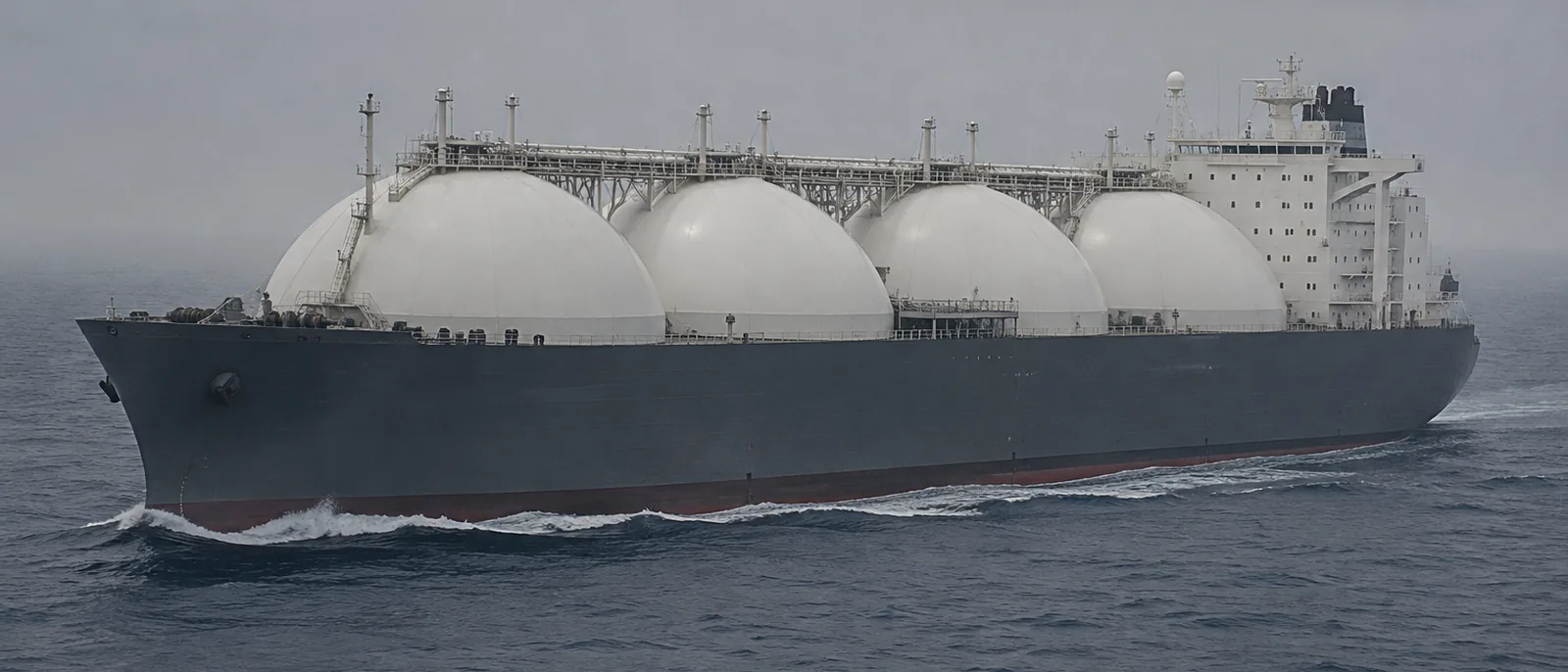
Most ships hide their cargo. A gas carrier does not. Look at one class and you see four white spheres standing above the deck like buoys that lost their way; look at another and the deck is flat enough to land on. Both carry the same cargo at the same temperature. The difference is not styling, and it is not the shipyard's taste. It is a decision about how to hold something that is trying very hard to stop being a liquid.
Why the names sound different
If you have read our guide to bulk carrier sizes you will remember that almost every dry bulk class is named after an obstacle. Panamax is a set of lock walls. Kamsarmax is a berth in Guinea. Newcastlemax is an Australian coal port. The ship is named for the thing it only just fits.
Gas carriers are named for how much they hold. VLGC means Very Large Gas Carrier and nothing more. VLEC is a Very Large Ethane Carrier. VLAC is a Very Large Ammonia Carrier. There is no port in any of them.
Pressure, cold, or both
Propane boils at about minus forty-two degrees Celsius at atmospheric pressure. You have two ways to keep it liquid at sea. You can hold it under pressure at ordinary temperature, the way a camping gas cylinder does. Or you can chill it to below its boiling point and hold it at almost no pressure at all, the way a vacuum flask holds coffee — not by force, but by refusing to let heat in.
The flask is the better analogy, and it is worth pushing further than the usual version. A flask does not work harder as it gets bigger; a larger flask actually holds temperature better, because volume grows faster than surface area and there is proportionally less skin for heat to cross. A pressure vessel is the opposite. Double its dimensions and the force trying to burst it grows with the enclosed area while the steel has to get thicker to match. One design gets easier with scale. The other gets punished by it.
So the fleet sorts itself by size almost automatically. Small ships are fully pressurised, carrying LPG at ambient temperature in thick cylindrical tanks. Medium ships are semi-refrigerated, working at a few bar and well below zero. Large ships are fully refrigerated, carrying cargo at close to atmospheric pressure in prismatic tanks that fill the hull efficiently because they do not have to be round.
The LPG classes
LPG carriers are graded by capacity, and unlike dry bulk there is no formal body setting the boundaries — the bands are market convention and the edges are soft.
Below roughly 15,000 cubic metres are coasters, the fully pressurised ships that serve small terminals. Between about 15,000 and 25,000 sit the handysize gas carriers. From roughly 25,000 to 50,000 are midsize carriers, usually written MGC. From about 50,000 to 70,000 are large gas carriers, LGC. Above that is the VLGC.
The VLGC band nominally starts around 70,000 cubic metres, but almost nothing is built there any more. The modern ships cluster between about 84,000 and 93,000, and the top of that range is still moving.
Then there are two newer initials worth knowing, because both are really a VLGC wearing different tanks. A VLEC carries ethane, which liquefies at about minus eighty-nine degrees — far colder than LPG — so it needs a stronger self-supporting tank type rather than the simple prismatic tanks of a refrigerated LPG ship. A VLAC carries ammonia, and here the borrowing is literal. Jane Mærsk, delivered from a Korean yard in the summer of 2026 as the first vessel of her kind, holds 93,000 cubic metres and measures 230 metres by 36.5 metres — the dimensions of a VLGC, because that is what she is underneath. Ammonia is the cargo the industry is building for, and it is being built for by adapting a hull that already exists.
Where the canal went
Which is where the constraint went. It did not disappear when the naming changed — it moved out of the name and into the specification, where only the people buying the ship can see it.
The original Panama locks admit a beam of 32.31 metres. The Neopanamax locks, opened in 2016, admit 51.25 metres. Those two numbers cut the VLGC fleet in half.
One Norwegian owner markets its 88,000 cubic metre newbuildings as Panamax VLGCs and states plainly that they carry the largest LPG parcel that can still transit the original locks. The ammonia carrier described above, at 36.5 metres in the beam, cannot. She is built on an ordinary VLGC hull and she is four metres too wide for a hundred-year-old wall.
So the canal name did not vanish from this fleet. It reappeared as an adjective — Panamax VLGC — bolted onto a capacity class, describing a subset of ships that chose a lock over a few thousand cubic metres of cargo. Dry bulk put the constraint in the noun. Gas put it in the option list.
This is not a museum question. On the United States Energy Information Administration's figures for early 2024, liquefied petroleum gas and ethane together made up around sixty-three per cent of American petroleum product exports crossing the Panama Canal — and 2026 has been an expensive year to need a slot. VLGC spot earnings have averaged something like 110,000 dollars a day, against roughly 48,000 in the same period of 2025, and touched near 200,000 in May. Some exporters have started transferring cargo ship-to-ship near the canal rather than transiting at all.
A ship four metres too wide for the old locks competes for the same restricted Neopanamax slots as every laden container ship on the route. That is what the naming convention buried.
LNG: one size, almost
LNG carriers went the other way. Where LPG spread into half a dozen bands, LNG has converged on something close to a single ship.
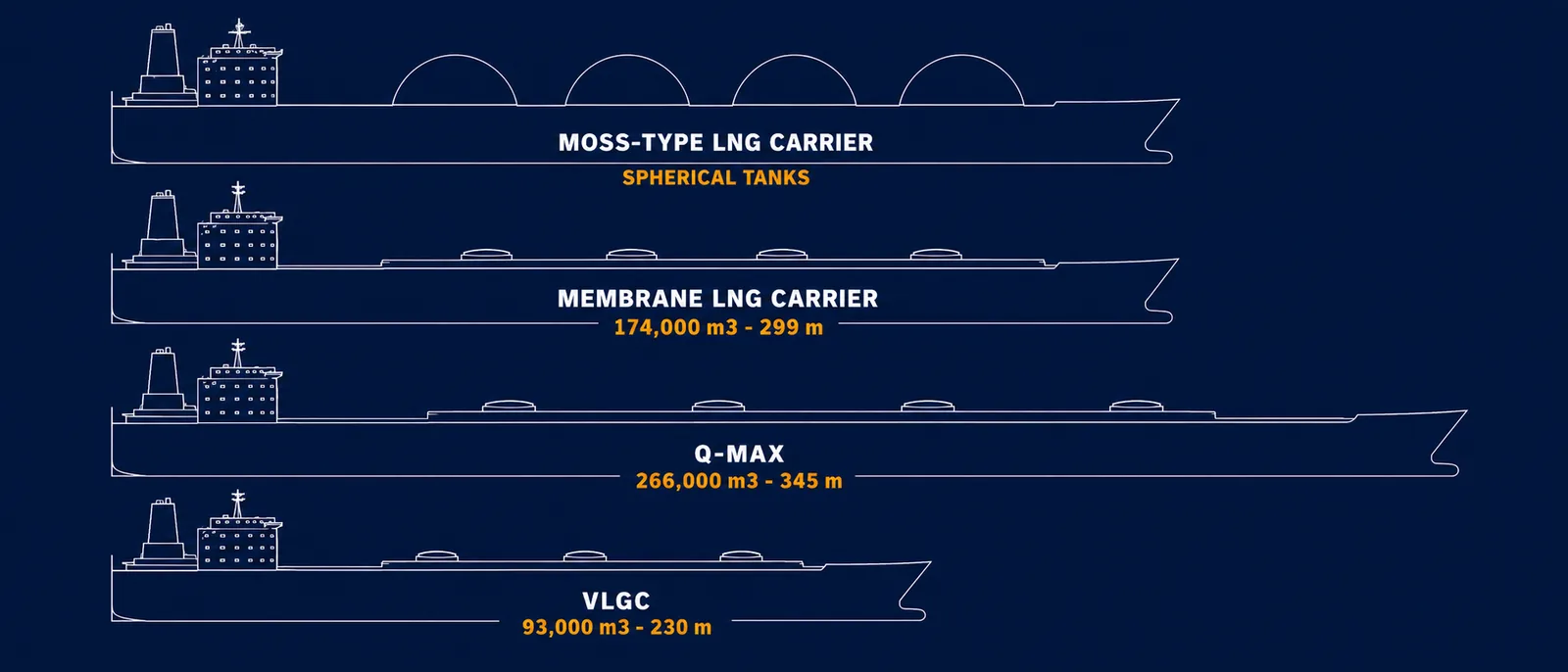
The reference size is 174,000 cubic metres. It is the vessel the freight benchmarks are quoted against, and it is what the tank designers publish their performance figures for. Every one of the seventy-nine LNG carriers delivered during 2025 fell between roughly 172,600 and 200,000 cubic metres. For a fleet of over eight hundred ships, that is a remarkably narrow target.
A standard carrier of that size runs about 299 metres long, 46.4 metres in the beam, on a draft near 11.5 metres. Set those against the Neopanamax limits — 370.33 metres, 51.25 metres, 15.24 metres — and the ship fits on every axis with room to spare. Whether the canal is the reason for the convergence is a claim we cannot source, and we are not going to make it. What is plainly true is that the standard ship fits, and the largest ships ever built do not.
There are exceptions at the top, and they prove the point. Between 2007 and 2010 Qatar ordered two classes far larger than anything before or since: Q-Flex, from about 165,000 to 216,000 cubic metres, thirty-one ships; and Q-Max, 266,000 cubic metres, fourteen ships, 345 metres long and 53.8 metres in the beam. That beam is two and a half metres too wide for the Neopanamax locks. The largest LNG ships in the world cannot use the canal the standard ship passes through comfortably — and a 271,000 cubic metre successor class is under construction in China for delivery from 2028.
Why some have spheres
An LNG cargo tank has to hold liquid at about minus 160 degrees Celsius, and it has to do so without letting the cold reach the steel of the hull, which would become brittle. The international gas carrier code recognises several ways to build such a tank, and two of them dominate.
A Moss tank is a self-supporting sphere, structurally independent of the hull and resting on a skirt. It is designed on the leak-before-failure principle — a crack would grow slowly enough to be found before the tank gave way — which is why it needs only a partial secondary barrier rather than a full one. A sphere is the strongest shape for the job and the least efficient use of a rectangular hull, so the tanks are few and very large, and their upper halves simply do not fit below the weather deck. What you see from the quay is the top of the tank.
A membrane tank is the opposite idea. Instead of a tank sitting in the hull, a thin metal membrane and its insulation are built directly against the inner hull, which carries the load. The result fills the hull almost completely and leaves the deck flat. Two systems dominate: one uses a double layer of invar, a nickel-steel alloy that barely contracts when chilled; the other uses a corrugated stainless steel membrane over prefabricated insulation panels.
Membrane has won the newbuilding market decisively. Of the LNG carriers on order in mid-2026, roughly four out of five use one of these membrane systems.
The cargo that leaves on its own
One last thing separates gas from every other cargo: it evaporates continuously, and nobody can stop it. Heat leaks through even the best insulation, so a fraction of the cargo turns to vapour every day. This is boil-off, and it is not a fault — on modern newbuildings the tank designers guarantee rates in the region of 0.07 to 0.085 per cent of volume per day, and older ships lose considerably more.
A ship has three options. It can burn the vapour as fuel, which is why LNG carriers were the first merchant ships to run routinely on gas. It can reliquefy it and put it back, which is what the Qatari classes do. Or it can do both, switching according to the price of the cargo against the price of bunkers — which makes a gas carrier the only merchant ship whose voyage economics include a running argument about whether to sell the cargo or burn it.
The 30-Second Version
- Gas carriers are sorted by capacity in cubic metres, not by deadweight and not by a canal. VLGC just means Very Large Gas Carrier.
- LPG: coasters (under 15,000 m³), handysize (15–25,000), midsize MGC (25–50,000), large LGC (50–70,000), VLGC (70,000 and up, in practice 84–93,000).
- LNG has converged instead of spreading. 174,000 m³ is the reference newbuild; every carrier delivered in 2025 fell between about 172,600 and 200,000.
- Size decides how the cargo is held: small ships carry it under pressure, large ships carry it cold at almost no pressure. Pressure vessels are punished by scale; insulation is rewarded by it.
- Spheres above the deck mean Moss-type self-supporting tanks. A flat deck means membrane tanks built into the hull — about four in five ships on order.
- The canal constraint is still there, just not in the name. An 88,000 m³ “Panamax VLGC” fits the original locks at 32.31 m. A 36.5-metre beam does not.
Reading a gas headline
VLGC means propane or butane, and probably the United States Gulf to Asia, and probably an argument about Panama. VLAC means ammonia and a fleet being built ahead of demand. VLEC means ethane and a petrochemical plant at the far end. A 174,000 cubic metre carrier is the LNG market's unit of account, the ship that spot rates are quoted for. Q-Max means Qatar, fourteen ships, and a beam too wide for the canal.
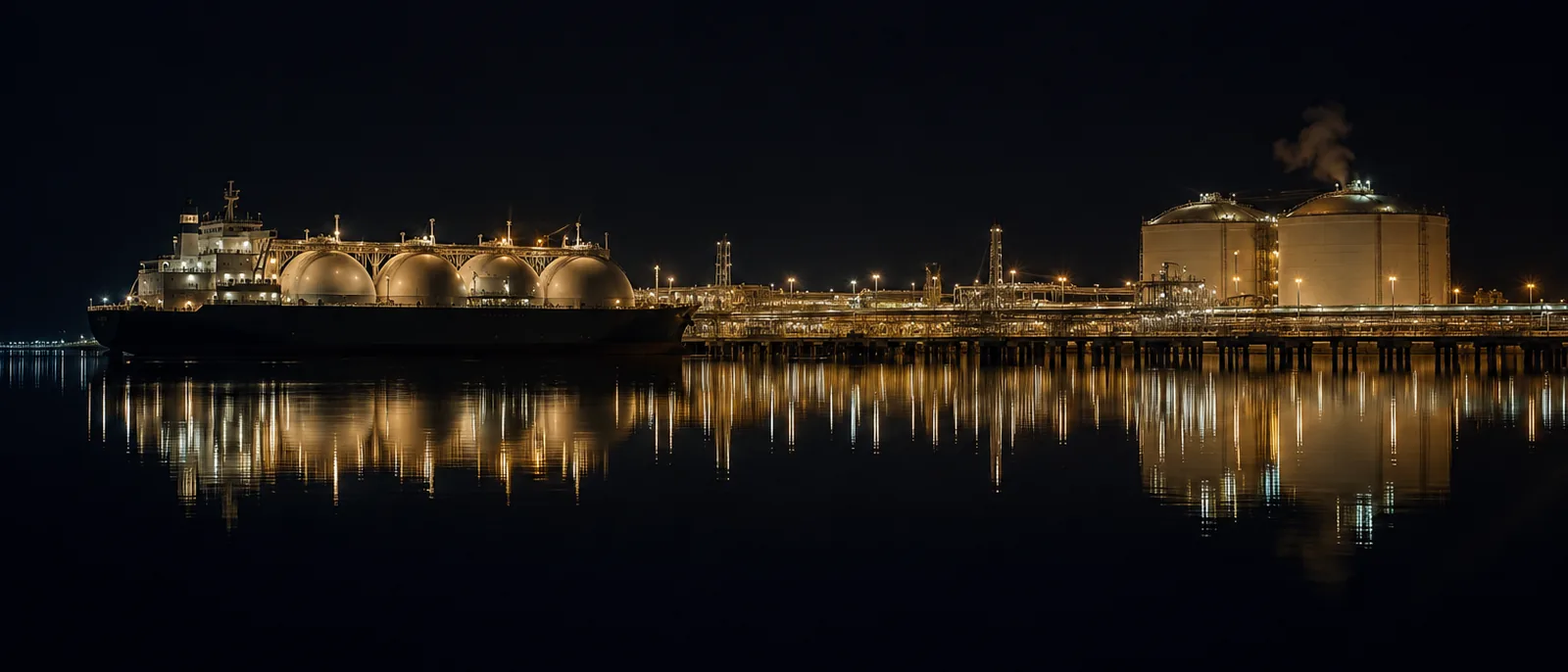
And if a photograph shows spheres above the deck, you are looking at an older design and a shrinking share of the fleet — a ship whose tanks were built to stand on their own, in an industry that decided it would rather use the whole hull.
Sources
- International Gas Union — World LNG Report, 2026 edition
- Autoridad del Canal de Panamá — published vessel requirements for the Panamax and Neopanamax locks
- The IMO gas carrier code and class society guidance — cargo containment tank types and boil-off guarantees
- US Energy Information Administration; builder, owner and broker announcements for individual vessels and market rates
Related on Fairway ETA
- Bulk Carrier Sizes Explained — where size names come from obstacles instead of capacity
- Tanker Sizes Explained — Aframax, Suezmax, VLCC and ULCC
- Panama Is Buying Draft With Transits — why gas carriers are bidding millions for a slot
- Ship Tonnage Explained — why gas ships are measured in cubic metres and not tonnes