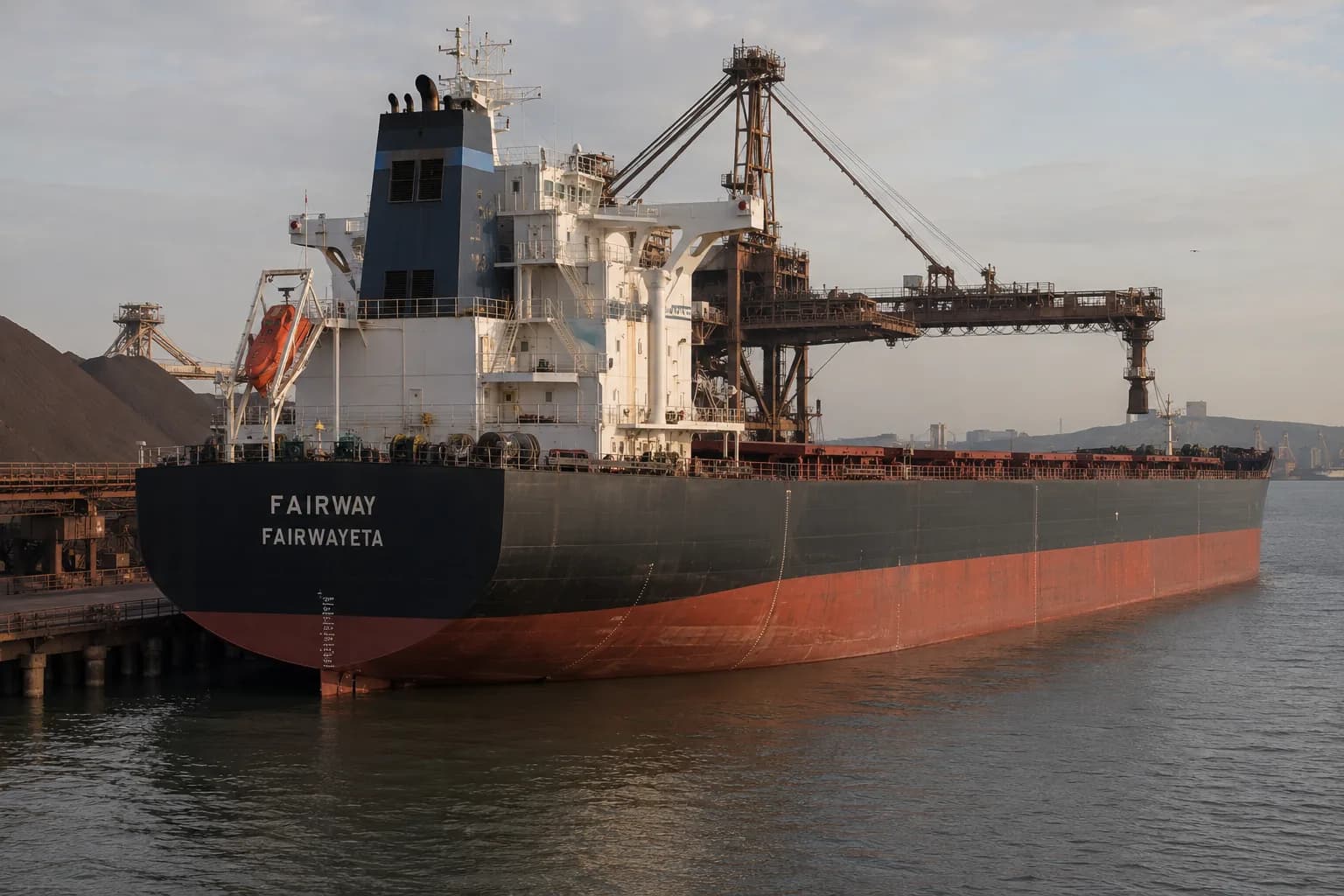
A Capesize bulk carrier loads 170,000 tonnes of iron ore at Port Hedland. With the 62% Fe index around 95 dollars a tonne in mid-August 2026, that parcel is worth something in the order of sixteen million dollars.
Nobody weighs it.
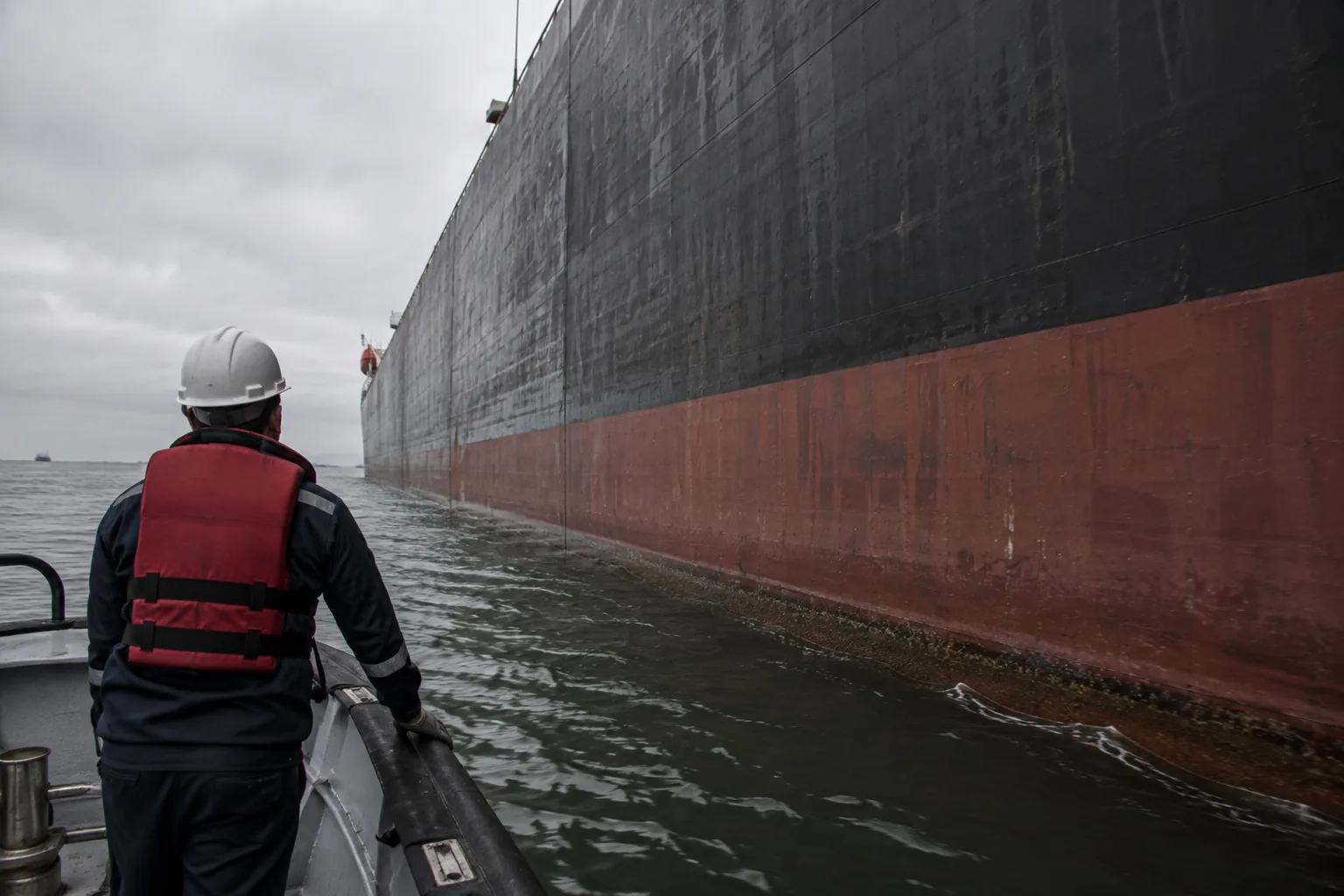
There is no scale at the berth large enough, and conveyor systems accurate enough to fill a hold are not accurate enough to settle an invoice. The figure that ends up on the bill of lading — the figure the buyer pays against — comes from two people in a launch reading marks painted on the side of the hull, and then doing arithmetic.
That is a draft survey. It is the oldest measurement in commercial shipping and still the primary one for dry bulk. The half-percent of uncertainty it carries is worth more than most people outside the trade would guess.
The ship is the instrument
Archimedes settled this in the third century BC. A floating body displaces its own weight in water. Add weight to a ship and she sinks lower, and the volume of water pushed aside grows by exactly the weight added.
So if you know how deep she is sitting, and you have a table telling you what volume of hull sits below any given waterline, you know what she weighs. Do that before loading and again after, and the difference is the cargo.
Every ship carries that table. The hydrostatic table — think of it as a lookup chart built for one specific hull, produced by the shipyard and approved by class — lists displacement against draft, along with a handful of coefficients we will come back to. Read a draft, find the row, and it tells you what she weighs. It is the translation layer between how deep she is sitting and what is under her. The concepts underneath it — displacement against deadweight against gross and net tonnage — are covered in our tonnage explainer. This piece is about using displacement as an instrument rather than defining it.
The elegance is that the ship measures herself. The awkwardness is everything that gets between the reading and the answer.
Six readings, not one
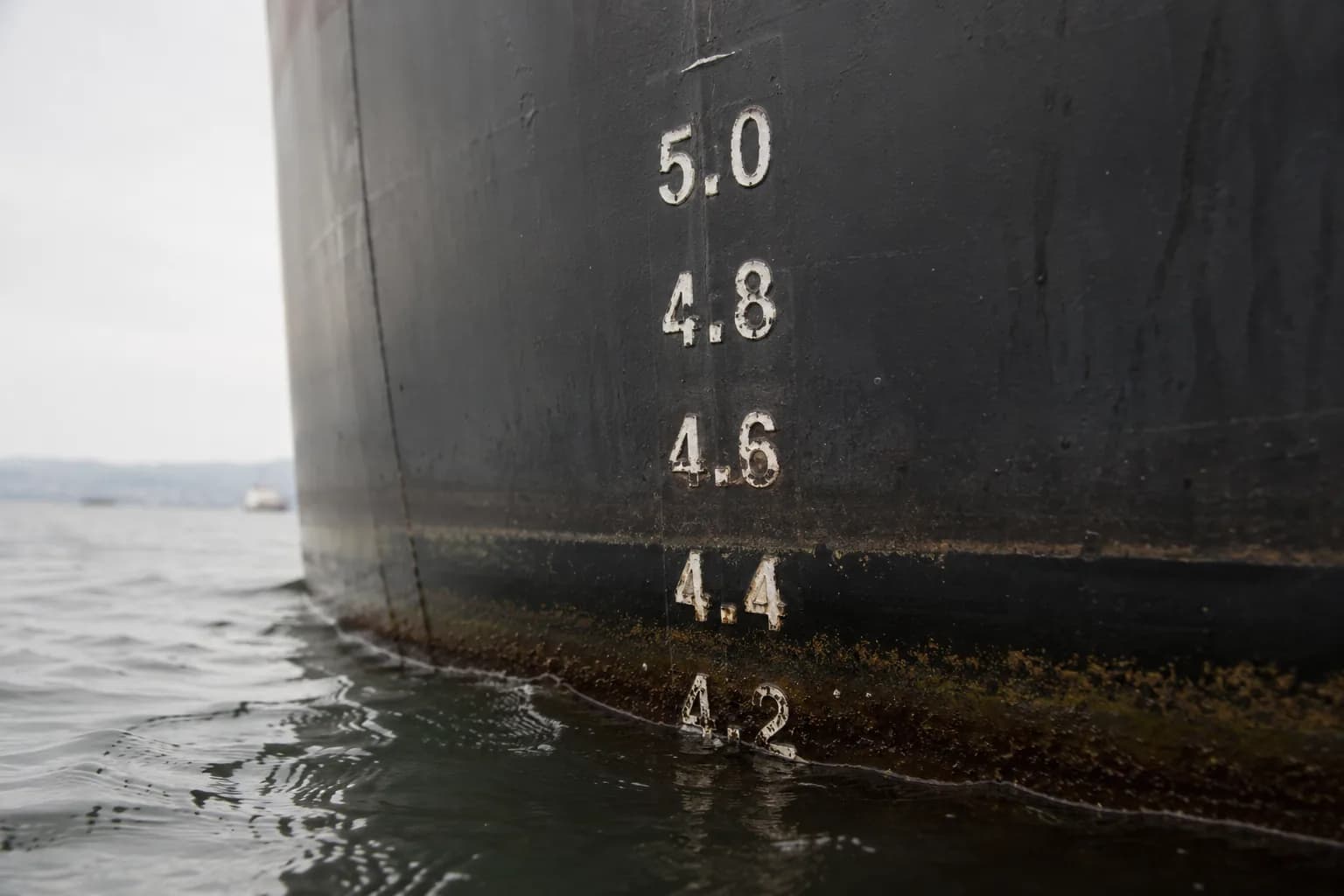
Draft marks are painted at six positions: forward, midship and aft, on both port and starboard sides.
Six rather than one, for two reasons. A ship almost never floats level — she usually sits deeper aft, which is trim. And she may lean slightly to one side, which is list. Reading a single mark gives you the depth at one point on one side, which is not the depth corresponding to her total displacement.
Port and starboard readings at each station are averaged, which cancels the list. That leaves three numbers: forward, midship, aft. Most codes want the list held inside about half a degree before the readings are treated as reliable at all.
Then comes the correction that surprises people the first time they meet it.
The plank in the bathtub
Before the arithmetic, a picture that makes the rest of it obvious.
Float a long wooden plank in a bathtub and mark how deep it sits at each end and in the middle. While the plank is straight, the middle mark sits exactly halfway between the two end marks. Measure any one of them and you can work out the others.
Now press down on the middle of the plank. It bows. The ends lift slightly, the middle dips, and the three marks no longer line up — the middle now reads deeper than the average of the two ends. Nothing about the plank's weight has changed. Only its shape has.
A loaded ship is a 300-metre plank. Steel is stiff, but it is not rigid, and a hull with 170,000 tonnes distributed unevenly along it bends in exactly this way. So if you want to know how much water the hull is really pushing aside, you have to measure where the bending actually shows up — and that is the middle.
Everything in the next section is the industry's way of doing that without pretending the plank is straight.
Why midship ends up carrying six-eighths
A ship's hull is not rigid. Load the middle holds heavily and it bends downward amidships — sagging. Load the ends and it bends upward — hogging. On a 300-metre Capesize the deflection runs to several centimetres.
That bending means the midship draft does not sit halfway between the forward and aft readings. Average the three evenly and hull deflection goes into your displacement figure, in a way that scales with the size of the cargo.
The method deals with it by halving twice. Take the mean of forward and aft. Average that against midship, and you have the mean of means. Average that against midship again, and you have the quarter mean — the figure that actually goes into the hydrostatic table. Written out in one line, the two halvings collapse to:
Quarter mean = (6 × Midship + Forward + Aft) ÷ 8
The two names are not interchangeable, and using them as though they were is a quick way to be corrected on deck. The mean of means is the intermediate step; the quarter mean is the answer.
A worked example, using drafts already corrected to the perpendiculars:
| Position | Draft |
|---|---|
| Forward | 5.40 m |
| Midship | 6.30 m |
| Aft | 7.25 m |
(6 × 6.30 + 5.40 + 7.25) ÷ 8
= (37.80 + 12.65) ÷ 8
= 50.45 ÷ 8
= 6.306 m
A plain average of the three gives 6.317 m. The gap looks trivial — about a centimetre. On a Capesize, where one centimetre of immersion is on the order of a hundred tonnes, it is not.
Three corrections before the table
The quarter mean still is not ready. Three adjustments come first, and each exists because the real world does not match the assumption behind the hydrostatic table.
Correction to the perpendiculars. Draft marks are painted where they can be read, not at the mathematical points the table is built around — the forward and aft perpendiculars. When the ship is trimmed, the difference matters. Each reading is shifted by an amount proportional to the trim and to the distance between the mark and its perpendicular, taken from the stability booklet.
Trim corrections. The hydrostatic table assumes an even keel. She is not on one. A trimmed ship does not tip about her midpoint — she tips about the balance point of her waterplane, the centre of flotation, which usually sits somewhere aft of midships. Two corrections follow from that. The first is the larger, and uses the trim, the position of that balance point, and the tonnes per centimetre of immersion — the weight it takes to push her one centimetre deeper. The second is smaller, and allows for the way the balance point itself moves as she trims. Both come out of the hydrostatic data, and both change sign depending on whether she is down by the head or the stern.
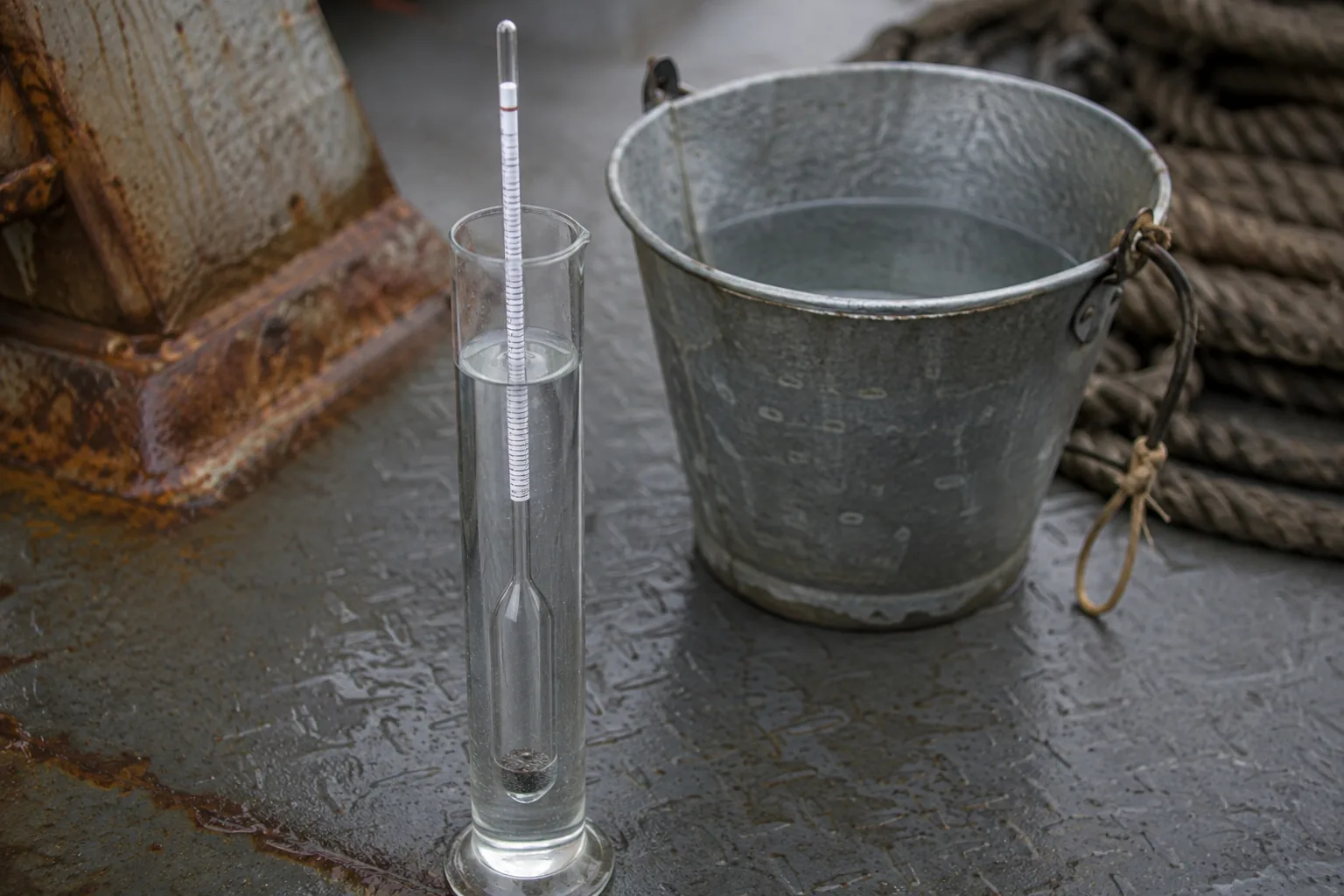
Density correction. Hydrostatic tables are computed for seawater at 1.025 tonnes per cubic metre. Dock water rarely is. Rain, river outflow and tide all move it, and in some ports it moves through the day. The surveyor draws a sample and measures it with a hydrometer, then scales the displacement:
Correction = Displacement × (measured density − 1.025) ÷ 1.025In a brackish river berth the density might read 1.010, which on a 200,000-tonne displacement moves the answer by nearly three thousand tonnes. That is not a rounding adjustment.
Subtracting everything that is not cargo
You now have a corrected displacement: what the ship weighs, right now, with everything aboard. Cargo is what remains after subtracting everything that is not cargo.
| Deduction | How it is measured |
|---|---|
| Lightship weight | From the ship's documents, fixed at build |
| Ballast water | Tank soundings, corrected for density and trim |
| Fresh water | Tank soundings |
| Fuel oil, diesel, lube oil | Tank soundings |
| Bilge and sludge | Tank soundings |
| Stores, dunnage, lashing gear | Declared or estimated |
| Ship's constant | Derived, not measured — see below |
Sounding tanks is slower and more tedious than reading drafts, and it is where most of a survey's hours go. On a trimmed ship the liquid in a part-full tank sits as a wedge rather than a level slab, so the depth down the sounding pipe is not the depth the tank table assumes — a wedge correction puts that right. A tank that is neither empty nor pressed full is the awkward case, and there are usually several of them. Plenty of surveys are lost here rather than at the draft marks.
The constant, and why people argue about it
The ship's constant is the difference between what she should weigh empty, according to her build documents, and what she actually weighs empty when you survey her.
It is never zero. Over a working life a ship accumulates mud in the ballast tanks, spare parts in the store rooms, layers of paint, water trapped in voids, gear nobody has landed ashore in a decade. She also loses steel to corrosion. The constant is the net of all of it, and on a well-run bulk carrier it might run from a hundred tonnes to a few hundred.
Here is the difficulty. The constant is not measured. It is derived — from a previous survey, declared by the ship, or agreed between parties. And it enters the calculation as a straight subtraction from displacement, which means every tonne of error in the constant is a tonne of error in the cargo figure.
A surveyor arriving on board will ask what the constant is, then compare it against previous surveys. A constant that has moved sharply since the last voyage is the single most common trigger for a dispute. It might mean unpumped ballast. It might mean the previous survey was wrong. It might mean this one is.
Nobody can settle it from the deck, which is exactly why it gets argued.
What half a percent is worth
A well-conducted draft survey on a large vessel is generally accepted as accurate to within plus or minus 0.5 percent. That figure is standard across the industry and it is worth sitting with.
On our Capesize with 170,000 tonnes of iron ore, half a percent is 850 tonnes. At the mid-August 2026 index level of roughly 95 dollars a tonne, that is around eighty thousand dollars of uncertainty — in a figure both parties are contractually bound by. Move the index and the arithmetic moves with it; the 850 tonnes does not.
This is why draft surveys are attended. The shipper appoints a surveyor. The receiver appoints one. Sometimes the charterer appoints a third. They read the same marks, sound the same tanks, and produce figures that differ. The commercial question is not who is right but how far apart they are, and whether the gap falls inside the tolerance the contract allows.
For where the Capesize sits among the other bulk carrier classes, see our bulk carrier sizes explainer.
What goes wrong
Most failed surveys fail for ordinary reasons rather than exotic ones.
Conditions. The ship should be upright to within about half a degree and trim should be modest. Beyond that the corrections stop behaving. Swell makes the marks unreadable — the surveyor watches the waterline rise and fall and takes a mean by eye, and in any real sea that eye is the largest single error in the survey.
Draft marks. Corroded, overpainted, or obscured by a fender. Occasionally painted in the wrong place, which is worse, because nothing about the reading looks wrong.
Parallax. Read a mark from a deck fifteen metres up and you are looking down at an angle at a line on the water. The number will be wrong. This is why surveyors go down in a launch, and why the ones who do not are trusted less.
Squat and current. A ship in shallow water with a current running past her sits deeper than she would in still water. At a river berth with a strong ebb this is a real effect on the reading, and it is not something the hydrostatic table knows about.
Density sampling. One bucket over the side at the gangway, at a berth where fresh water enters at one end of the dock. The sample is representative of one spot at one moment.
None of these are failures of the method. They are failures of the conditions the method assumes.
Cargo quantity is one input into a voyage estimate. Distance, speed, bunker consumption, canal dues and emissions costs are the others, and they move a great deal faster than the cargo figure does. The Ship ETA Calculator prices a voyage across Suez, Cape, Panama and the Northern Sea Route with current bunker levels included.
Open Calculator →- UN ECE — Code of Uniform Standards and Procedures for the Performance of Draught Surveys of Coal Cargoes (1992); written for coal, and the procedural reference the wider trade works to
- Dibble & Mitchell, Draught Surveys: A Guide to Good Practice, 2nd edition — North of England P&I Association loss prevention guide
- Marine surveying practice literature — six-point reading, mean of means and quarter mean weighting, trim and density corrections, ±0.5% accepted accuracy
- Iron ore 62% Fe index level, mid-August 2026 — used only to size the tolerance, not as a market call