Here is a question with no single right answer: how much does a ship weigh?
If you look up a large container ship, you might find it described as “150,000 tonnes” in one place, “165,000 tonnes” in another, and “240,000 tonnes” in a third. None of these is a typo. They are different measurements, each answering a different question, and each is correct in its own context.
A ship's “tonnage” is one of the most quietly confusing pieces of vocabulary in shipping. The word “ton” gets attached to at least five different concepts, and two of them are not weight at all — they are measures of volume that happen to use the word “ton” for historical reasons.
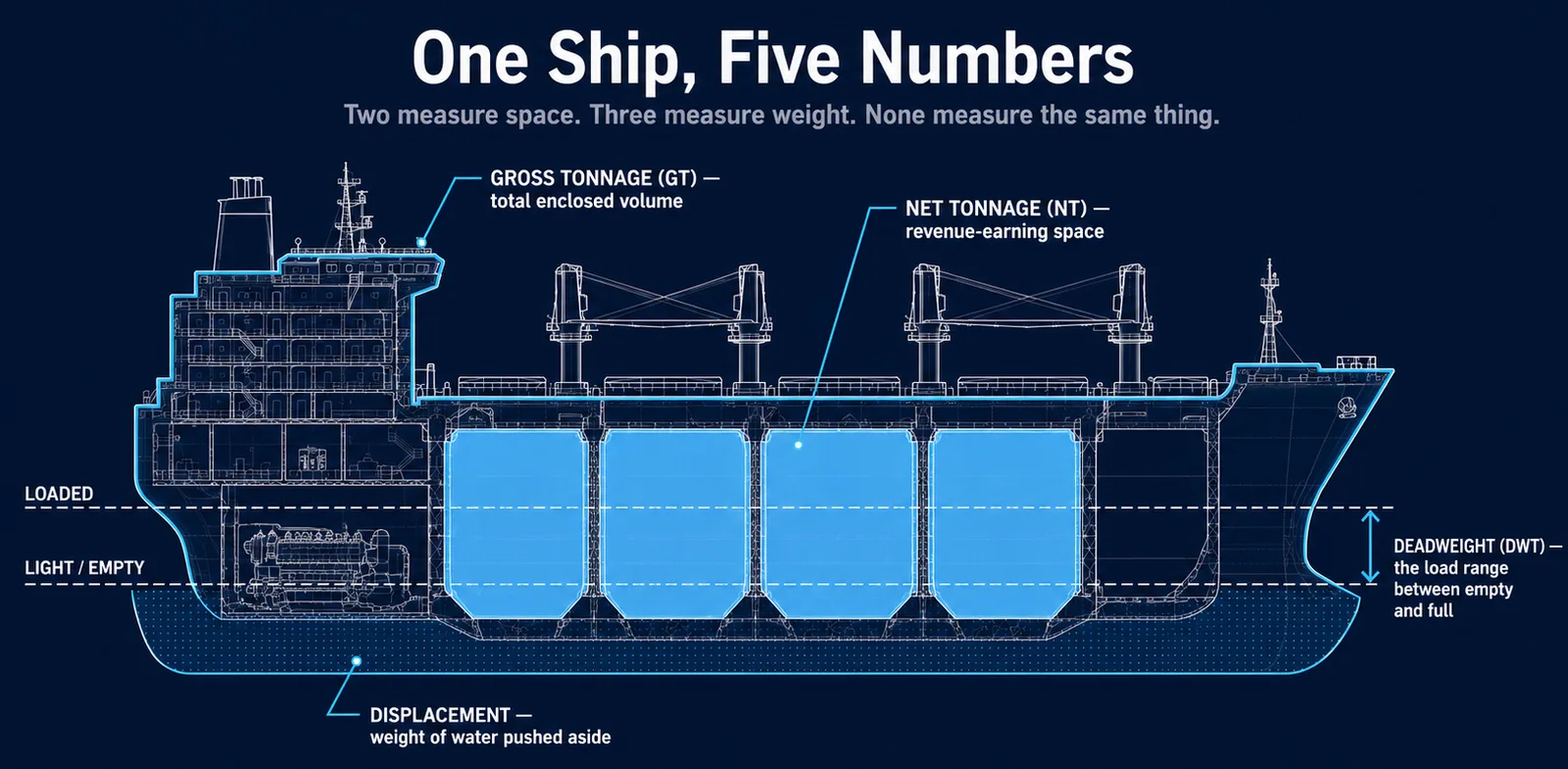
Once you know which number is which, a lot of maritime reporting becomes clearer. We'll see why a cruise ship and an oil tanker can have the same “tonnage” while being completely different sizes, why canal tolls are calculated one way and cargo contracts another, and why “the world's largest ship” depends entirely on which ruler you use.
Let's untangle it.
Why “Ton” Doesn't Mean What You Think
Start with the word itself, because the whole confusion begins there.
“Ton” comes from “tun” — a large cask used to ship wine in medieval Europe. A tun held about 954 litres (252 wine gallons) and took up roughly 40 cubic feet of stowage space. When merchants wanted to describe how big a ship was, the natural unit was: how many tuns of wine can it carry? A ship that could hold 200 tuns was a “200-ton ship.” Note what is being measured here — not weight, but volume. Capacity. How much space is inside.
Here is the twist that explains everything else. The weight unit “ton” came from the very same cask. A tun of wine weighed about 2,240 pounds — which is exactly the “long ton” (the imperial ton) still used in ship design today. So both meanings split off from the same wooden barrel: the volume it held, and the weight it carried. They were never separate concepts that happened to share a name. They were one thing — a barrel of wine — that got measured two ways.
That is why, to this day, the two primary official measures of a ship's size — Gross Tonnage and Net Tonnage — measure internal volume, while deadweight and displacement measure weight. All four trace back to the same medieval wine cask. The industry never cleaned up the overlap, because by the time anyone might have, the terms were embedded in law, contracts, and centuries of ship registries.
The Two That Measure Space (GT and NT)
Gross Tonnage (GT) is the total enclosed internal volume of a ship, expressed as a single index number. Every permanently enclosed space counts — cargo holds, engine room, accommodation, bridge, storage. It is, roughly, how big the whole building is.
GT is not measured in tonnes of weight, and it is not even measured in a simple volume unit. Since the IMO's International Convention on Tonnage Measurement of Ships took effect in 1982, GT has been calculated using a formula that takes the ship's total enclosed volume in cubic metres and runs it through a logarithmic multiplier. The result is a dimensionless number — no units at all. A ship “of 50,000 GT” does not weigh 50,000 of anything. The number just encodes its size.
The Five Tonnages at a Glance
| Measure | What it is | Unit | Used for |
|---|---|---|---|
| Gross Tonnage (GT) | Total enclosed volume | Index (no unit) | Regulations, safety, fees |
| Net Tonnage (NT) | Revenue-earning volume (GT minus non-cargo) | Index (no unit) | Port & canal tolls |
| Deadweight (DWT) | Max weight a ship can carry (cargo + fuel + etc.) | Metric tonnes | Cargo, chartering |
| Displacement | Actual weight right now (water pushed aside) | Metric tonnes | Naval ships, stability |
| GRT (historical) | Old volume measure, phased out by 1994 | 1 register ton = 100 cu ft (2.83 m³) | Replaced by GT |
GT matters because it is the number regulators reach for. Safety rules, crew requirements, registration fees, many port dues, and insurance calculations are all keyed to GT. When a regulation says “ships above 500 GT must carry X,” it is using GT as a proxy for how big and complex the vessel is.
Net Tonnage (NT) is GT minus the spaces that do not earn money. Take the whole enclosed volume, then subtract the engine room, the fuel tanks, the crew quarters, the navigation spaces — everything that exists to run the ship rather than to carry paying cargo. What is left is the revenue-earning volume.
NT, like GT, is a dimensionless index, not a weight. Its purpose is economic: it represents the ship's earning capacity, which is why port and canal authorities often use NT (or a close variant) to set tolls. The logic is that you should pay based on how much money the ship can make, not just how big it is. By rule, NT is never allowed to be less than 30 percent of GT.
A useful way to hold the two together: GT is the size of the whole building; NT is the size of the rentable floor space inside it.
The Two That Measure Weight (DWT and Displacement)
Now the weight measures — the ones most people expect “tonnage” to mean in the first place.
Displacement is the most physically real. It is the actual weight of the ship at a given moment, equal to the weight of water the hull pushes out of the way as it floats. (Archimedes: a floating object displaces its own weight in water.) Displacement changes constantly — it goes up as cargo and fuel are loaded, down as they are consumed or discharged. A fully loaded ship has a higher displacement than the same ship empty.
Two specific displacement figures matter. Lightship (or lightweight) displacement is what the ship weighs empty — just the steel, machinery, and fixed equipment, with no cargo, fuel, water, or crew aboard. Loaded displacement is what the ship weighs when fully loaded to its maximum permitted draft (the summer load line).
Deadweight Tonnage (DWT) is the difference between those two. It is loaded displacement minus lightship displacement — in other words, the total weight a ship can carry when loaded to its marks. And “carry” here means everything that gets added: cargo, fuel, fresh water, ballast, provisions, stores, and crew.
Deadweight = Loaded minus Empty
DWT is measured in actual metric tonnes of weight, which makes it the figure shipowners and charterers care about most. When a vessel is described as “300,000 DWT,” it can carry up to 300,000 tonnes of combined cargo and consumables. DWT is fixed by the ship's design — it does not change with loading, because it represents the maximum.
One subtlety worth knowing: DWT is not the same as cargo capacity. A 300,000 DWT tanker cannot carry 300,000 tonnes of crude, because some of that weight allowance is spent on fuel, water, and stores for the voyage. The portion actually available for paying cargo — after subtracting consumables — is called Deadweight Cargo Capacity (DWCC). Depending on voyage length, DWCC is typically 85 to 92 percent of DWT.
Why a Cruise Ship and a Tanker Confuse Everyone
Here's where the two systems collide — and where most of the confusion comes from.
A large modern cruise ship — the biggest afloat today reach around 250,000 GT — carries only about 20,000 to 30,000 DWT. A crude oil tanker is the reverse: a VLCC might be around 160,000 GT but 300,000 DWT or more.
How can the cruise ship have a bigger “tonnage” than the tanker in one measure, and a far smaller one in another?
Because they are being measured on different rulers. The cruise ship is enormous in volume — vast enclosed spaces full of cabins, theatres, restaurants, atriums, all air and light and very little weight. Its GT is huge because the building is huge. But it carries relatively little weight, because passengers and their luggage are light compared to the volume they occupy. So its DWT is modest.
The tanker is the opposite. Its cargo — crude oil — is dense and heavy. The ship is built to carry maximum weight in a relatively compact hull. So its DWT is enormous while its GT, the enclosed volume, is comparatively smaller.
The most extreme example ever built makes the point. The supertanker Seawise Giant, completed in 1979 and at 458 metres the longest ship in history, had a deadweight of 564,763 DWT — by weight capacity, nothing before or since has come close. Yet by gross tonnage it was unremarkable: its enclosed volume was modest relative to its staggering weight capacity. By DWT it stands alone in history; by GT it is just another large ship. Same vessel, two completely different places on the leaderboard, depending entirely on which ruler you pick up.
This is why “the world's largest ship” is an ambiguous claim. By GT, the largest ships afloat tend to be cruise vessels and the biggest container ships. By DWT, the largest are crude oil tankers and ore carriers. Both are correct. They are answering different questions.
Which Number Matters When
The practical takeaway is knowing which figure to look at for which purpose.
For regulation and safety, look at GT. Crew minimums, safety equipment requirements, registration, and most regulatory thresholds are keyed to gross tonnage. It is the standard proxy for how big and complex.
For port and canal fees, look at NT (or canal-specific variants). The Suez Canal and Panama Canal both use their own tonnage measurement systems. The Suez Canal still uses a system descended from the older 19th-century Moorsom rules, which is why a ship's “Suez tonnage” can differ from its standard NT. The Panama Canal uses its own Panama Canal Universal Measurement System (PC/UMS). A ship can carry a different official tonnage for each canal it transits.
For cargo and chartering, look at DWT. If you are moving cargo, the question is how much weight the ship can carry, and that is deadweight. Charter contracts, freight rates, and fleet comparisons in the bulk and tanker trades all run on DWT.
For naval and specialized vessels, look at displacement. Warships, icebreakers, and other vessels not built for commercial cargo are usually described by displacement, since “carrying capacity” is not the point of the ship. This is why you read that an aircraft carrier is “100,000 tonnes” — that is its displacement, its actual weight.
Reading the News With This in Mind
Once the five numbers are sorted, maritime headlines decode quickly.
Which Tonnage Is the Headline Using?
“Largest cruise ship at 250,000 tonnes” — almost certainly GT (volume). Cruise ships are always quoted in GT. “VLCC carrying 2 million barrels” — the underlying figure is DWT (weight capacity). Crude tankers are quoted in DWT. “Aircraft carrier displaces 100,000 tonnes” — displacement (actual weight). “Ship charged $X in canal tolls” — calculated on NT or a canal tonnage variant (earning capacity). “New regulation applies to ships above 5,000 tonnes” — almost always GT, since regulations key to gross tonnage.
The pattern: passenger and container ships get talked about in GT, cargo ships in DWT, naval ships in displacement, and fees in NT. When in doubt, ask whether the context is about size, capacity, weight, or money — each points to a different number.
The 30-Second Version
A ship's “tonnage” is several different numbers, and two of them are not weight.
Gross Tonnage (GT): total enclosed volume, as a unitless index. The size of the building. Used for regulations and safety rules.
Net Tonnage (NT): the revenue-earning volume — GT minus engine room, crew spaces, fuel tanks. Used for port and canal fees.
Deadweight Tonnage (DWT): the maximum weight a ship can carry — cargo, fuel, water, stores, crew. In actual tonnes. Used for cargo and chartering.
Displacement: the actual weight of the ship right now, equal to the water it pushes aside. Changes with loading. Used for naval ships.
(There is also a fifth, historical figure: Gross Register Tonnage, GRT, the volume measure these replaced — phased out by 1994.)
The word “ton” comes from “tun,” a wine cask — and both the volume meaning and the weight meaning came from that same barrel, which is why one word does two jobs.
When you see “the largest ship by tonnage,” check which tonnage. By volume it's a cruise or container ship. By weight it's a crude tanker. Both are right.
Closing
Ship tonnage looks like a mess from outside, and to be fair, it partly is — a centuries-old tangle of borrowed words and overlapping systems that no one ever rationalized. But the underlying logic is simple once the volume measures and the weight measures are kept apart.
Two rulers. One measures space: how big the ship is (GT) and how much of that space earns money (NT). The other measures weight: how much the ship can carry (DWT) and what it weighs right now (displacement). Every “tonnage” figure you will ever read is one of those four, plus the historical GRT they replaced — and all of them trace back to a wine cask.
The next time a headline calls a ship “200,000 tonnes,” you'll know to ask the only question that resolves it: tonnes of what?