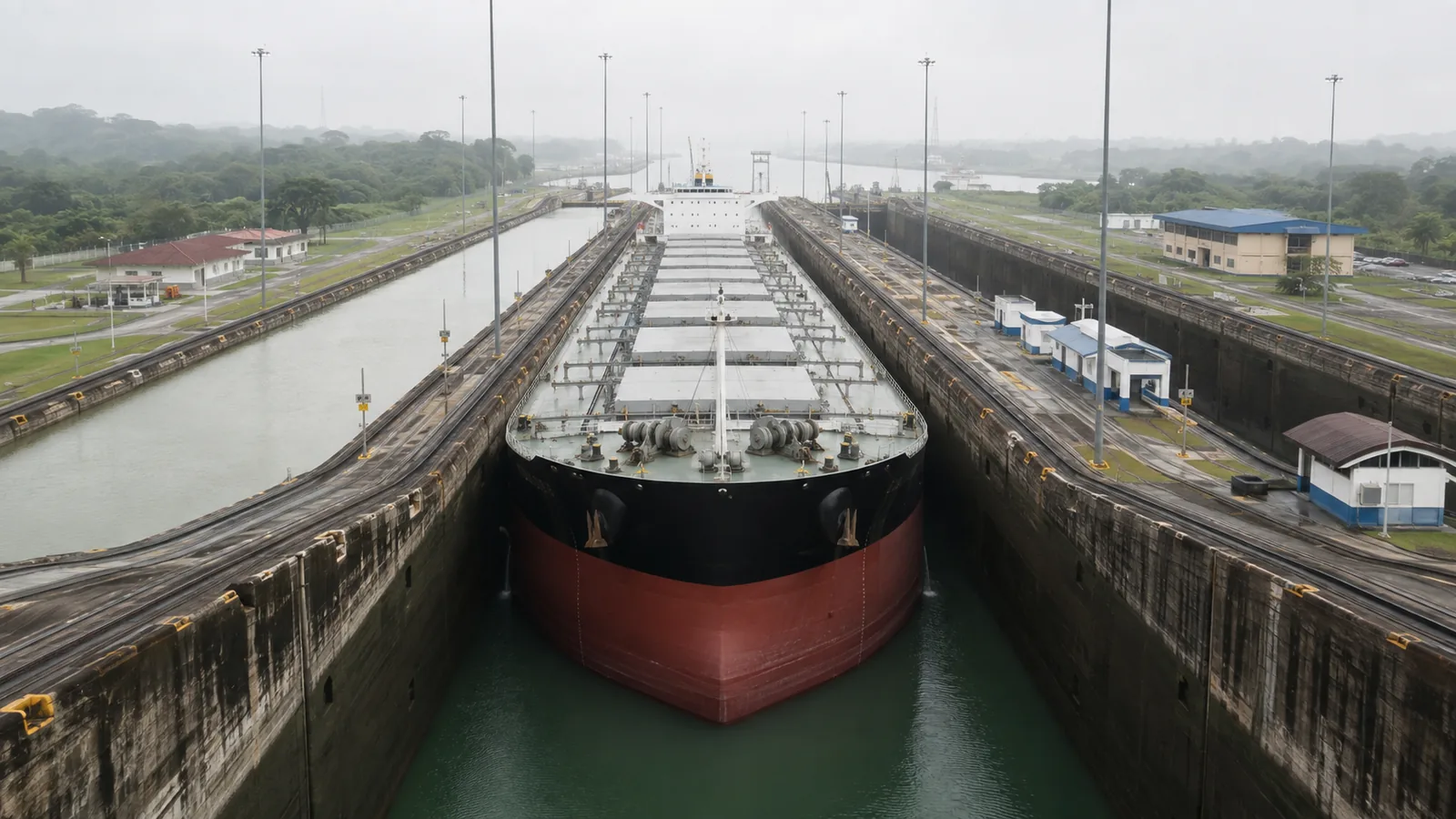
On 20 August the Panama Canal postponed two draft reductions it had already scheduled, and cut the number of ships it will lock through each day instead. Most coverage filed the two halves separately — a reprieve on draft, a tightening on transits. They are the same decision. The Canal is spending transit slots to buy back depth, and the bill for that trade does not land on the ships that keep their cargo.
One definition first. The canal has two sets of locks, and this concerns the newer one — the Neopanamax locks, opened in 2016, 51.25 metres wide and normally operated to a draft of 15.24 metres, or 50 feet. The original 1914 chambers are a separate passage with a separate, shallower limit that has not moved — so most dry bulk, which still transits the old locks, is not newly bound by any of this. The draft ceiling governs the tonnage that books the larger chamber: laden container ships, gas carriers, and bulkers of Kamsarmax size and above.
The advisory, and what it moved
Advisory to Shipping A-29-2026, issued on 20 August, moved the reduction to 48.0 feet from 26 August to 2 September, and the reduction to 47.5 feet from 3 September to 1 October. In the same document it cut daily transits: from 3 September, nine slots at the Neopanamax locks and twenty-five at the Panamax locks; from 15 September, the Panamax figure drops again to twenty-three.
The Authority gave its reasons in the same document, and gave two of them. It postponed the draft steps by reference to the current level of Gatun Lake and its latest weather projections. It cut transits on the ground that watershed conditions required further action to keep transit operations sustainable over the longer term. Two reasons, given separately, for two measures in one advisory. Gatun stood a little above 84 feet in mid-August, about a foot under its five-year average for the month. This is not a body concealing a problem.
It is also not a body explaining a trade-off. The reading below is an inference from the mechanism, not the Authority's stated logic, and it is worth saying so before making it.
One decision, not two
A draft limit and a transit limit look like the same kind of restriction and are not. Maximum authorised draft is a depth question — it is set by how much water stands over the lock sills, which is to say by the level of Gatun Lake. Daily transits are a volume question. Every lockage moves a large quantity of fresh water out of that lake toward the sea; water-saving basins and cross-filling recover part of it, but the net draw is real and it scales with the number of lockages.
So the levers connect in one direction. Transits are the thing you spend to keep draft. Fewer lockages, less water leaving, a lake that sits higher than it otherwise would, and the depth holds a while longer. Which means the 20 August advisory did not relieve a constraint. It moved one — from the ships that transit to the ships that want to.

Who pays, and in what currency
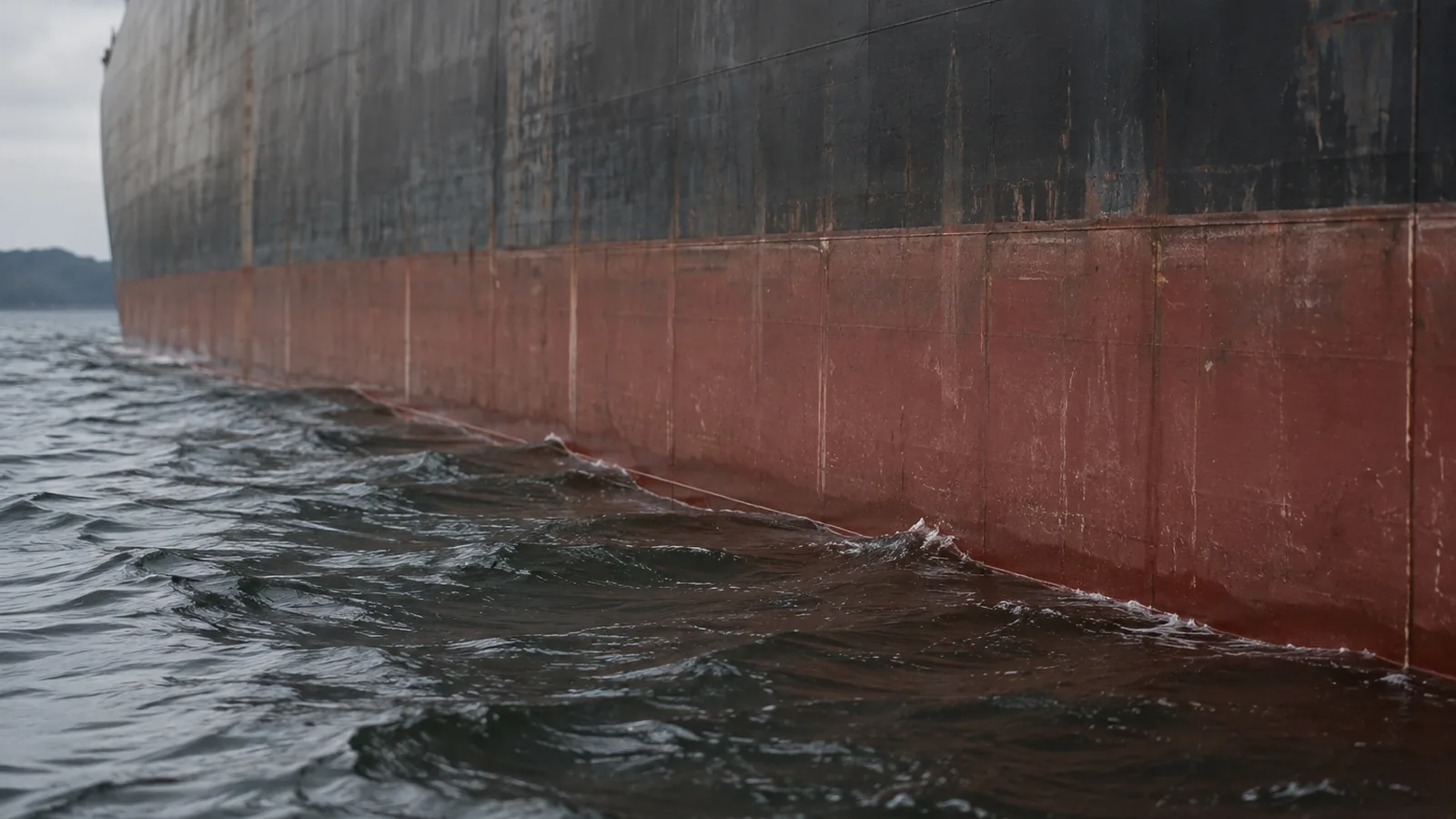
A draft cut is paid in tonnes, by whoever was loading deep. It is spread thinly across every laden ship using the larger locks, it never appears as a line item, and it is invisible in freight indices because it shows up as a slightly smaller parcel rather than a higher rate. A centimetre of immersion is worth roughly sixty-five tonnes on a Kamsarmax — the figure a draft survey turns into a bill of lading number — but the real loss for any given ship is only the gap between her own summer draft and the new ceiling. Most ships were not loading to 50 feet. The restriction is felt unevenly and reported quietly.
A transit cut is paid in dollars and days, by whoever does not hold a booking. It concentrates rather than spreads. The market for the remaining slots is an auction, and auctions do not distribute scarcity evenly — they hand the whole cost to the marginal bidder. Through August that bidder has been paying conspicuously: an LPG carrier sailing in ballast took a slot for a reported record of about 4.6 million dollars in mid-August, and an Authority spokeswoman told reporters that median auction results had roughly tripled from around fifty-five thousand dollars in late 2025 and early 2026. On 20 August, thirty-six vessels were waiting without a reservation, at an average of about eight days in each direction.
The order of events matters here, and it is where most of the commentary has the causation backwards. That premium was built by demand. Gas and energy cargoes rerouted by the closure of the Strait of Hormuz, together with Asian buying of US energy exports, had already been bidding into a tight window through the spring and summer — before the Canal touched supply at all. On 3 September the Canal starts taking slots out of that same market. Restricting supply into a queue that is already being bid up by a separate shock does not produce a proportionate price move. It produces a disproportionate one.
There is a third change in the same advisory, reported widely but rarely read for what it does. From 3 September the auction is split into four vessel categories — gas carriers in one group, dry bulk and general cargo in another, containers and vehicle carriers in a third, tankers in a fourth — and a customer already holding a reservation may not take an additional slot unless the bid is uncontested. That is not a water measure. It is a decision about who is allowed to bid against whom. Putting gas carriers in a pen of their own does not save a litre; it changes who clears the market.
Those two bills fall on different businesses. The tonne cost lands on cargo interests with long-run contracts of affreightment, and it is absorbed. The slot cost lands on spot and time-critical trades — gas carriers, reefer, boxships chasing a service window — and it is not absorbed, it is bid for. The 20 August advisory moved weight from the first group to the second, and the Panamax locks, where most of the transit cut falls, carry a great deal of the trade that has never bought an auction slot in its life.
Two readings to discard
Two readings should be discarded before they take hold, and one of them was ours.
The first is that scheduling several dated steps in a single advisory shows unusual foresight. It does not. It is the Canal's ordinary drafting practice. Advisory A-22-2023 carried three dated levels in one document, and it existed only to postpone a step that A-20-2023 had set three weeks earlier. A batched schedule is a plan, not a commitment, and the Canal has revised its own more than once. Anyone reading the 2026 pairings as a signal of anything is reading a house style.
The second is that the Canal Authority is failing. Nothing in the record supports it. The advisories are numbered, dated, public and issued ahead of effect; the postponement was published fifteen days before the step it deferred; the administrator has said plainly that 2023 and 2024 were the rehearsal. This is a water manager doing arithmetic in the open. The question is not how Panama is managing a shortage. It is whether the freight market has noticed which lever moved.
The timing problem
The US forecasters have an El Niño advisory in effect and put the chance of a very strong event through the coming autumn and winter at better than nine in ten, with a smaller but material chance of the strongest event in the modern record. Two cautions on that second number, since it is the one being repeated loosely: it is measured on a relative index, benchmarked against the tropical-mean sea temperature rather than as a raw anomaly, which makes it a higher bar than it looks — and it is a probability, not a forecast.
The timing is where most of the commentary goes wrong, this piece included in draft. The link between El Niño and this watershed is well established in the hydrological literature, and the signal is strongest not at the peak but in the months from December to March. A reservoir integrates a rainfall deficit rather than tracking it. So an event peaking in the fourth quarter of 2026 does not do its damage in the fourth quarter of 2026. It does it to the dry season that follows — the first four months of 2027, entered from a lake that never refilled.
Which reframes what happened on 20 August. Deferring a draft cut by four weeks and paying for it with transit slots is a sensible move if the constraint is a few weeks of shortfall. It is a considerably more expensive one if the lake has to be carried through to April.
What would have to be true
Treating this as a manageable seasonal squeeze requires one of two things to hold. The first: the rains come back before the lake is drawn down, the deferred steps are cancelled rather than merely postponed, and the transit cuts are restored in the fourth quarter. Possible — the Canal restored draft in 2024 after the previous event, and the watershed can recover quickly when the pattern breaks. It requires the watershed to recover while the driving event is, on the forecaster's own numbers, still intensifying.
The second: the auction absorbs the whole cost without it reaching anyone else. For a single fixture that is correct — a record slot price is one owner's problem. It weakens as the count grows, because a cargo that cannot buy a slot does not evaporate. It goes around, it waits, or it does not go, and each of those consumes tonne-miles the fleet was not carrying last quarter.
Both are testable, which is more than most market assumptions manage. The trouble is that they are usually held together while nobody tracks whether either is coming true.
The close
The thing to watch is not the next draft number. It is which lever the next advisory pulls. If the Canal defers 47.5 feet again and takes more transits out, it has decided that per-ship cargo capacity is the thing worth protecting and that the queue can carry the cost — and the auction, not the freight index, is where that decision will be priced. If instead it lets the draft step land on 1 October and restores slots, it is protecting throughput and the cost goes back into the cargo hold, quietly, spread across everyone.
Watch the auction groups too, which start the same day the slots come out. If that split holds, the Canal has changed who competes for scarcity, and the segment that cleared the market in August will not clear it the same way again. These are opposite trades with opposite winners, and the market has no position on any of them. It is watching a depth number the Canal has just told it is negotiable.
Sources
- Autoridad del Canal de Panamá — advisories to shipping, 2026
- NOAA Climate Prediction Center — ENSO diagnostic discussion, August 2026
- Published research on ENSO and Panama Canal Watershed hydrology
- Trade press reporting of auction results and waiting times, cross-checked against the Fairway ETA Maritime Data Hub
Related on Fairway ETA
- Bulk Carrier Sizes Explained — the classes that sit in the affected draft band
- SCNT and PC/UMS — how the canal charges, as distinct from what it will accept
- Global Chokepoints 2026 — where Panama sits among the world's constrained passages
- Six Marks on the Hull — why a permitted draft and an actual draft are different numbers