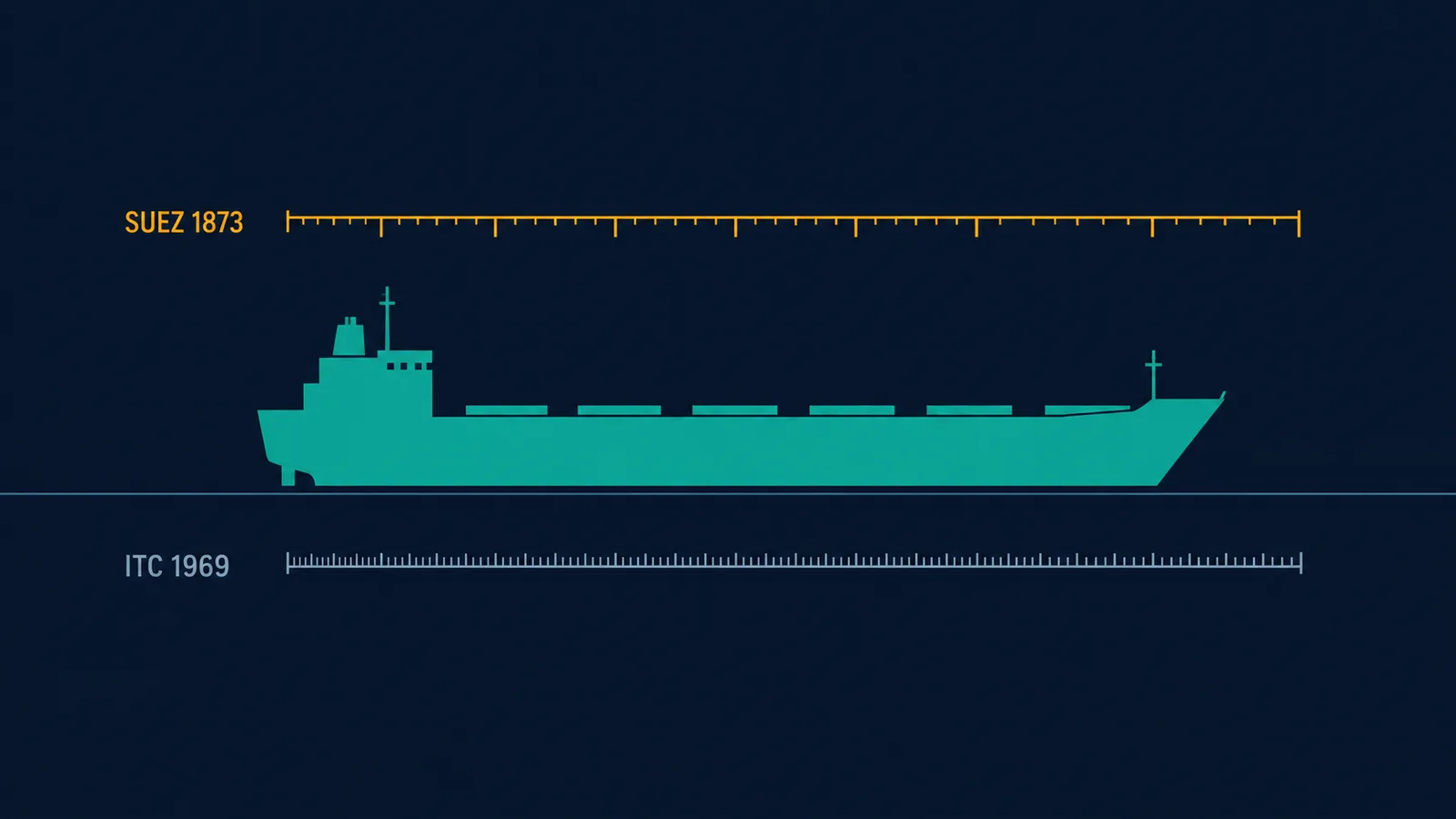
A Kamsarmax bulker sits at anchor off Port Said. Her certificates say 82,000 deadweight, 43,000 gross, 27,000 net. The Suez Canal Authority is about to bill her on none of those.
It will bill her on roughly 41,000 Suez Canal Net Tons, a figure produced by rules written in 1873 using a measurement method from 1854. At Panama the same ship would be assessed on a third system again.
This is structural rather than administrative. Each canal has its own view of what a ship is, and that view sets what she pays every transit for the life of the hull.
Six numbers, one hull
Ask what a ship weighs and you get an argument. Ask what she measures and you get six answers.
Displacement is the mass of water the hull pushes aside. It is the only figure here that is genuinely a weight.
Deadweight is carrying capacity — cargo, bunkers, fresh water, stores, crew. It is what a chartering desk means by size.
Gross tonnage is not weight at all. It is enclosed volume converted by formula into a dimensionless number, and it drives manning scales, survey regimes, and most regulatory thresholds.
Net tonnage is the earning part of that volume, with machinery and accommodation removed.
Those last two come from the 1969 International Convention on Tonnage Measurement of Ships, adopted by the great majority of flag states and applied by every classification society. It replaced a patchwork of national systems with one.
Then there are two more, and they appear on no certificate your surveyor issued. SCNT — Suez Canal Net Tonnage. PC/UMS NT — Panama Canal Universal Measurement System Net Tonnage. Both exist for one purpose: to be multiplied by a toll rate.
The base four are covered in our tonnage explainer. This piece is about the two the canals added.
Suez: a ruler older than the Panama Canal
The Suez Canal opened in 1869. Within four years its operators had the problem every toll road eventually meets — ships were being measured differently depending on where they were registered, and owners had noticed.
The answer was the International Tonnage Commission, convened at Constantinople in 1873. It set one measurement standard for canal purposes, built on the volumetric principles George Moorsom had devised for Britain in 1854: divide enclosed volume in cubic feet by 100, call the result a ton.
That system is still in force. The 1969 convention standardised the tonnage flag states assign; Suez continued to assess transits on its own basis. A Suez Canal Special Tonnage Certificate issued this year applies rules that predate the Panama Canal.
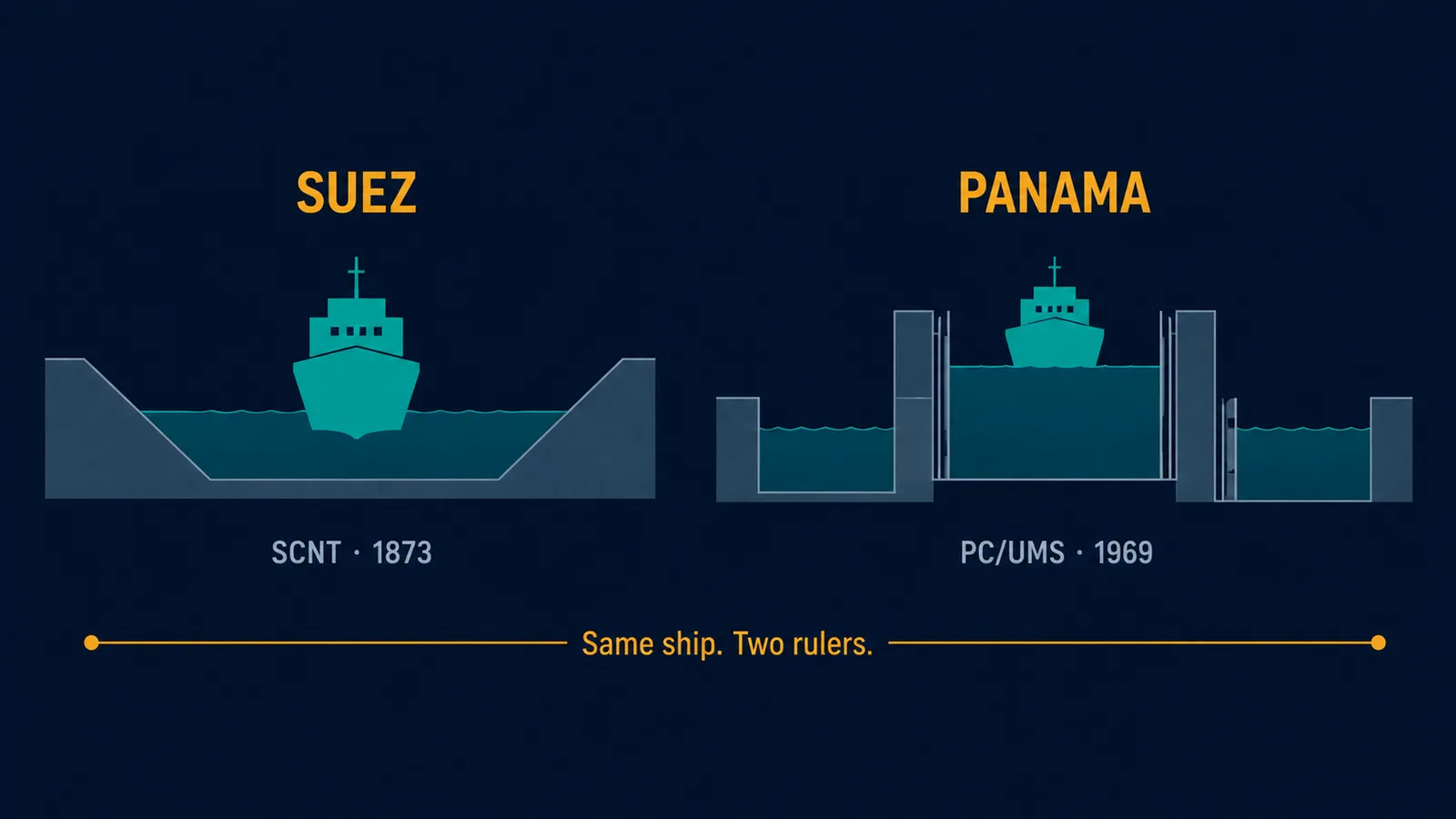
This is less defiance than a division of scope. The 1969 convention governs the tonnage a flag state assigns for international voyages; it does not govern what a canal charges for passage. Both canal authorities attended the 1969 conference as observers and kept their own assessment systems, which is what the convention left room for.
The practical consequence is that SCNT is not international net tonnage. The Suez calculation captures spaces the 1969 convention leaves out, so for the same hull it comes out higher. As rough orientation, SCNT tends to land near the vessel's international gross tonnage, and at roughly half her deadweight. A ship certified at 27,000 NT can be billed on 41,000 SCNT.
What you actually pay
Transit dues = SCNT × toll rate in SDR × SDR exchange rate
Two things in that line matter.
The rate varies by vessel type and by laden or ballast condition, with rebates for certain trades, and it is tiered — banded so the rate per ton falls as tonnage rises. The marginal ton costs less than the first. That structure matters more than it looks, and it comes back below.
The rate is also denominated in SDR, the International Monetary Fund's Special Drawing Rights. The SCA publishes rates in SDR, the IMF publishes the exchange rate daily, and the invoice is usually settled in dollars though other hard currencies are accepted. So the dollar cost of a Suez transit moves in weeks when the SCA has changed nothing. A voyage budgeted in USD carries a small unhedged currency position, whether or not anyone has noticed.
Above the base dues sit temporary surcharges, revised by circular and differing sharply by vessel type. These have changed more than once a year recently — the 2026 circulars are a clear example. Current values are on our Data Hub.
The certificate is not optional
A newbuilding can lose real money here in her first month of trading.
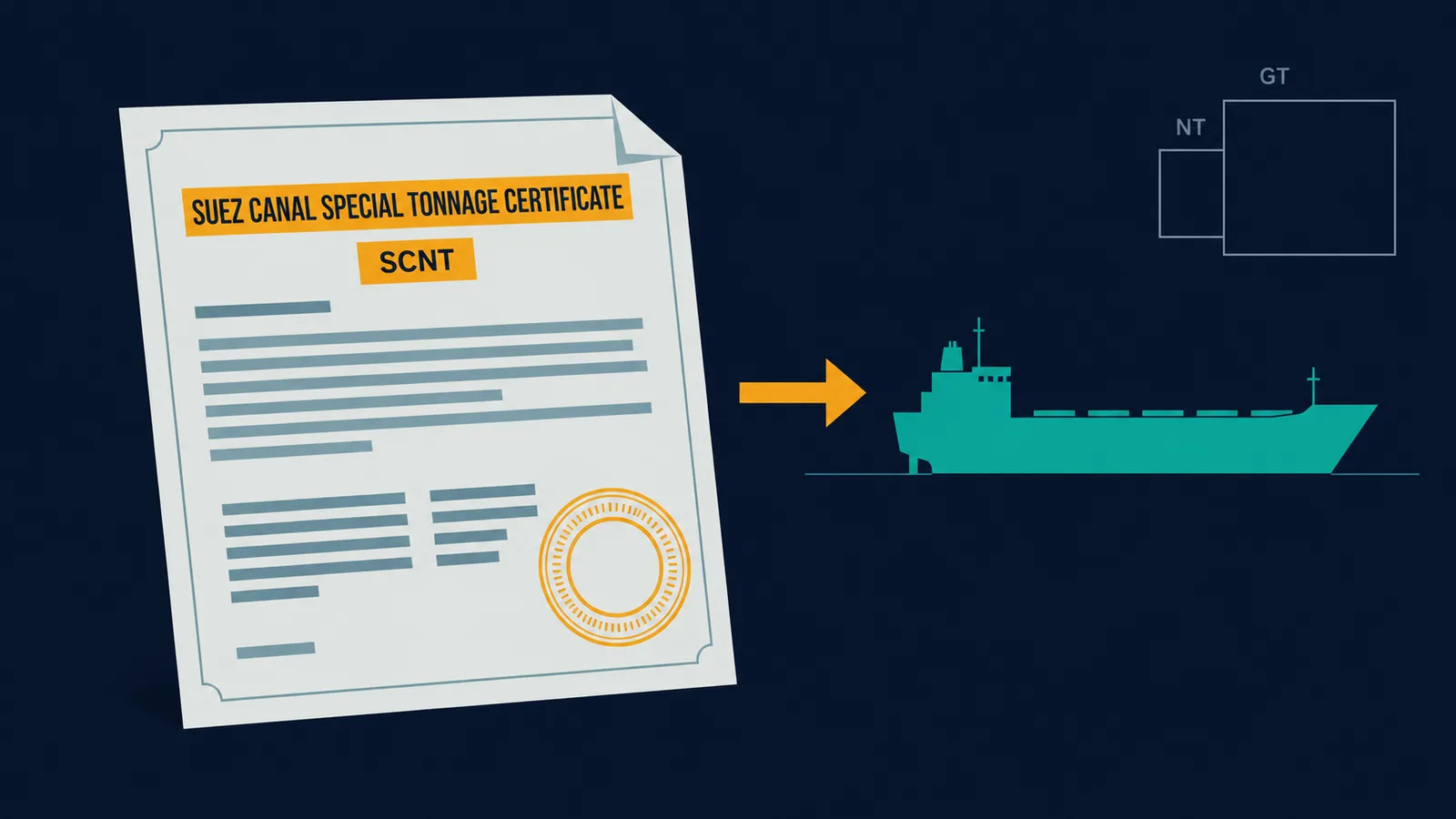
To be billed on SCNT a vessel must present a valid Suez Canal Special Tonnage Certificate together with a general arrangement plan and a capacity plan. The certificate comes from a class society and is normally arranged at delivery.
Where those documents are missing or incomplete, the SCA does not hold up the transit. It bills provisionally on Suez Canal Gross Tonnage instead.
There is no penalty here in the formal sense. Without the calculation sheets and plans, the deductions that turn gross into net cannot be established, so gross is the only figure available — and the Rules of Navigation say so openly. The commercial effect is unchanged: the ship pays more for the same passage because her paperwork was not ready. Dues revert to SCNT once the certificate is produced on a later transit. The earlier transit is not revisited.
For a vessel with no Suez history, arranging measurement before arrival adds days. It is one of the few costs in shipping that is entirely avoidable and entirely self-inflicted.
The LNG case: same cargo, different number
What SCNT actually measures shows up most clearly on gas carriers.
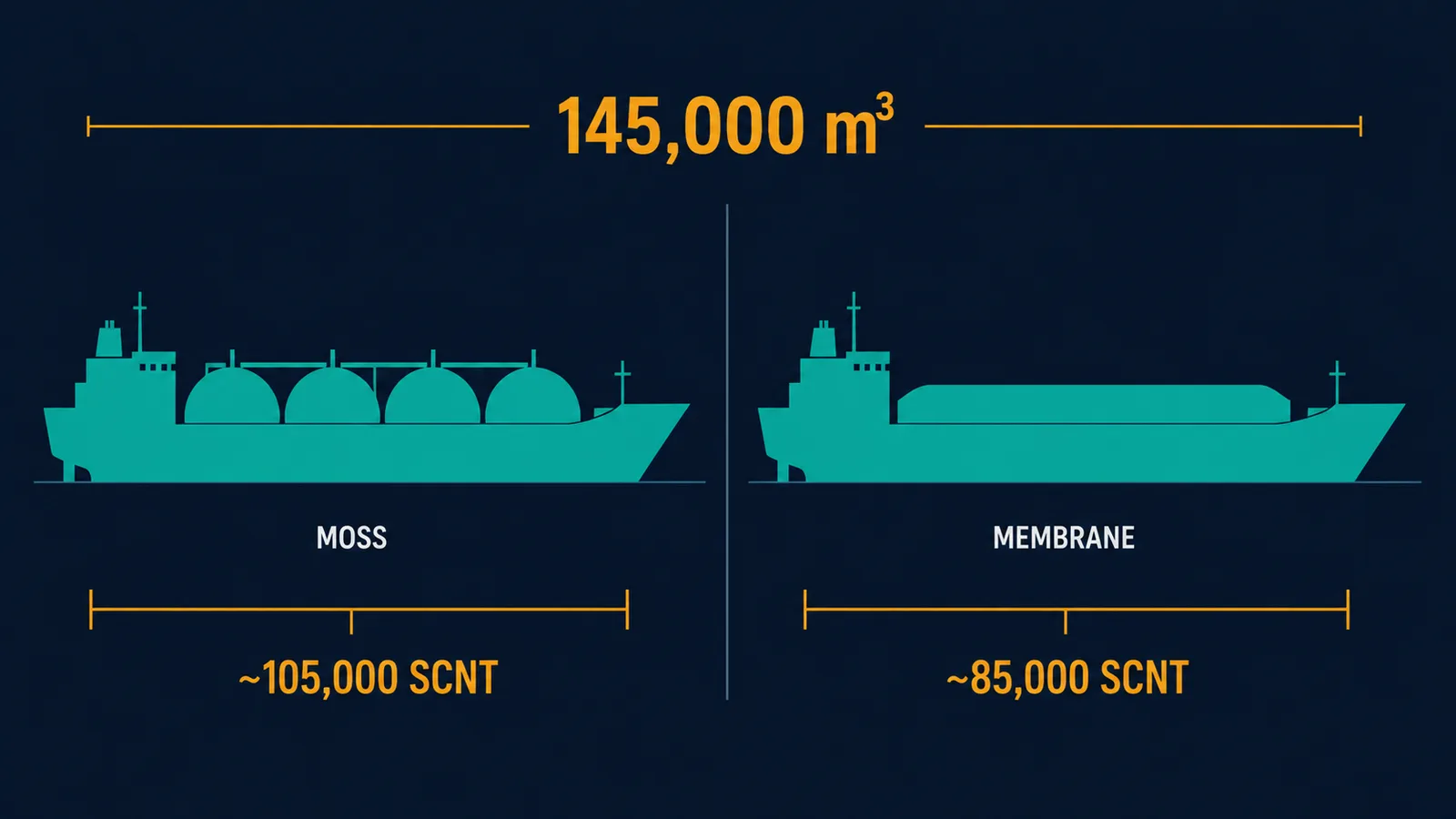
Take two LNG carriers of 145,000 cubic metres cargo capacity — identical commercial capability. One is a Moss type, with spherical independent tanks standing proud of the deck. The other is a membrane type, with prismatic tanks integrated into the hull structure.
| Type | Cargo capacity | Approximate SCNT |
|---|---|---|
| Moss (independent spherical) | 145,000 m³ | ~105,000 |
| Membrane (integrated) | 145,000 m³ | ~85,000 |
Approximate figures, from agency calculator guidance. Actual SCNT is determined by measurement.
Roughly 20,000 tons apart on the billing basis, or about a quarter, for ships carrying the same gas to the same terminal.
The reason is geometry. A prismatic membrane tank follows the shape of the hull, so the volume enclosed is close to the volume that earns. Spherical tanks do not — they leave void space around each sphere, and the tank covers extend above the weather deck. For the same cargo volume, the Moss design needs more hull, and it is the hull that gets measured.
One qualifier that matters commercially. A 24 percent difference in SCNT is not a 24 percent difference in the bill. Because the rate structure is banded and declining, those additional 20,000 tons fall into the cheapest tiers. The gap in dues is real but smaller than the gap in tonnage. Gas carriers also attract rebates that further compress it.
What survives the qualifier is the principle: a containment system chosen in the shipyard becomes a permanent canal cost differential, transit after transit, for thirty years. Worth remembering the next time two ships are described as the same size. Same size measured how?
Panama: a modern standard, then modified
Panama went the other way. Rather than preserve a nineteenth-century system, the Panama Canal Authority built on the 1969 convention and added its own variations.
PC/UMS uses the 1969 framework to establish total vessel volume, then applies ACP rules on top. One PC/UMS net ton equals 100 cubic feet, or 2.83 cubic metres. The Moorsom lineage survives here too — the same divide-by-100 logic applied to a modern standard. Rates differ by vessel category and by laden or ballast condition.
Container ships are assessed differently, and this is where people tend to get it wrong.
A full container ship's toll is built from several components: a fixed transit tariff set by lock type and size category, a capacity charge on TTA — Total TEU Allowance, the maximum container capacity established by admeasurement — then a charge on TTL, the loaded TEU actually aboard, and a further charge on TTE, the empties.
So the capacity component is still measured from the vessel. What Panama adds is a second layer that responds to what she is carrying on the day. Two sister ships transiting together pay different tolls if one is fuller. Neither pays on tonnage.
That is the cleanest way to see the difference between the two canals. Suez measures the hull and ignores what is inside it. Panama measures how many boxes the ship could carry, then charges again for the boxes actually aboard. Neither measures the cargo. They have chosen different proxies for it.
The variable nobody budgets for
Since 2020 Panama has levied a freshwater surcharge, tied to the level of Gatun Lake. It combines a fixed component with a variable percentage of the vessel's tolls — around 1 percent when the lake sits above 85.5 feet, rising toward 10 percent as it falls below 72 feet. Because part of it scales with the toll itself, the absolute figure grows with the size of the transit. Current values are on our Data Hub.
It is worth knowing where the lake stands. Through early 2026 Gatun has run above its five-year seasonal average, high enough at one point to require preventive release through the Gatún spillway. The variable component sits at the bottom of its range, not the top. That will not hold forever, which is rather the point of a surcharge indexed to rainfall.
The mechanism is worth sitting with. Each lockage consumes fresh water from a lake that also supplies drinking water to much of the country, and the canal has priced that constraint into the transit.
Which produces a symmetry the two canals probably never intended. A Suez transit is priced partly by currency markets. A Panama transit is priced partly by rainfall. Neither variable has anything to do with the ship, and neither appears in a route comparison built from distance and speed.
Two towns, one house
Picture two towns that both tax the same house.
One assesses on floor area, the other on lot size. Neither is measuring the wrong thing, and neither assessment is incorrect. The same house simply pays different tax in each town, and no argument about which method is right will change either bill.
Your ship is the house. SCNT and PC/UMS are the two assessments. Unlike a house, your ship can be assessed by both on the same voyage.
What this means for a voyage estimate
Net tonnage is the wrong number for estimating canal cost. It is on the certificate, but it is not what either canal bills. For Suez the billing tonnage sits closer to gross.
The certificate itself is worth confirming before the first transit rather than at the anchorage — particularly on newbuildings, on vessels entering a new trade, and after any modification affecting tonnage, whether a conversion, a change of cargo gear, or a scrubber retrofit.
The surcharge layers deserve a line of their own in the estimate. Base dues are comparatively stable; surcharges are not, and at Suez they vary by vessel type in ways that can reverse a route comparison outright.
And the currency sits underneath all of it. SDR-denominated tolls move the dollar figure independently of any rate change, which is easy to miss when a fixture is priced weeks ahead.
Canal fees, surcharges, and the Turkish Straits rate that catches people on the way north are all on our Data Hub. To price a specific voyage with canal costs included, run it through the calculator.
Canal cost is the line in a voyage estimate most often copied from the last fixture and least often rechecked. The Ship ETA Calculator prices Suez, Panama, Cape of Good Hope, and the Northern Sea Route side by side with canal dues included, so a comparison still holds when the surcharges move.
Open Calculator →- Suez Canal Authority — Rules of Navigation; tonnage certificate requirements and provisional gross-tonnage billing
- Panama Canal Authority (ACP) — Regulations for the Admeasurement of Vessels; tolls assessment structure for container and non-container vessels
- International Convention on Tonnage Measurement of Ships, 1969 (IMO) — the GT/NT standard SCNT predates and PC/UMS builds on
- Leth Agencies — Suez transit calculator guidance; SCNT orientation figures and LNG containment comparison