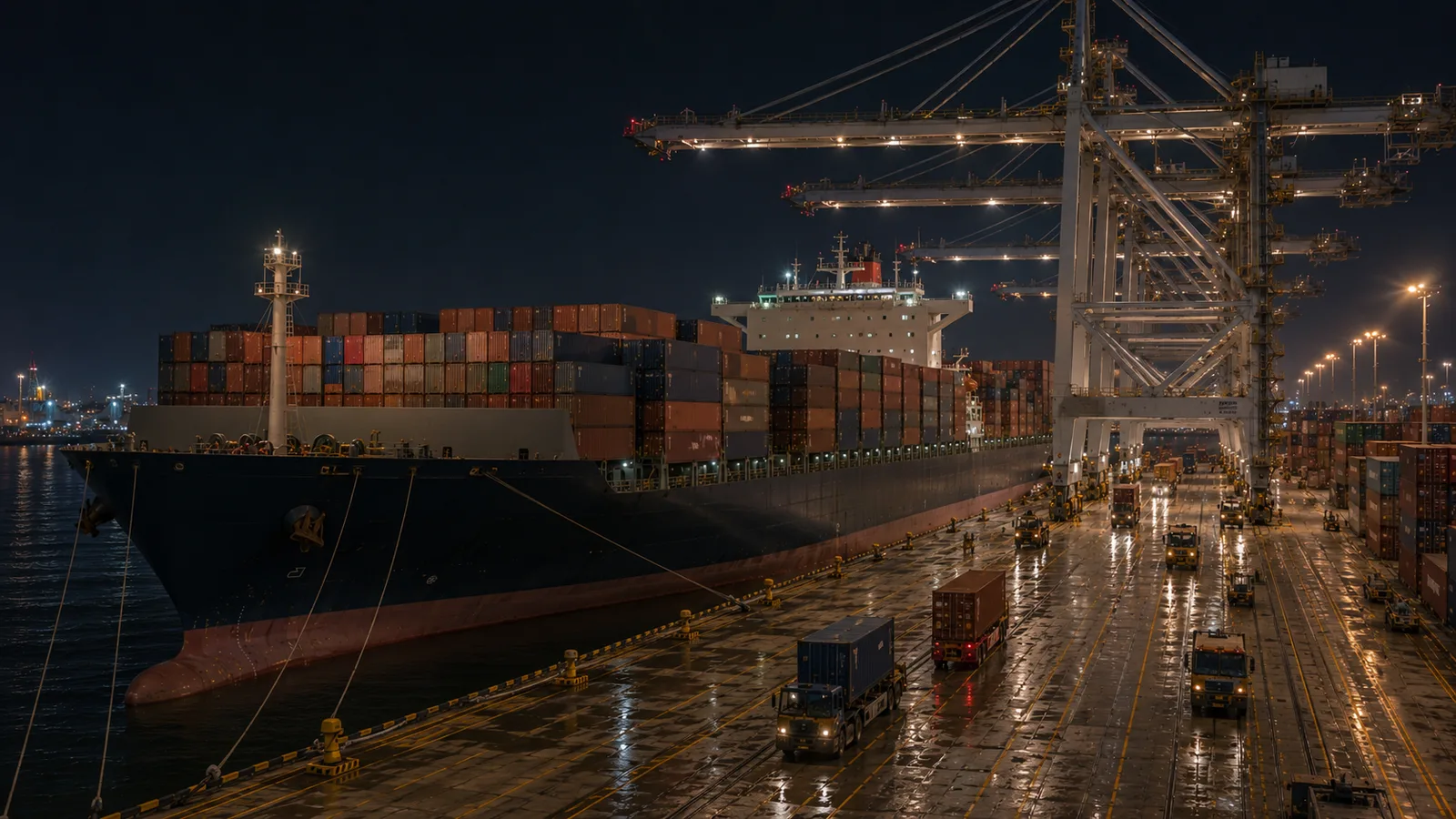
A container ship recently docked at the Port of Rotterdam at 02:47 local time. The vessel was a Neo-Panamax, around 14,000 TEU, carrying mixed cargo on the Asia–Europe loop. The arrival hour appeared on the port call schedule alongside a 09:15 berthing that morning and a 22:30 the previous evening. Nothing in the operational log flagged the 02:47 dock as unusual. To the terminal, it was the most efficient hour available that day.
This is the part of shipping the industry rarely explains to outsiders. Port arrival hours look random from a distance. They are not. They are the output of an optimization problem with three hard constraints — set by IMO as berth, fairway, and nautical services availability — run thousands of times per day across the world's container terminals, dry bulk anchorages, and tanker jetties. A 02:47 berth is not late. It is the price the system paid to avoid a different cost.
There is also a market angle worth naming up front. The most important number in port arrival economics is the share of voyage time vessels spend at anchor — not moving, still burning fuel for auxiliaries, still depreciating, still on charter hire. The IMO's upper-bound estimate is 9% of voyage time. That estimate has been the target of a coordinated international fix for over five years. The fix is mostly working on paper and mostly not working at the port. The gap between those two states is where the real cost sits.
The 9% Upper Bound
The 9% figure comes from the IMO's Global Industry Alliance to Support Low Carbon Shipping, published in the 2020 Just-In-Time Arrival Guide. It is the upper-bound estimate of vessel voyage time spent waiting at anchor, derived from a 2018 dataset covering merchant vessels above 5,000 gross tonnes. The number has held through the post-COVID congestion peaks and the subsequent normalization, which is itself a meaningful fact — the structural waste is stable across very different demand environments.
The economic reading is straightforward. A merchant ship at sea typically burns somewhere between 30 and 150 tonnes of fuel per day depending on segment and speed — a 14,000 TEU container ship at service speed sits around 80 to 120 tonnes, while a slow-steaming bulker sits near the bottom of the range. At anchor, that drops to roughly 5 to 10 tonnes per day for auxiliary loads. The fuel cost goes down, but it does not go to zero. Charter hire continues at full daily rate. Crew costs continue. The voyage clock continues. For a tonne of cargo being delivered under a time-charter equivalent, the wait at anchor is a measurable drag on landed cost.
The 2020 GIA study quantified the savings opportunity in three scenarios that matter for any operator reading this piece. For a containership, JIT speed optimization applied across the entire voyage yields fuel savings of about 14.16%. Limit the adjustment to the last 24 hours of the voyage and the saving collapses to 5.90%. Limit it to the last 12 hours and it falls again to 4.23%. The economic case for JIT lives upstream — two to four days out from arrival — and that is precisely where the data needed to plan the adjustment is least available today.
A 2017 study published in Transportation Research Part D by Adland, Jia and colleagues at NHH approached the question from the tanker side, evaluating roughly 5,000 VLCC voyages between 2013 and 2015 using AIS data. They concluded that substantial fuel savings were available across varying assumptions about congestion reduction, with the upper bound appearing when “excess” port waiting time was largely eliminated. A 2025 review in Journal of Shipping and Trade that compiled these and related estimates put the practical range at roughly 7% (for a 25% reduction in congestion-related waiting) to 19% (for full elimination). Earlier European pilot work — the MONALISA project — landed in similar territory at 10–12% by its own methodology.
Three studies, three vessel segments, three methodologies. The numbers converge on the same underlying claim: somewhere between 7% and 19% of voyage fuel is being burned because ships are not arriving when the port can take them. The exact figure depends on the congestion baseline. The principle does not.
The Four Clocks
The reason a ship cannot simply “arrive when it arrives” is that several separate clocks have to align before the vessel can move from the Pilot Boarding Place (PBP) to the berth. The IMO formally groups these into three categories — berth, fairway, and nautical services — but the operational reality separates the fairway constraint into two distinct clocks (channel direction and tidal window), which often fail independently. Four operational clocks, three IMO categories. Both framings are correct; the four-clock view is more useful when diagnosing why a specific port call ran long.
The first clock is the berth itself. A container berth is a finite resource. If the previous ship is still loading export boxes, the arriving ship waits. Analysis from the Port of Antwerp, published by Qronoport in 2022 based on 32,000 port calls between 2018 and 2020, made the link between berth occupancy at the moment of pilot pickup and anchorage waiting time unambiguous. When a vessel waited less than two hours at anchorage, only about 16% of cases involved the destination berth being occupied at pilot time. When the wait stretched past 72 hours, that figure climbed to roughly 81%. The relationship is not subtle.
The Antwerp dataset also revealed that the 9% global figure hides large segment-level differences. The average wait at anchorage was about 12 hours across all vessel types, but tankers averaged over 19 hours and gas carriers about 30 hours. The aggregate number is true at the system level. At the segment level, it is misleading.
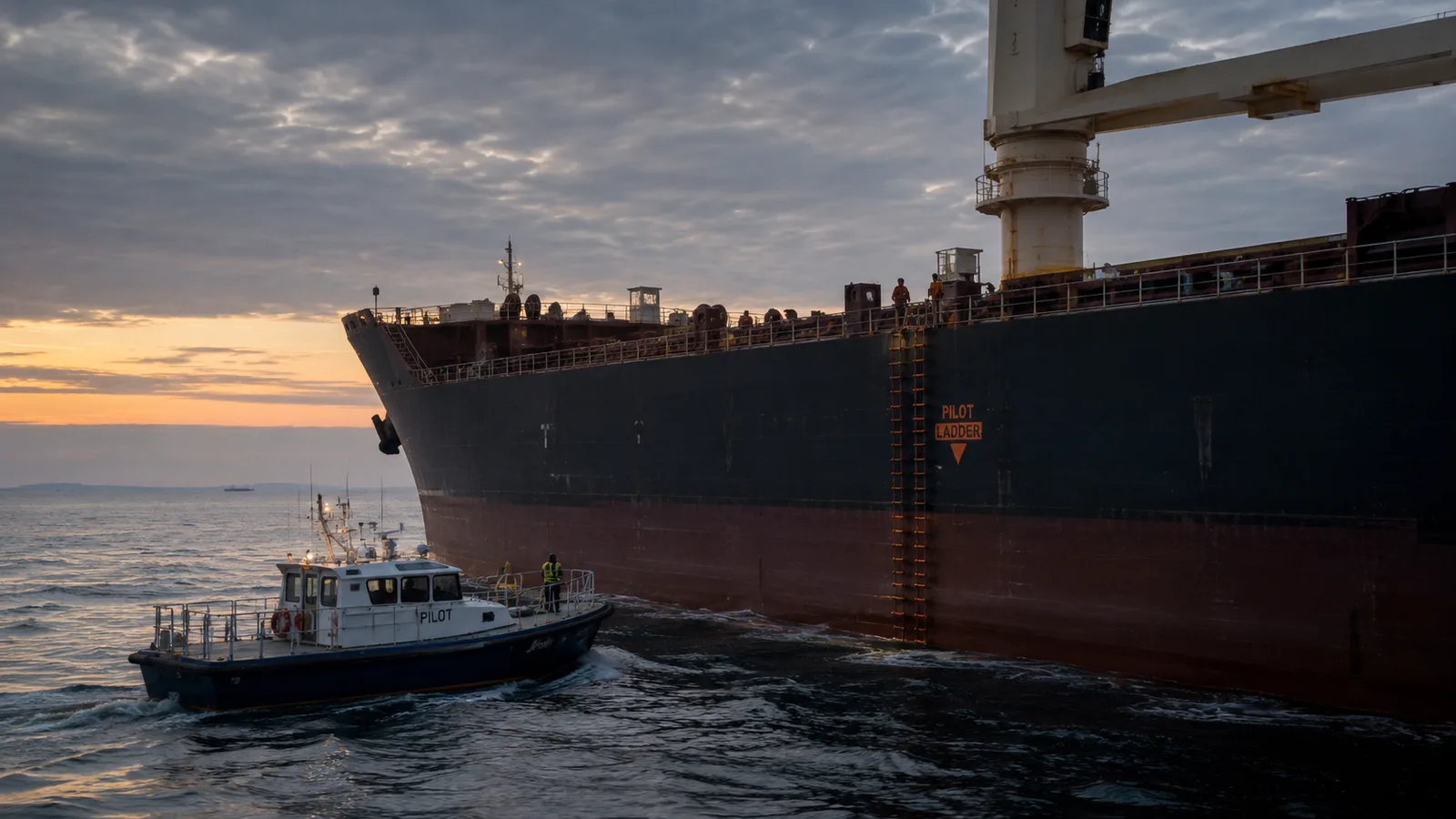
The second clock is nautical services — pilots, tugs, and linesmen, taken as one coordination layer. Pilotage is mandatory at most major ports for vessels above a tonnage threshold, and pilots work in rotations with finite roster slots. Tugs are mandatory for large vessels at most container and tanker terminals, and the available tug fleet at any given hour is constrained. Linesmen are required for mooring operations and work on similar shift patterns. A ship can be on schedule and in position. If any of the three is not available at the requested hour, the ship waits.
The 2024 Singapore study by Zhang and colleagues, published on arXiv, used pilotage booking records fused with AIS and meteorological data and found that pilot availability information was the single most powerful predictor of vessel arrival time accuracy — more so than weather, more so than the AIS track itself. The model achieved a mean absolute error of 4.58 to 4.86 minutes, with roughly 90% of predictions falling within 10 minutes of actual arrival. Those are not hypothetical numbers. They are what becomes possible once the nautical-services data is treated as a structured input.
The third clock is the tide. Deep-draft vessels at tide-restricted ports — Hamburg on the Elbe, Antwerp on the Scheldt, the Mississippi system below Baton Rouge, Liverpool on the Mersey — can only enter or leave during specific tidal windows. A ship arriving six hours outside its window waits six hours. The window itself is a function of vessel draft, channel depth, and the local tidal cycle, which can run anywhere from a half metre in the Gulf of Mexico to over twelve metres on the Bristol Channel. None of this is negotiable.
The fourth clock is the channel. One-way navigation channels, common at older ports and at any port with significant traffic separation requirements, mean that inbound and outbound traffic cannot overlap. The port authority controls the channel direction in blocks, often coordinated with tides. A vessel arriving at the start of an outbound block waits for the inbound block to open. This is not delay in the operational sense. It is the channel doing exactly what it was designed to do.
When the four clocks align, a ship berths quickly. When they do not, the ship anchors. The arrival hour visible on a port schedule is the timestamp of alignment, not the timestamp of intention.
The Queue That Has Not Changed
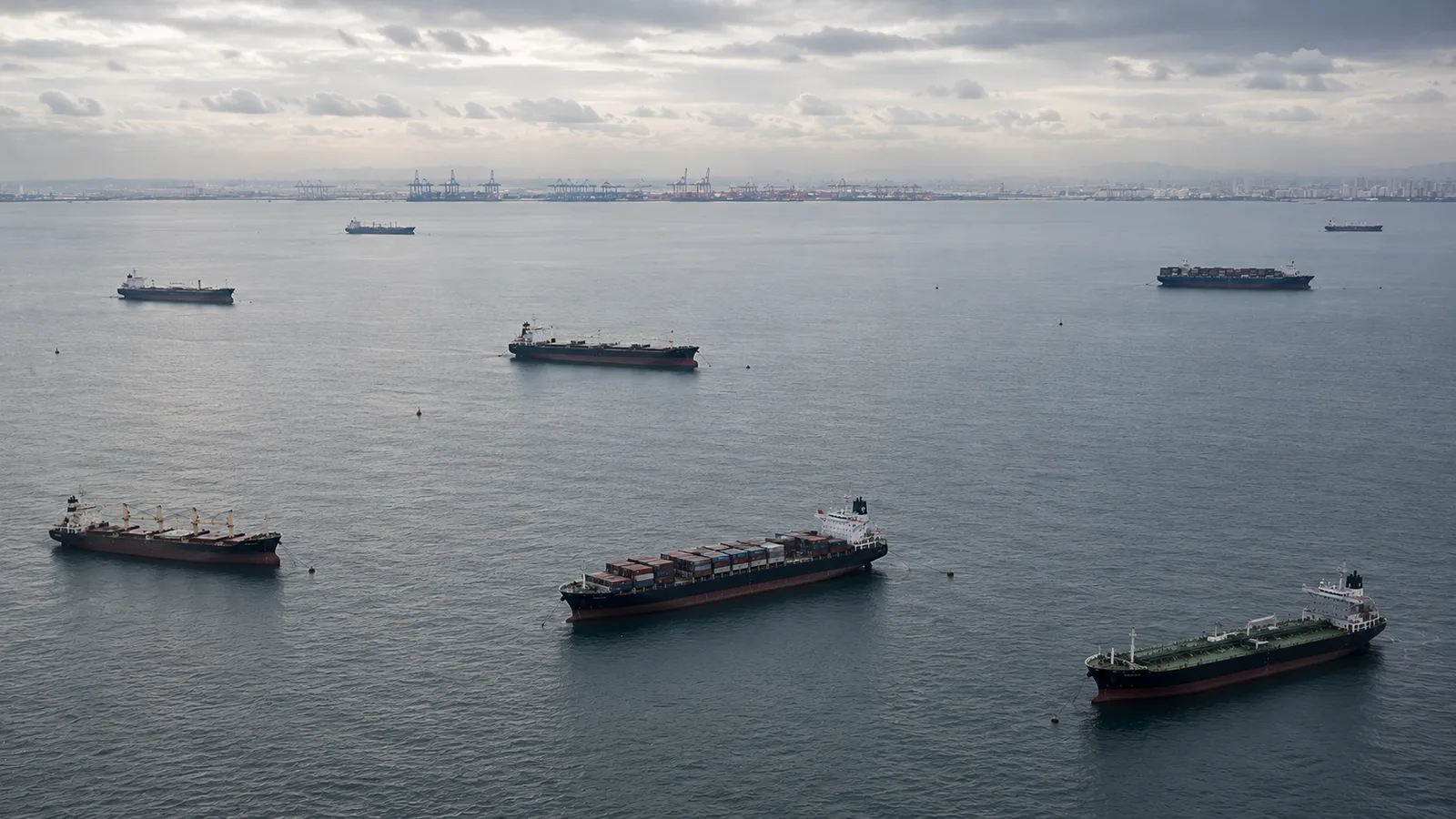
For most of the modern container era, the rule governing which ship moves next when a berth opens has been first-come, first-served. It is the queue discipline at the anchorage, at the pilot station, and at the berth allocation desk. It is simple, it is unambiguous, and it is responsible for an enormous share of the upper-bound 9%.
First-come, first-served has one unavoidable consequence: it rewards ships that race to anchor. A vessel that arrives early and waits secures berth priority over a vessel that arrives exactly on time. A vessel that arrives exactly on time secures priority over one that arrives late. The incentive structure points all ships toward arriving early. The collective result is an anchorage full of ships that did not need to get there when they did, each burning fuel to preserve a position in a queue that the port could, in principle, manage differently.
The fix has been on the table since 2019. IMO resolution MEPC.323(74), adopted in May of that year, formally encouraged voluntary cooperation between ports and shipping operators to adopt Just-in-Time Arrival practices — recalibrating ship speed during the voyage so that the vessel arrives at the Pilot Boarding Place exactly when berth, fairway, and nautical services align. The resolution was broadened in December 2022 as MEPC.366(79), extending the cooperation framework across the wider port-call value chain. The 2020 JIT Arrival Guide laid out the operational mechanics. The 2025 Journal of Shipping and Trade review confirmed the economic case across the available empirical evidence.
The framework is well-defined. The technology exists. The data-sharing standards have been developed. The adoption has stalled because Just-in-Time Arrival is not, at its core, a technology problem. It is a coordination problem with a commercial bridge.
The commercial bridge has a name: the Notice of Readiness, or NOR. Under a voyage charter, the NOR is the timestamp at which the vessel formally declares itself ready to load or discharge. The NOR starts the laytime clock — the period during which the charterer is allowed to load or unload the ship without paying demurrage. The closer relative of JIT in commercial practice, Virtual Arrival, works by allowing the charterer to accept a notional NOR at the moment the ship would have arrived had it steamed at full speed, even though the ship actually sails slower and arrives later. The fuel savings flow to the shipowner. The laytime integrity is preserved for the charterer. Both sides have something to gain.
In theory, this is a small contractual move. In practice, it requires charter party templates to absorb the Virtual Arrival or JIT language, which most still do not. Voyage-charter clauses are conservative by default and changing them is slow. The IMO's own technical staff have flagged a more practical constraint as well: a ship typically does not receive firm berth information until it is within the final approach to port — often the last 12 to 24 hours of voyage time. By that point, the vessel is already too close for meaningful speed adjustment to recover material fuel. The ETA window where JIT actually pays is two to four days upstream, and that is where the data is least available today.
The Singapore Lesson
The Singapore experience offers the clearest published evidence that the coordination problem is solvable. The Zhang study, using two years of Singapore port call data, demonstrated that fusing pilotage booking information with AIS tracks and meteorological data produced arrival time predictions accurate to within five minutes on average, with nine out of ten falling inside a ten-minute window.
The accuracy is striking, but the methodology is the interesting part. The single largest gain came from incorporating the pilotage booking record. That is, the system already knew when the pilot would be available, and the prediction engine simply used that information instead of inferring it from ship speed and position. The system worked because the port had made the pilotage schedule a structured data feed available to the prediction engine. Most ports have not.
The Singapore lesson is not that AI predicted arrival times. The lesson is that the input data the prediction engine needed was already being generated by the port's operational systems — it just had not previously been treated as a data product. The technical work was small. The institutional work was the real lift.
The Port of Rotterdam has been pushing in a similar direction through its public operational transparency dashboard, which publishes anchorage waiting times and port-call performance as structured data. The list of ports doing this is growing slowly. It is the list to watch.
What Operators Can Actually Do
In the absence of a global JIT regime, individual operators still have meaningful levers. None of them is new. All of them are underused.
The first lever is honest ETA reporting. Most carrier ETAs reflect a target arrival, not a realistic one. When a port authority receives ten ETAs that all cluster around the same shift, it knows from experience that not all ten will land within that window — but the planning system cannot easily spread them out. An honest ETA that reflects the actual expected arrival, including a margin for typical congestion, gives the port a real input to plan against.
The second lever is upstream speed flexibility. If a ship is sailing Singapore–Rotterdam and the operator knows several days in advance that Rotterdam berth slots are saturated for the target day, a modest one-knot speed reduction over the final five days can shift the arrival by roughly four to five hours — enough to drop into a less congested slot. The arithmetic is not dramatic, but it is the only fuel-saving lever available once the ship is past the upstream window. This requires the operator to be receiving usable congestion signals several days in advance, which most operators are not. The gap is narrowing — several commercial AIS-based congestion services now publish rolling forecasts — but the data does not yet flow into the ship's planning loop reliably.
The third lever is the charter party. Time-charter clauses already give the charterer speed-instruction authority, which makes JIT adoption relatively straightforward on that side. Voyage-charter language is harder, because the NOR and laytime clauses must be written to accommodate Virtual Arrival without penalizing the master for missing a nominal ETA. The contractual block is addressable through standard clause work, and industry templates are beginning to absorb it. It has not yet propagated through the back catalogue of existing fixtures.
The Hour the Math Chose
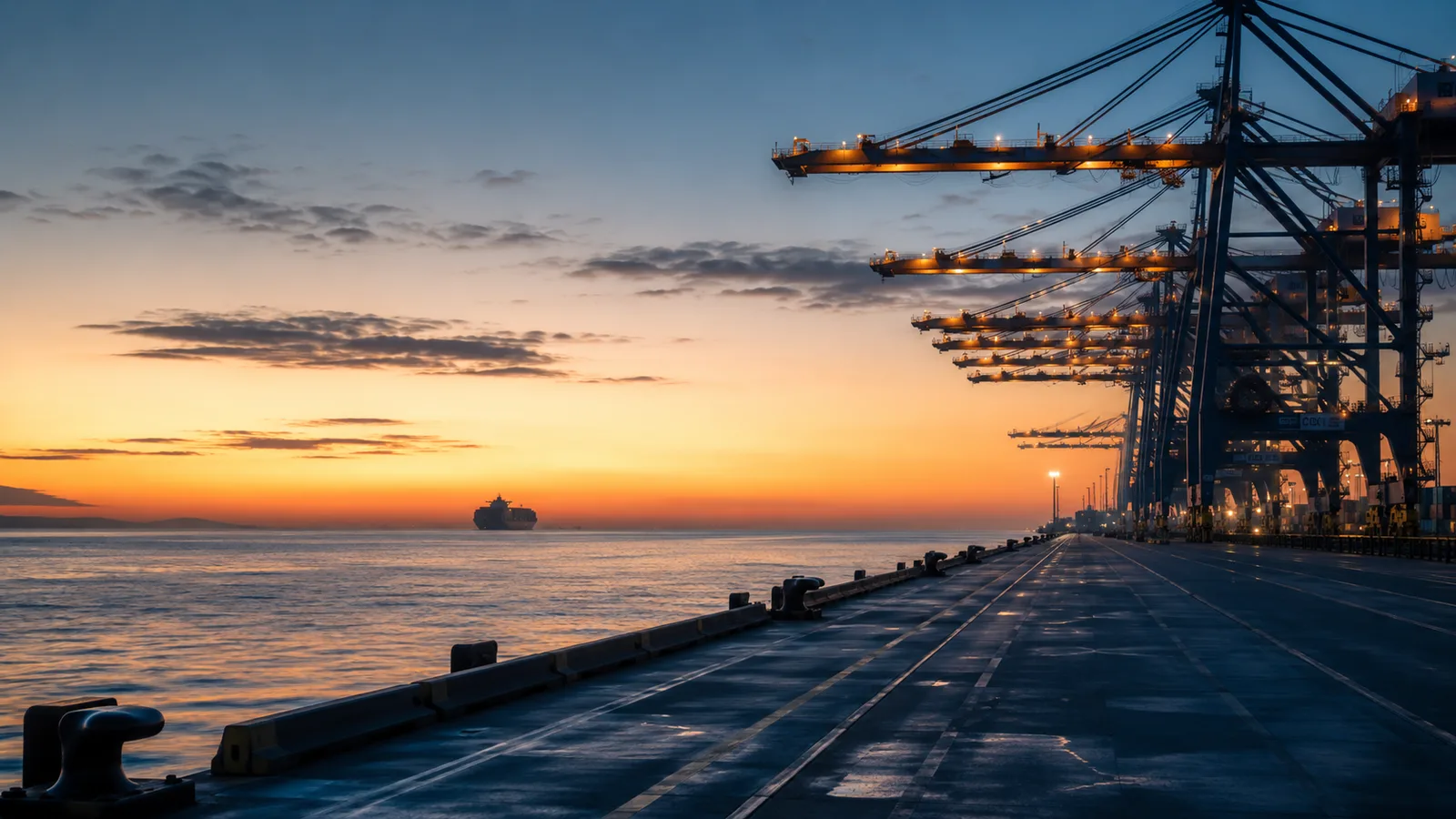
A ship docking at 02:47 is doing what the system asked of it. The four clocks aligned at that hour, the queue allowed it, and the alternative — an earlier berth slot that would have required arriving at 18:00 the previous day and waiting nine hours at anchor — was more expensive.
The market is gradually learning to read these signals. Port congestion data is moving from a niche operational input to a charter-rate variable. The 9% upper bound is being repriced as fuel costs stay high. The institutional barriers to Just-in-Time Arrival are starting to feel like the bottleneck they always were.
For now, the strangest hours on a port arrival schedule are usually the ones where the system worked correctly. The 03:00 dock is the optimization. The 15:00 dock — the one that looks reasonable on the schedule but required twelve hours at anchor to secure — is often where the real cost sat.
Want to estimate arrival timing for your own route? Try the Calculator.