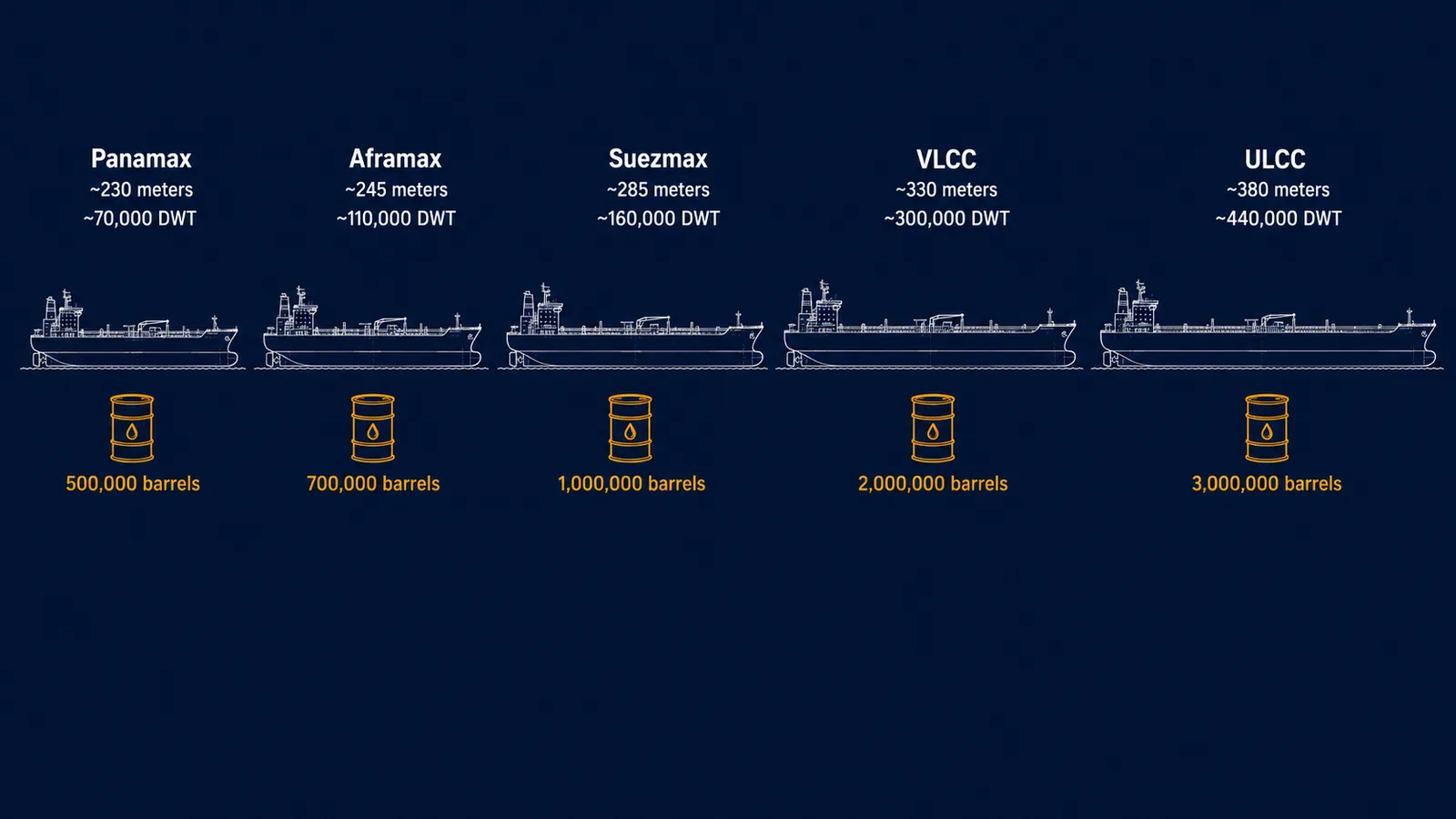
A tanker can be longer than the Eiffel Tower is tall and carry two million barrels of oil, yet the industry refers to it with four letters: VLCC. Open a shipping news feed and you'll see these labels in headlines about oil prices, sanctions, the Strait of Hormuz, and freight indices. To someone outside the industry they sound technical, almost like ship model numbers. They aren't. They're size labels — and each one carries information about where the ship can sail, what cargo it tends to move, and which canals it can fit through.
Tankers are sorted by deadweight tonnage, the standard measure of how much weight a ship can safely carry — cargo, fuel, water, ballast, and stores combined. The size classifications are not arbitrary. Most of them come from physical constraints: the depth of a canal, the width of a strait, the draft a particular port can handle. A few come from historical reasons that have stuck around.
Let's walk through them in order, from smallest to largest, and look at why each class exists. Once you know what the labels mean, shipping headlines become much easier to decode.
The Smaller Classes: MR, LR1, Panamax
At the smaller end of ocean-going tankers, three classes do most of the work.
Medium Range (MR) tankers run roughly 25,000 to 55,000 DWT. They are the workhorses of refined-product trade — gasoline, diesel, jet fuel — moving short to medium distances between refineries and regional terminals. An MR can fit almost anywhere with a deepwater port. A typical MR carries around 300,000 barrels, roughly one-tenth the cargo of a ULCC.
Long Range 1 (LR1) tankers carry 55,000 to 80,000 DWT. They are larger product tankers, often used on longer routes where the cargo volume justifies a bigger ship but port restrictions still rule out anything bigger.
Panamax tankers, named because they were originally the largest size that could fit through the locks of the Panama Canal, run 50,000 to 80,000 DWT. The Panama Canal expansion in 2016 introduced larger locks (called “New Panamax”), but the original Panamax class name has stuck. Panamax tankers carry both crude and products, and their flexibility — they can call at almost any major port — keeps them in regular service even though they're not the cheapest tonnage per barrel.
These smaller classes account for a large share of tanker movements but rarely make the news. The biggest headlines tend to involve larger ships.
Aframax
The first of the “headline” tanker classes is Aframax — typically 80,000 to 120,000 DWT.
The name has nothing to do with Africa. It comes from the Average Freight Rate Assessment system, a freight pricing scheme developed by Shell in the mid-1950s to standardize how oil shipments were priced. The name was originally a freight-rate category. Over time, it became a size class.
An Aframax tanker is around 240 meters long with a beam of about 34 meters and a draft of about 20 meters. It carries roughly 600,000 to 800,000 barrels of crude — typically around 700,000 — depending on cargo density and loading conditions. About a third of what a VLCC carries. But it has a critical commercial advantage: it can fit into nearly every major oil port in the world. Larger ships can't.
That access is why Aframax tankers dominate regional crude trades in places where port infrastructure isn't built for giants — the Mediterranean, the North Sea, the Caribbean, and East Asian coastal routes. They are the most flexible crude carriers on the water, and they make up the bulk of US crude oil exports out of Houston and Corpus Christi for exactly this reason.
If a port can take an Aframax but not a Suezmax, the trade goes Aframax. That's essentially the trade-off — and why this class remains so widely used.
Suezmax
Suezmax tankers carry 120,000 to 200,000 DWT and earn their name in the most direct way of any tanker class: they are the largest tankers that can transit the Suez Canal fully loaded.
A Suezmax is roughly 285 meters long, 45 meters wide, and draws about 23 meters when loaded. It carries close to 1 million barrels of crude — about half a VLCC. The Suez Canal has been progressively deepened and widened over the years (the most recent expansion raised the maximum draft to about 20.1 meters), so some Suezmax vessels now transit at partial load even above the original design limits. But the class name continues to anchor around the canal's working dimensions.
Suezmax tankers are the dominant class on the West Africa to Europe crude route, and they show up frequently on routes from the Black Sea and Mediterranean to Asia. They sit in a useful commercial middle ground: large enough to be economical on long voyages, small enough to access more ports than a VLCC, and crucially, able to cross the Suez without the partial-load penalty that limits bigger ships.
When the Suez Canal is open and predictable, Suezmax tankers are some of the most flexible long-haul ships on the water. When it isn't, their advantage shrinks.
VLCC: The Headline Tanker
VLCC stands for Very Large Crude Carrier — 200,000 to 320,000 DWT. This is the tanker class that shows up most often in maritime headlines, because it's the workhorse of long-haul intercontinental crude transport.
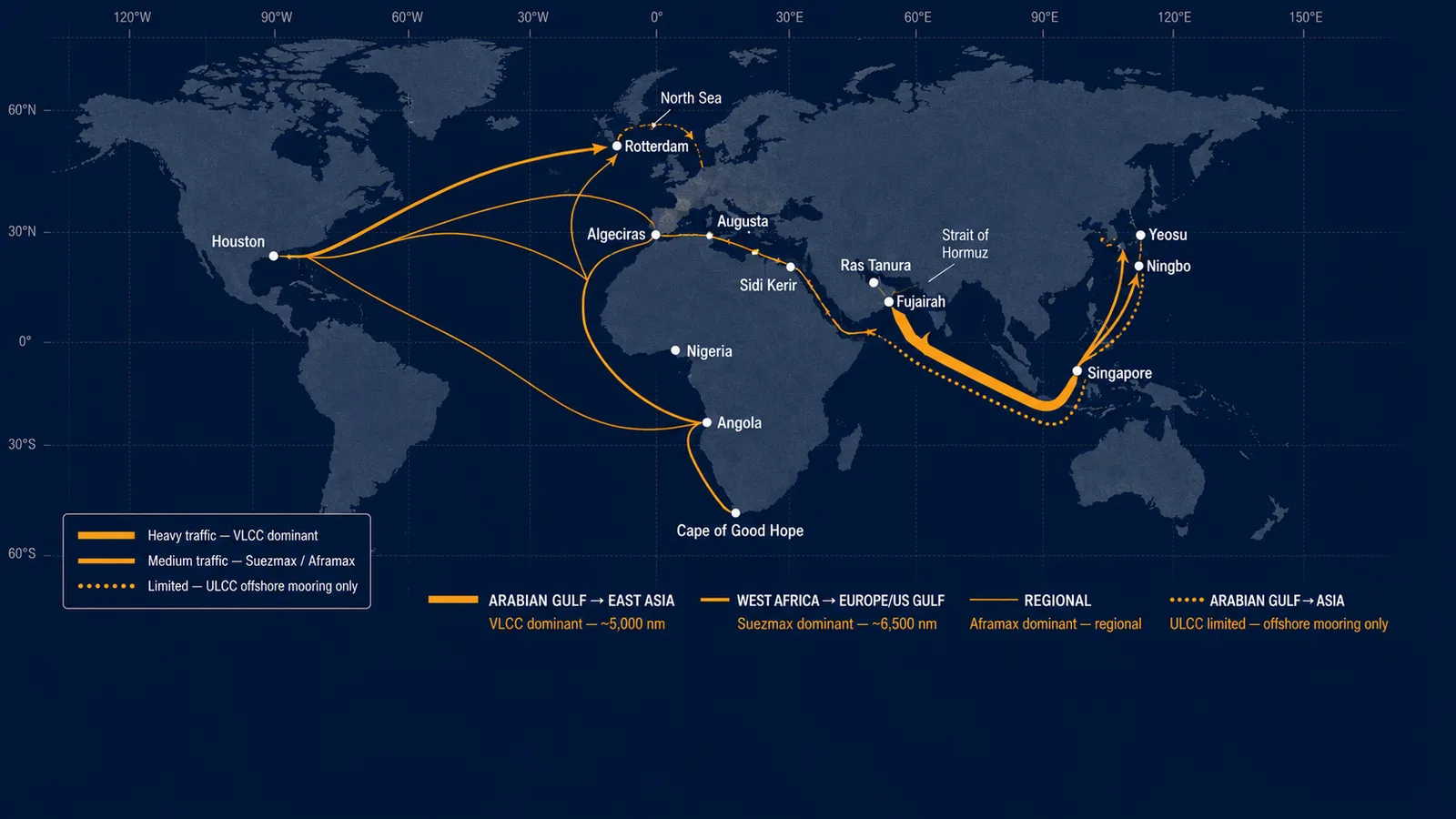
A typical VLCC is around 330 meters long — longer than the Eiffel Tower laid flat. It carries about 2 million barrels of crude per voyage. The dominant route is the Middle East Gulf to East Asia: load at Ras Tanura or Fujairah, sail the Indian Ocean, discharge at Yeosu, Ningbo, or Singapore. That trade lane is dominated by VLCCs.
Why VLCCs dominate this route comes down to economics. A VLCC carries roughly three times as much cargo as an Aframax with only a slightly larger crew, slightly more fuel, and roughly the same port time. The per-barrel cost of moving oil on a VLCC is dramatically lower than on smaller classes. On the Middle East to Asia run — about 5,000 nautical miles each way — that cost difference adds up to real money.
The trade-off is access. A VLCC needs deep water at both ends. It cannot transit the Suez Canal fully loaded — it has to either go in ballast (empty) or partially loaded, which usually means it doesn't bother. So VLCCs tend to operate on dedicated long-haul routes with deep-water terminals at each end: the Middle East to Asia, the Middle East to the US Gulf, West Africa to the US Gulf or to Asia via the Cape of Good Hope.
When you read about a “supertanker” in the news, you're almost certainly reading about a VLCC. When you read about freight rates spiking, the index doing the spiking is usually a VLCC route. When the Baltic Exchange's TD3C is in the headlines — that's a VLCC route from the Persian Gulf to Asia. Most of what “tanker market” means in shorthand is really “VLCC market.”
ULCC: The Largest
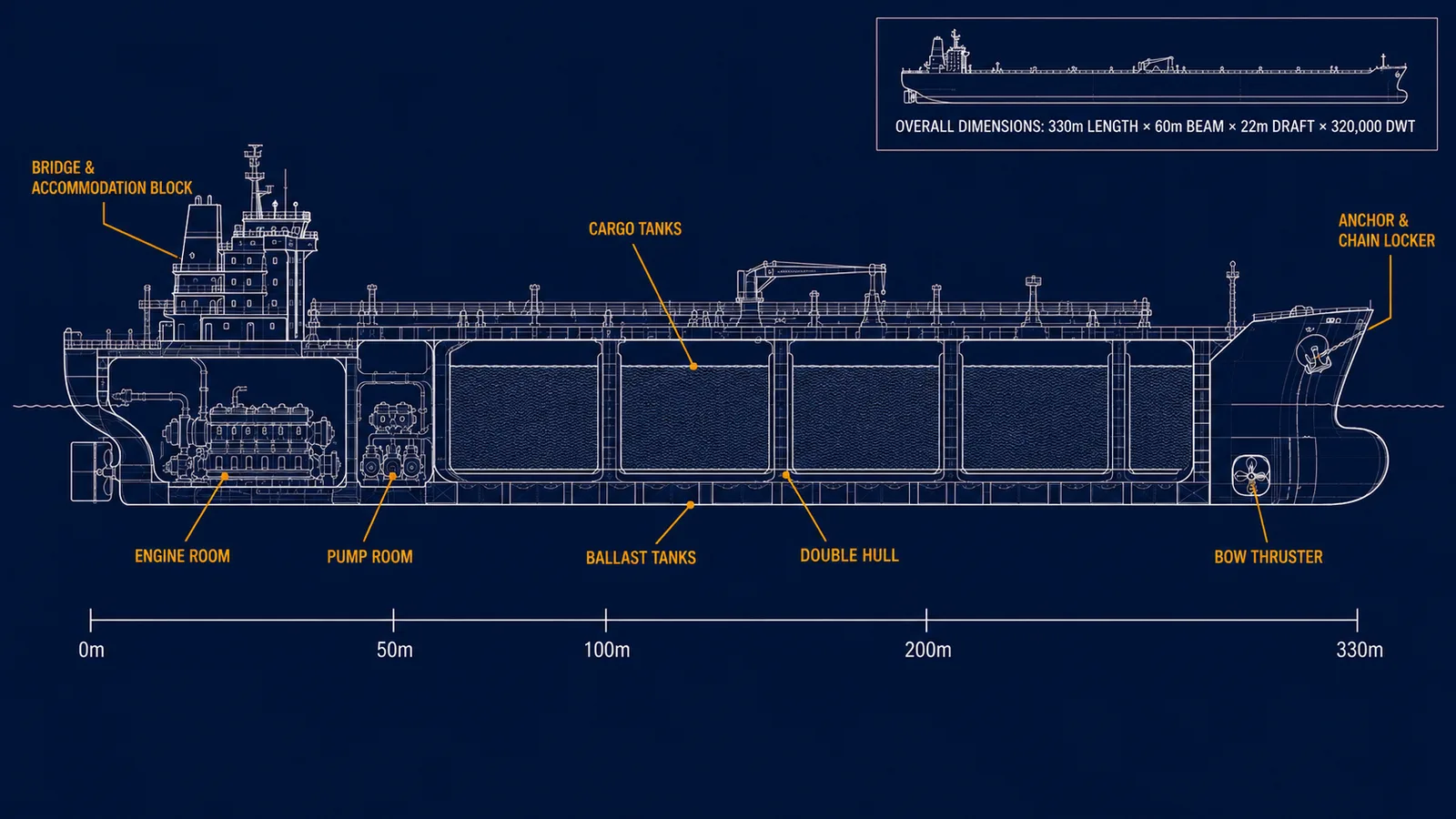
ULCC — Ultra Large Crude Carrier — refers to tankers over 320,000 DWT. The largest ULCCs ever built reached around 550,000 DWT, though only a handful of those exist today.
A ULCC is enormous. Some are over 380 meters long — close to the length of four soccer fields placed end to end. They can carry 3 million barrels of crude in a single voyage. That's enough crude to supply the entire United States for roughly three to four hours, or about two weeks of demand for a country the size of Norway.
The problem with ULCCs is that almost no port can handle them. Their draft — often over 24 meters when fully loaded — exceeds the depth available at most fixed terminals. ULCCs typically load and discharge at offshore single-point mooring buoys, where a hose connects from the ship to a subsea pipeline running to shore. That arrangement adds complexity and limits which terminals can serve them at all.
Because of these access constraints, ULCCs are commercially less flexible than VLCCs. They make sense when cargo volumes are enormous, both terminals can handle them, and the per-barrel cost savings are worth the operational complexity. In most other cases, owners prefer VLCCs. As a result, the global ULCC fleet has shrunk over the last two decades. Most new orders for large crude carriers today are VLCCs, not ULCCs.
One Note on Product Tankers
Everything above describes mostly crude tankers — ships that move unrefined oil from production regions to refineries. But a significant share of tanker movements involves refined products: gasoline, diesel, jet fuel, naphtha, fuel oil. These move on product tankers, which use similar size categories but with different operational details.
You'll see them labeled MR (Medium Range, 25,000-55,000 DWT), LR1 (Long Range 1, 55,000-80,000 DWT), and LR2 (Long Range 2, 80,000-160,000 DWT). LR2 product tankers overlap in DWT range with Aframax crude tankers — sometimes the same physical ship can switch between the two depending on whether it's been cleaned and certified for product cargo.
Product tankers have segregated cargo tanks, often with internal coatings (zinc silicate or epoxy) to prevent contamination between different refined products. A clean Aframax-sized product tanker might carry diesel one voyage and jet fuel the next, with cleaning between cargoes.
The distinction matters for trade analysis. When freight indices like the BCTI (Baltic Clean Tanker Index) move, they're tracking product tanker rates — which respond to refining margins, gasoline demand, and seasonal patterns, not the same drivers that move VLCC crude rates.
Why the Names Persist
There's a small irony in tanker classifications: many of them are named after physical constraints that have changed.
Panamax tankers are named for canal locks that were superseded in 2016. The new locks accommodate ships well over 100,000 DWT, but we still call those larger ships “New Panamax” rather than rolling the size up into Aframax. Suezmax tankers can transit a canal that has been deepened beyond the class's original draft limits. Aframax tankers are named for a Shell freight assessment system that hasn't been used in its original form for decades.
The names persist because chartering desks, brokers, and the trade press use them as shorthand for a particular operational profile: how much cargo it carries, where it can go, what it usually does. A new name would require relearning a set of associations that everyone in the industry already understands. So the names stay, even as the underlying constraints shift.
If a port can take an Aframax, that means something to a chartering desk regardless of whether the AFRA freight assessment still exists. If a tanker is Suezmax, every broker knows what routes it can sail. The labels have outlived the original constraints, but they remain useful enough that the market keeps them.
Reading the News With This in Mind
When a news article mentions a specific tanker class, the class is doing work in the sentence — telling you something about the route, the cargo, and often the kind of story being told.
A headline about VLCCs is almost always about long-haul crude. A story about Suezmax rates is usually about Atlantic Basin or West Africa to Asia trades. An Aframax move points to regional crude or product trade — often Mediterranean, North Sea, US Gulf, or Asia coastal. ULCC headlines are rare and usually relate to specific large cargoes or unusual storage situations.
When the same story uses the generic word “tanker,” check the context. If the figure quoted is in millions of barrels, you're looking at a VLCC. If it's in hundreds of thousands, probably Aframax or Suezmax. If the route mentioned passes through the Suez Canal at full load, it's Suezmax or smaller.
Once you know what the labels mean, a tanker headline tells you much more than it seems to.
The 30-Second Version
- Tankers are sorted by deadweight tonnage (DWT) — how much weight they can carry — into named size classes.
- MR (25-55k), LR1 / Panamax (50-80k), Aframax (80-120k), Suezmax (120-200k), VLCC (200-320k), ULCC (320k+).
- Most size names encode a physical constraint: Panamax (Panama Canal locks), Suezmax (Suez Canal depth), Aframax (a freight-rate assessment from the 1950s).
- VLCC is the headline tanker — the workhorse of Middle East to Asia crude. Most “tanker market” shorthand is really VLCC market.
- The size class tells you the route, the cargo type, and roughly what story is being told.
Closing
Tanker size classes are one of those bits of industry shorthand that look forbidding from the outside and turn out to be straightforward once you see the logic. They encode physical constraints — canal locks, port depths, route economics — and they organize a fleet of thousands of ships into a handful of operational categories.
Most maritime headlines you read mention a class by name, and the class is doing work. Knowing whether you're reading about a VLCC or an Aframax tells you which trade lane is moving, which freight index is responding, and roughly how much oil is at stake.
The same naming logic runs through every other cargo type. Dry cargo follows it in bulk carrier sizes, gas follows it in LNG and LPG carrier classes, and boxes follow it in container ship sizes — in each case the name records a canal, a port or a strait rather than the cargo.
The next time you see “VLCC rates surge” or “Suezmax tanker attacked” in a headline, you'll already know more than the headline says.
Sources
- Suez Canal Authority — rules of navigation and the maximum permitted draught for laden transit
- Autoridad del Canal de Panamá — published lock dimensions for the original and Neopanamax chambers
- London Tanker Brokers’ Panel — the Average Freight Rate Assessment scale and its size bands
- Baltic Exchange — tanker route definitions and the vessel size each route is assessed on