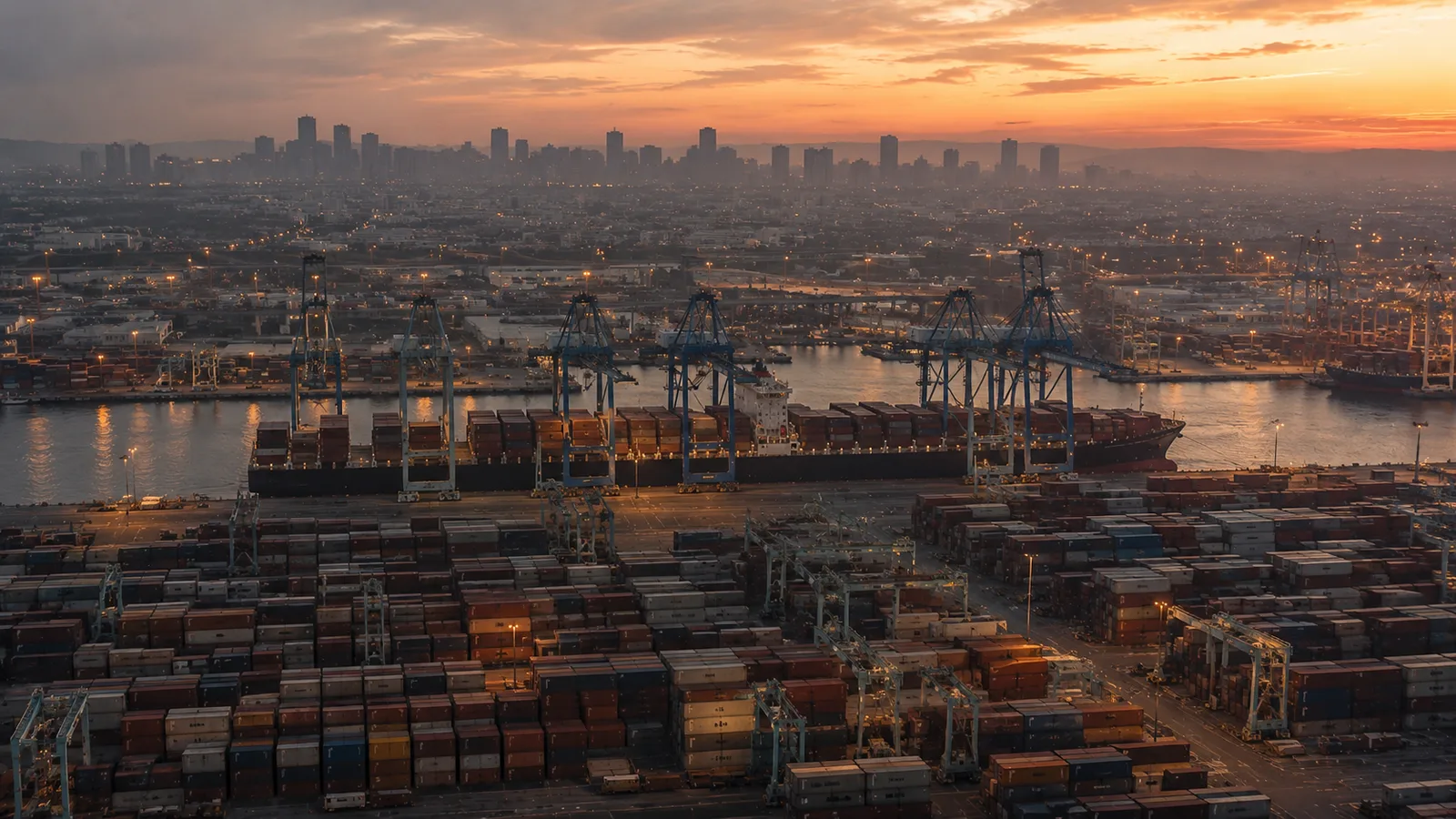
If you've been waiting for the next iPhone, here's something strange to consider. The price you pay later this year might be shaped less by what's inside the phone, and more by which ship carried the parts.
That sounds odd. Let's see why it's true.
In October 2025, the United States started charging a new fee on certain ships calling at American ports. The fee got bigger on April 17, 2026. We're now about a month into the new, higher version, and the shipping industry is still figuring out what to do — with the answers quietly showing up in prices.
What the fee actually is
The U.S. Trade Representative (USTR) — the government office in charge of trade policy — decided that China had grown too dominant in shipbuilding. China builds roughly 70% of new commercial ships ordered globally. The U.S. builds almost none.
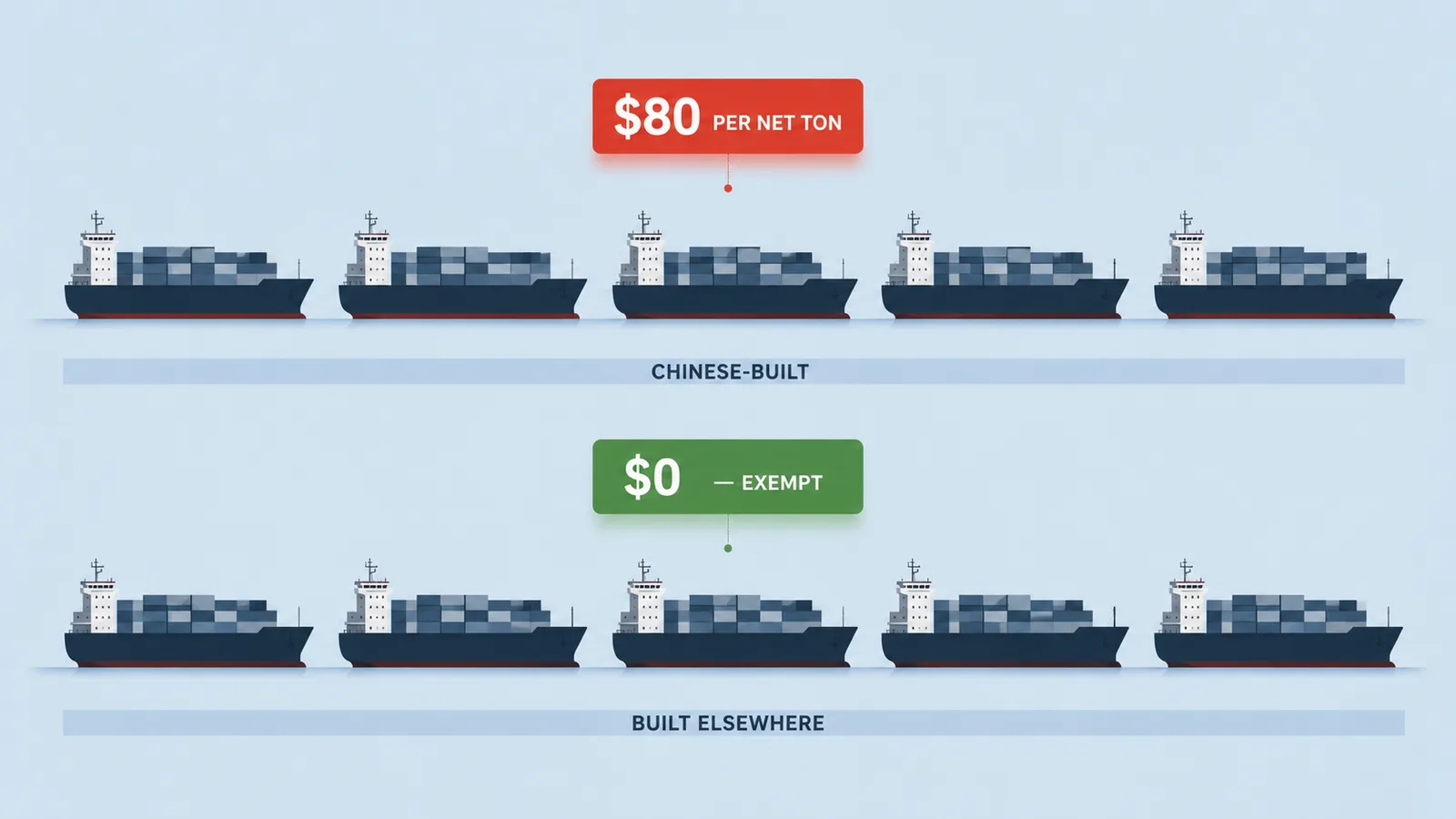
So Washington introduced a fee on Chinese-built or Chinese-operated ships when they enter U.S. ports.
Here's the part most people miss: this isn't a tariff on goods. It's a fee on the vessel itself — not the cargo inside it. A 100,000-ton container ship calling at Los Angeles is now liable for a fee just for showing up. Whether it's carrying phones, sneakers, or industrial equipment doesn't matter.
The rates are scheduled to rise every year:
- October 14, 2025: $80 per net ton (NT) of the vessel
- April 17, 2026: $140 per NT (the current rate)
- April 17, 2027: $110 per NT
- April 17, 2028: $140 per NT
For a single large Chinese-operated container ship, the fees under today's framework can theoretically run into the millions of dollars per U.S. voyage — significantly higher than a year ago, and on track to keep climbing. Exact exposure depends on tonnage, ownership structure, and how many U.S. calls a vessel makes per year (the fee is capped at five times annually per ship).
Think of it a bit like a city introducing a congestion charge in its downtown. The fee itself matters. But the bigger effect is how everyone quietly changes their route to avoid it.
Why this matters to a smartphone buyer
Phones aren't built on one ship. The parts come from a sprawl of factories — chips from Taiwan, screens and components from across East and Southeast Asia, batteries from China, final assembly often in China or India. Most of those finished phones cross the Pacific in container ships. Many of those container ships are Chinese-built. Some are Chinese-operated.
When the fee hits those ships, it doesn't vanish into thin air. Carriers — the companies that own and run the ships — pass it down the chain. The cost lands on the importer first (Apple, Samsung, Walmart, every brand). The importer then has a choice: absorb it, or add it to the sticker price.
How much are we talking about? According to the World Shipping Council, a trade group that represents most major carriers, the fees could add $600 to $800 per container entering the U.S. in its submissions to U.S. regulators. A standard 40-foot container can hold roughly 1,500 phones. That works out to less than a dollar per phone in pure fee terms.
A dollar. That's it.
So why does this matter?
Because the cost doesn't stop at the fee itself. The bigger story is what carriers are doing to avoid the fee — and those workarounds are quietly reshaping everything that moves on a ship.
The workarounds (where the real cost lives)
HSBC analysts have warned that the fees could consume a large share of projected 2026 profits for some major Chinese carriers. Faced with that pressure, shipping companies are making three moves at once.
One: deploying non-Chinese-built ships on U.S. routes. Maersk and Hapag-Lloyd, two of the world's largest carriers, are quietly redeploying vessels built outside China onto their transpacific lanes. Those ships don't trigger the fee. But shipyards outside China have limited capacity and charge more per vessel — so the supply gets tighter, and freight rates inch up.
Two: reducing direct U.S. port calls on some routes. A ship from Asia might unload in Vancouver or in Mexican ports like Lázaro Cárdenas, with goods then moving south by truck or rail across the border. Same destination, longer journey, more handling fees, more delays. Somewhere this month, a container of consumer electronics is being unloaded in Vancouver instead of Los Angeles — not because Canada was the destination, but because the math changed halfway across the Pacific.
Three: restructuring corporate ownership. A handful of carriers are reorganizing their company structures so their ships technically don't count as “Chinese-operated” anymore. This is the most expensive option in legal fees and the least visible to consumers — but it's happening.
None of these changes are free. Extra handling tends to slow things down, longer routes burn more fuel, and ownership restructuring is the kind of legal work that takes months. None of it shows up on a receipt that says “USTR fee: $0.78.” It shows up as a quietly higher price tag at the end of the year.
The numbers nobody talks about
Here's a comparison worth holding onto.
Before October 2025, the total annual U.S. port-related charges a typical container ship paid — pilotage, dockage, tonnage tax, the whole list — usually added up to a few hundred thousand dollars per year. Under the new framework, a single Chinese-operated vessel making its capped five U.S. calls can be liable for fees an order of magnitude larger than everything else combined.
When a single line item moves by that much, the system doesn't simply absorb it. Networks shift. That's what's happening right now, in May 2026, in real time.
So is the iPhone actually going to cost more?
Honestly? Probably a little. But not because of the fee itself.
The direct fee per phone — under a dollar — is too small to notice. The real pressure comes from everything around it: tighter ship supply, longer routes, higher freight rates, insurance repricing, and the slow drag of a global shipping network rerouting itself to avoid a single line in a U.S. trade rule.
Analysts expect transpacific container freight rates to stay 10–15% above where they would have been without the fee. Apple, like every other importer, will have a choice to make on the next product cycle: shrink the margin, or nudge the price. Usually, the answer is somewhere in between.
So your next iPhone might cost $10 or $20 more than it otherwise would have — not because of the fee, but because of the world the fee created.
We track the freight-rate side of this story on the data hub, where the relevant indices update with each significant move.
The 30-second version
- The U.S. charges fees on Chinese-built and Chinese-operated ships entering U.S. ports.
- The rate jumped from $80 to $140 per net ton on April 17, 2026.
- A single large vessel can now face fees running into the millions per U.S. voyage.
- Carriers are responding by deploying non-Chinese ships, reducing direct U.S. calls, or restructuring ownership.
- The direct cost per imported product is small — but the workarounds keep freight rates elevated.
- Expect transpacific container rates to stay roughly 10–15% higher than they would be otherwise, for the rest of 2026.
One honest thing
What started as what looked like a negotiation tool — pressure goes up, then eventually comes back down once China concedes something — has begun to look more like a long-term redesign of the shipping system instead.
Nobody at USTR is sitting in a room waiting for the rate to be rolled back. Shipyards outside China are picking up orders. Mexican ports are adding capacity. Ownership structures are being redrawn. In a few years, this will just look like “how shipping works.” But right now, in May 2026, we can still see the seams.
Whether that's worth the cost — to importers, to consumers, to the carriers caught in between — depends on who you ask. And what you're shopping for.