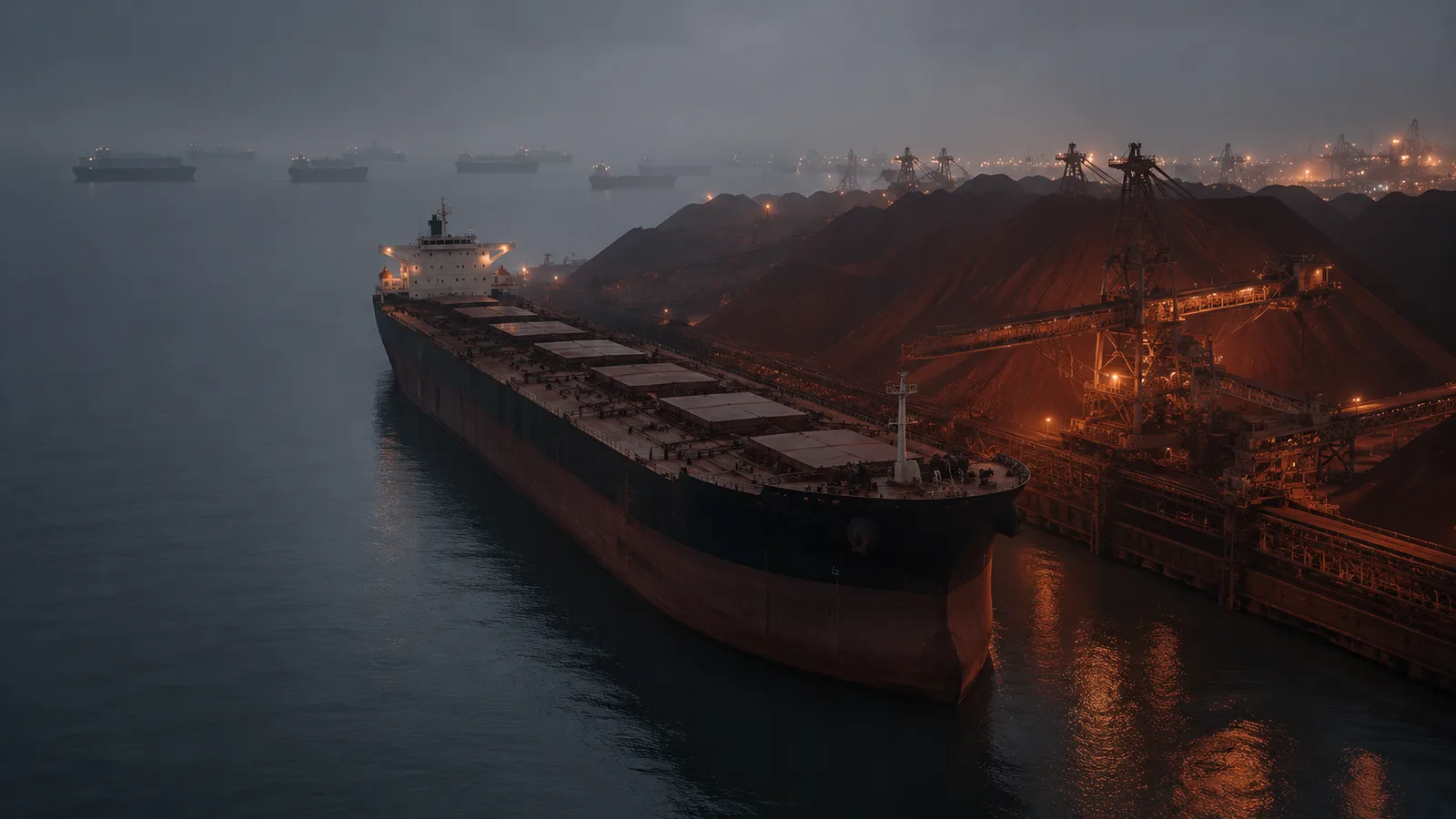
The Baltic Dry Index closed at 3,189 on Wednesday, May 13 — the highest reading since November 2023, up 19% over three trading sessions. The Capesize sub-index pulled the move, rising from 4,356 to 5,340 over the same window. Spot Capesize TCE earnings cleared $44,000 per day. By Thursday, the cocktail-version of the story was already in wide circulation: Hormuz friction was finally cascading into dry bulk.
It is the natural explanation. It is also, mostly, wrong.
The Easy Story, and Where It Breaks
A pattern has held in maritime commentary since late February. Whenever a freight index moves more than five percent in a session, the first cause cited is Hormuz. The reasoning is intuitive — supply-side shocks usually radiate outward — and through April the framing fit the tanker market well enough that it became reflex.
For dry bulk, the framing does not hold up to a fundamentals check.
The Strait of Hormuz, in iron ore terms, is small. According to BIMCO's most recent shipping analysis, vessels transiting Hormuz account for approximately 2% of global iron ore tonne-mile demand. Oman, just outside the strait, adds another 2%. The remaining 96% comes from Australia (the dominant supplier), Brazil, South Africa, and now Guinea — none of which touch the Persian Gulf on the loaded leg. A complete closure of the strait, holding all else equal, would withdraw roughly 4% of Capesize tonne-mile demand. The recent move added closer to 22%.
The numbers do not match. The story has to come from somewhere else.
Iron, on Its Own Terms
Iron ore was a story before Hormuz was a story.
Through the first quarter of 2026, global iron ore shipments rose roughly 5% year on year, supported by Chinese import demand. That is unusual on its own, because the same quarter saw Chinese steel production fall by about 4%. The gap — more ore arriving than steel mills could consume in real time — went into portside inventories, which reached a record 179.5 million tons in mid-March, according to BIMCO data citing Chinese trade reporting. Imports of that size, sustained for a quarter, are what Capesize freight rates are built to price.

By May, three additional currents had reinforced the move. Iron ore spot prices climbed to their highest level since October 2024 — Breakwave Advisors flagged the print in its May 12 dry bulk note, citing stronger steel mill demand. Steel mill profitability in China hit an 8-month high. And Simandou — the long-delayed Guinea iron ore project, three decades in development — began its first commercial shipments to China, with Rio Tinto guiding to 5–10 million tonnes for 2026.
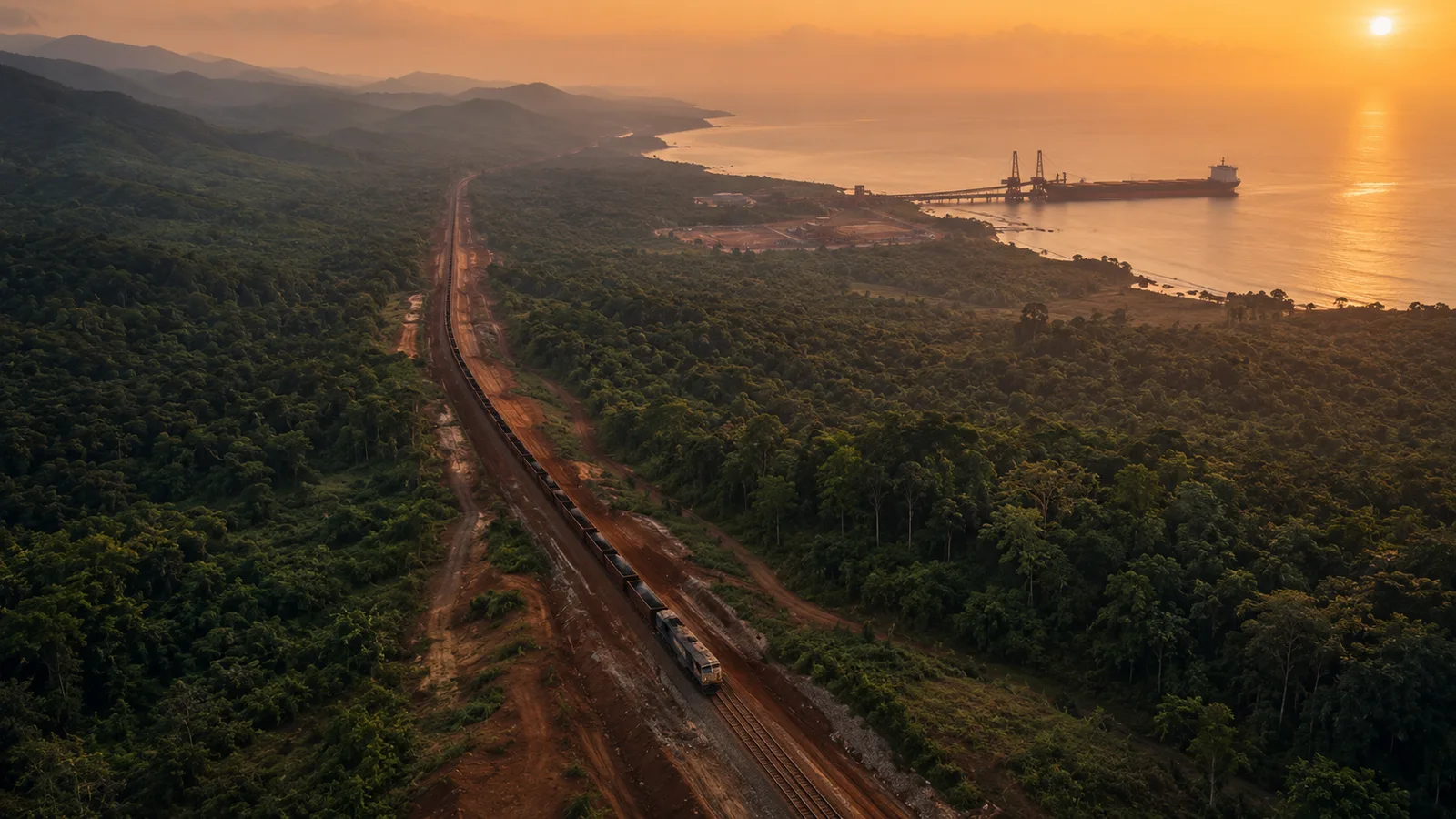
The Simandou point is where the tonne-mile story gets specific. Guinea to North China is roughly 12,000 nautical miles via Cape of Good Hope routing — longer than the Australia-China benchmark and broadly comparable to the Brazil-China haul. Every Simandou cargo absorbs more Capesize time than an equivalent Australian cargo would. Forty million tonnes of Guinea ore, which is BIMCO's expectation for 2026 at full ramp, generates substantially more tonne-mile demand than the same tonnage from Pilbara. That is not a Hormuz effect. That is a structural addition to the demand side of the Capesize equation, scheduled for 2026 since long before February.
What the Desk Was Actually Talking About
Several chartering desks this week described the same pattern: physical fixtures clearing above internal Q2 models, while the macro commentary still framed the move through Hormuz. The desk conversations were running on different variables — Vale loading schedules, Simandou's June arrival cadence, ballaster counts in the South Atlantic, whether Qingdao port inventories would absorb another month at current volumes. The strait did not come up. It would not have helped if it had.
The operational market and the headline market are not reading the same thing right now. The freight clears on its own physics — supply tightness, ballaster counts, mine schedules, port congestion. The headline cause, when it comes, is fitted afterward.
Why the Misread Matters
Reading a Capesize spike as a Hormuz effect leads to two mistakes operators may not realize they are making.
The first is on duration. Hormuz is event-driven. It can reverse on a diplomatic breakthrough. Iron ore demand structures are inventory-driven and mine-driven. They move on multi-quarter cycles. An operator who books Q3 capacity expecting the strait to “normalize the curve” is positioning for a reversal that the underlying demand does not support. The Baltic FFA forward curve for Q3 Capesize, as of mid-week, was pricing only modest softening from current spot levels — a position more consistent with the iron ore reading than with a temporary Hormuz spike.
The second is on hedging. Hormuz-linked freight hedges sit in different instruments than dry bulk hedges. A charterer with iron ore exposure who reads the move as Hormuz-driven may underweight Capesize FFA cover relative to actual position risk. The exposure is real, but it is not where the framing puts it.
Breakwave Advisors' May 12 note flagged the same divergence between sentiment and fundamentals — iron ore volumes running some 4% above last year's levels supporting the current strength, with Hormuz noted as a macroeconomic risk to the Asian demand picture rather than a direct driver of freight.
What Would Actually Move This
Three signals matter more than the strait, for the next 60 days of Capesize pricing.
Chinese portside iron ore inventory. The record 179.5 million tons figure is the ceiling. If port stocks draw down through May and June, mill consumption is finally catching up and the freight rally has fundamental room to extend. If they hold or build further, the rally is running ahead of physical consumption and is exposed to a steel-side reset.
Simandou ramp-up cadence. Rio Tinto's 5–10 million tonne guidance for 2026 is a range, not a forecast. The high end depends on rail and port commissioning that has slipped before. Every month of delay reduces 2026 Guinea-to-China tonne-mile demand by roughly the same proportion. The market is currently pricing closer to the optimistic case.
Vale's quarterly guidance. Brazil's tonne-mile profile per ton is roughly comparable to Guinea's, and Vale's 2026 production guidance — cut in December from earlier expectations — was the demand-side caveat the market mostly chose not to focus on. A revision in the next earnings cycle would move the Capesize forward curve more than a Hormuz headline.
None of these is in the day-to-day flow of energy and geopolitics. All of them sit closer to the actual freight than the strait does.
Two Markets, One Reading Habit
The TD3C tanker index has its own version of this problem in a different direction. The number prints daily on a route that is not being sailed, and the contracts that reference it settle as if it were. The dry bulk version is the inverse — a real route, a real spike, and a misattributed cause. In both cases the distance is between what the market is told about the number and what the number is actually doing.
Indexes do not lie. They report what their methodology measures, on the routes their panellists assess. The distortion, when there is one, is usually in the explanation that travels alongside the number — the explanation that lets a charterer not look at the iron ore inventory chart because the cable news version of the morning already explained the move.
This week's BDI is not a Hormuz spike. It is an iron ore market doing what iron ore markets do when Chinese inventories sit at record highs, Guinea ships its first cargoes, and a new mining cycle begins to fold into the freight curve. The operator who positions for a Q3 reversal on the assumption that the strait reopens is positioning against the wrong variable.
Closing
Hormuz is a real story. It is the dominant story for tanker freight, for crude pricing, for war risk insurance, for the structural cost stack across most of the maritime industry. It is just not, this week, the story for Capesize.
The reading that matters for the next sixty days of dry bulk is much duller. Port inventories at Qingdao. Rail commissioning timelines in Guinea. Steel mill margins in Hebei. None of those make a headline. All of them are pricing the freight.