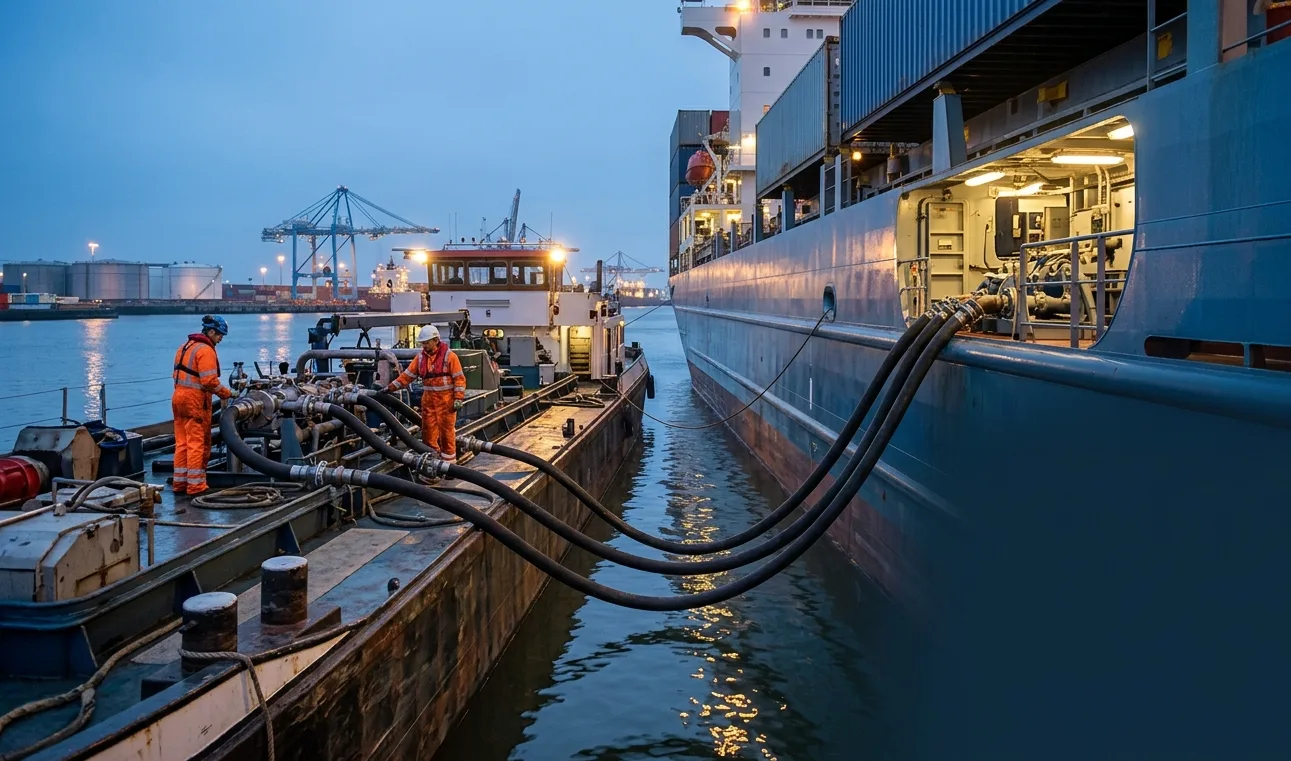
VLSFO prices jumped sharply in early May 2026. Singapore VLSFO moved from $778/mt to $862/mt in roughly a week — a 10.8% rise — while Rotterdam, Fujairah, and Houston followed similar trajectories. With Asian premiums widening relative to other regional benchmarks, operators are facing pressure to bunker wherever fuel is available, often switching suppliers and ports more frequently than usual. That pattern surfaces one of the largest hidden costs in marine fuel operations: the cost of incompatible blends. VLSFO is not one fuel. It is a family of blends with chemistries that vary widely between suppliers and ports. Mix two incompatible batches in the same tank and you can get filter blockages, purifier overload, and — in severe cases — scavenge fires or engine damage running into six or seven figures, none of which appears in the bunker price quote. This is how the hidden cost works, what to watch for, and what a disciplined fuel management process looks like in 2026.
Why VLSFO Is Different — And Why That Matters
Before the IMO 2020 sulphur cap, the global bunker market ran on two relatively well-understood fuels: HSFO (high-sulphur fuel oil, ~3.5% S) and MGO (marine gas oil, distillate). Compared with today's VLSFO environment, pre-IMO 2020 residual fuel markets were generally more standardised and operationally more predictable — though they were never free of quality disputes, cat fines incidents, or off-spec deliveries. VLSFO introduced a step-change in chemistry variability on top of those existing concerns. To meet the 0.5% sulphur cap without scrubbers, refiners produce VLSFO by blending lower-sulphur residual streams with distillate cutter stocks, often supplemented with low-sulphur components from a wide variety of crude sources. The resulting fuel meets the sulphur specification — but its chemistry can vary substantially between batches, between suppliers, and between ports.
The four chemical components of any residual fuel oil that matter here are saturates, aromatics, resins, and asphaltenes. A stable fuel keeps these in balance, with asphaltenes held in suspension by the surrounding aromatic and resin matrix. Mix two fuels whose component balances are different, and that suspension can break. Asphaltenes precipitate out as a sticky black sludge — sometimes called "asphaltene drop-out" or "flocculation" — that blocks filters, overwhelms purifiers, and in the worst cases reaches the injector and combustion chamber. The fuel was on-spec at the bunker delivery. The fuel was on-spec when tested. But once mixed in the ship's tank with what was already there, it became a problem.
The Five Trouble Patterns Operators See Most Often
Industry technical bulletins from VPS, Van Ameyde Marine, classification societies, and fuel testing laboratories consistently identify the same recurring failure modes. The table below summarises six common VLSFO trouble patterns, what causes them, and what they cost when they happen. Note that stability (degradation within a single fuel batch) and compatibility (problems arising when two different batches are mixed) are distinct mechanisms; treating them separately is standard practice in marine fuel management.
| Pattern | Mechanism | Symptoms | Typical Cost |
|---|---|---|---|
| 1. Stability (single-fuel) | Asphaltene precipitation in a single batch under thermal/storage stress over time | Sludge build-up in tank bottoms, gradual purifier load increase | Tank cleaning, additional purifier maintenance |
| 2. Compatibility (co-mingling) | Asphaltene drop-out when two on-spec batches with different chemistries are mixed in tanks | Rapid purifier overload, filter clogging, sticky tank residue | Filter changes, deep tank cleaning, possible voyage delay |
| 3. Cold Flow / Wax | High Wax Appearance Temperature (WAT) blends solidify in cold tanks/lines | Pumping failure, line blockage, heater overload | Tank reheating, line flushing, schedule disruption |
| 4. Cat Fines | Aluminium-silicate particles from refinery FCC catalyst exceed engine spec | Cylinder liner scuffing, fuel pump & injector wear | Six-figure engine damage in severe cases |
| 5. Reduced Lubricity | Low-sulphur fuel + low-BN cylinder oil interaction | Accelerated injector / fuel pump wear, scuffing risk | Earlier component replacement, increased maintenance |
| 6. Combustion Variability | Inconsistent calorific value & ignition properties between blends | Higher fuel consumption, unstable engine load, scavenge fire risk | Reduced efficiency, potential scavenge box damage |
Among these six, compatibility (mechanism #2) is the most operationally impactful in 2026 because it is the one most likely to arise from operator decisions rather than supplier negligence. A vessel can take on perfectly on-spec VLSFO from two different ports, and the act of co-mingling them in the same tank can create a problem that neither batch caused alone. This is what makes 2026 different from the 2020 wave of VLSFO quality disputes: now both batches can pass laboratory analysis on their own, and the problem only emerges from the mixture. Van Ameyde Marine reported handling more than 60 VLSFO-related quality disputes in 2020, the first year of the IMO sulphur cap; the underlying chemistry challenges that drove those cases have not gone away.
The Hidden Cost Stack — What the Bunker Invoice Doesn't Show
When operators benchmark fuel decisions, the comparison usually centres on the per-tonne price quoted at delivery. That misses most of the actual cost. A single VLSFO compatibility incident on a bulk carrier or container vessel can stack the following costs on top of the invoice — none of which appear in the bunker quote.
The math is uncomfortable. A ship operator who saves $30/mt on a 1,200-mt bunker stem captures $36,000 in apparent savings. A single severe compatibility incident on the same voyage can erase that saving many times over once filter and purifier intervention, tank cleaning, voyage delay, and any consequential engine damage are added up. This is why bunker procurement decisions cannot be made on price alone in 2026 — and why the discipline of fuel management has become a meaningful competitive variable between operators.

The Compatibility Decision: A Framework
When a ship is bunkering at a new port or from a new supplier, the question is rarely "is this VLSFO on-spec?" — that is what the bunker delivery note attests to. The harder question is "is this VLSFO compatible with what is already in our tank?" The decision framework below reflects standard practice as taught in marine engineering courses and as recommended by classification societies and major fuel testing labs.
Why 2026 Is Different — And Why the Risk Is Rising
Three factors specific to 2026 are amplifying compatibility risk relative to the 2020-2024 baseline period.
First, regional price divergence is unusually wide. As of early May 2026, the Singapore VLSFO benchmark sits around $862/mt while Rotterdam is around $843/mt according to Ship & Bunker — a roughly $19/mt premium that has moved through wider spreads earlier in the conflict period. When regional prices move out of line, operators rationally chase the spread — bunkering opportunistically rather than from established relationships. Each new supplier is a new compatibility unknown.
Second, the Hormuz crisis since February 2026 has disrupted normal Gulf bunker flows. Fujairah, historically one of the most reliable bunker hubs, has seen volume disruptions and supplier changes through the conflict period. Vessels that would normally bunker at Fujairah have rerouted to Singapore, Salalah, Sohar, or Sri Lankan ports — each with its own blend recipes and its own compatibility profile against the previous Fujairah stem.
Third, the bio-blend transition is accelerating. B24 (24% biofuel) and B30 (30% biofuel) blends are now common in Singapore and Rotterdam respectively. Biofuels add a new compatibility dimension on top of the existing residual chemistry questions. UCOME (used cooking oil methyl ester), the most common biocomponent, has different stability behaviour than petroleum-derived blendstocks. Mixing a bio-VLSFO with a conventional VLSFO from a different port introduces an additional layer of compatibility uncertainty on top of the existing residual chemistry concerns.

Quality Dispute Mechanics — When the Fuel Has Already Caused the Damage
When a compatibility event has already occurred and engine damage or operational disruption is in progress, the legal and commercial framework is well-established but moves slowly. The standard reference document is the BIMCO Bunker Terms 2018 (or equivalent contractual provisions in the bunker supply contract). Three operational points matter for voyage planners.
The retained MARPOL sample is the primary evidence base for any dispute. Without it, claims are extremely difficult to substantiate. Ship's officers should treat sampling discipline as a non-negotiable procedure regardless of time pressure during bunkering operations. Second, dispute notification has time limits — typically 14 to 30 days from delivery — and missing the window can extinguish the right to claim regardless of merit. Third, the burden of proof in arbitration generally rests on the claimant (the buyer/operator) to demonstrate that the supplied fuel was off-spec or incompatible. This is why the spot test and laboratory analysis chain matters: contemporaneous evidence outweighs after-the-fact technical argument.
For voyage planners, the practical implication is straightforward. Build the sampling and testing discipline into bunker SOPs as a mandatory step rather than a nice-to-have. The cost of doing it consistently is small. The cost of needing to dispute a fuel quality issue without it can run to the upper end of the hidden cost stack.
What Disciplined Operators Are Doing Differently
- Maintain a preferred-supplier list with documented quality history. Switching suppliers under price pressure is acceptable; switching to an unknown supplier without enhanced testing is not.
- Run ISO 8217 + GCMS-VOC analysis on every stem from a new supplier or port for at least the first three deliveries. Establish a baseline before normalising the testing burden.
- Treat the spot compatibility test as mandatory before commingling new fuel with existing tank fuel. The test takes minutes and costs effectively nothing relative to the downside.
- Use tank segregation deliberately. Modern vessels have multiple service and settling tanks. Use them as a buffer when the supply situation is volatile rather than treating segregation as an inconvenience.
- Update bunker procurement policy weekly during periods of price divergence. The Hormuz crisis and the Asian premium widening are both 2026 phenomena that will not be reflected in 2024-vintage SOPs.
- Build in cylinder oil compatibility as part of fuel switch decisions. Low-BN oils with low-sulphur fuels carry their own risk profile; the optimal pairing is not always obvious.
- For chartered vessels, confirm responsibility for fuel quality issues in the charter party. Ambiguity here is expensive when a dispute arises.
The Bigger Picture: Fuel Quality Is a Competitive Variable
Marine fuel has historically been treated as a commodity input — a line item to minimise on cost. The shift since IMO 2020, accelerated through 2026 by the regional price divergence and the Hormuz crisis, is making fuel quality management itself a meaningful operational discipline. Operators who run rigorous bunker procurement, sampling, and compatibility testing programmes are systematically capturing margin that less-disciplined competitors are giving back to their engine manufacturers. The discipline does not show up in the fuel invoice; it shows up in the maintenance budget, in the off-hire days, and in the dispute resolution column of the year-end review.
For 2026, the simple version of the message is this: the per-tonne price on the bunker quote is the smaller part of fuel cost. The larger part is in what happens to the engine over the next 30 days as a result of the decision. Operators who internalise that — and build the SOP discipline that reflects it — are the ones who will navigate the volatility window of the next year with intact margins.
Reading List
For a related case of a market benchmark diverging from the physical market it prices, under the same disruption, see The Index That Doesn't Exist: What TD3C Is Really Measuring. For the bunker-specific price context, see Bunker Fuel Prices 2026: What's Driving the Volatility. For the geopolitical drivers behind the Asian bunker premium, see HMM Namu Caught Fire in Hormuz and War Risk Insurance: The Hidden Cost That's Closing Today's Shipping Map.
Live VLSFO, MGO, and HSFO prices across Singapore, Rotterdam, Fujairah, Houston, and other major ports — plus 12-month price history charts — are available on the Maritime Data Hub. For voyage cost modelling that incorporates regional bunker price differentials, use the Ship ETA Calculator.