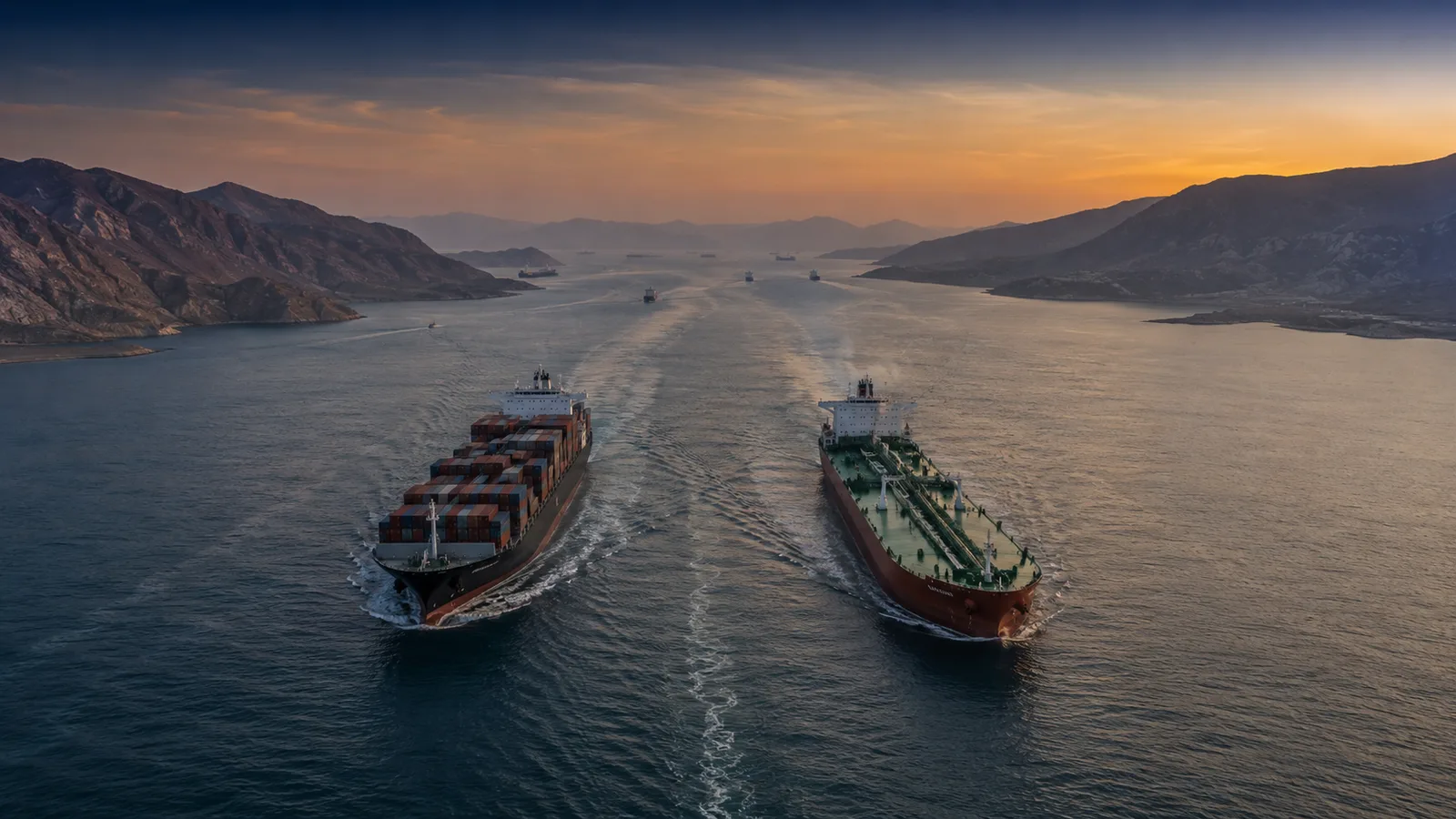
On February 28, 2026, a Very Large Crude Carrier transiting the Strait of Hormuz could typically be insured for a war risk premium of around 0.25% of hull value. Within roughly a week, industry reporting indicated quoted rates had moved into a 1% to 3% range, with individual quotes reaching higher levels for vessels perceived to have heightened risk profiles. For a $150 million tanker, that range translates to a single-transit insurance bill moving from around $375,000 to between $1.5 million and $4.5 million. The vessel did not change. The cargo did not change. The route did not change. What changed was the perceived risk — and the entire structure of marine insurance reprices instantly when that perception shifts. War risk insurance has moved from a fine-print line item to a first-order driver of voyage decisions in 2026. This is how it works, what it costs, and what every voyage planner needs to know.
The Mechanics: Why Insurance Can Close a Strait
It is tempting to think of a maritime chokepoint as being closed only by missiles, mines, or naval blockade. In 2026, an equally important constraint is contractual. When the Lloyd's Market Association's Joint War Committee expanded its Listed Areas in March 2026 to cover a wider span of the Arabian Gulf, Gulf of Oman, and adjacent waters, the immediate consequence was not military. It was insurance-contractual. Annual hull war risk policies are suspended over listed waters. To re-extend coverage for a specific transit, the shipowner must pay an Additional Premium, or AP, calculated as a fraction of hull value.
That AP is not a fixed number. It is renegotiated for each vessel, on each voyage, by each layer of the reinsurance chain. Capacity withdrawn at the treaty level cannot be reinstated by political announcement; it must be rebuilt through individual underwriting decisions. This is why a ceasefire does not immediately reopen the insurance market. It also explains why, when International Group P&I clubs — mutual insurers that collectively cover roughly 90% of the world's ocean-going tonnage — moved to revise war risk arrangements through cancellation notices in early March 2026, the operational effect compounded the impact of the underlying military risk. Without insurance, financiers typically will not allow vessels to sail. Hormuz commercial traffic in early March was effectively constrained by a combination of factors: military risk, owner and charterer judgement, and the rapid repricing decisions made by underwriters in London. Insurance was an accelerator, not the sole cause.
What the Numbers Look Like Right Now
The chart below shows how Strait of Hormuz war risk premiums have moved through the 2026 conflict cycle. Each bar represents the typical Additional Premium quote as a percentage of vessel hull value for a single transit. The figures are drawn from Caixin, Marsh estimates, Insurance Business reporting, and Lloyd's Market Association statements; daily quotes vary by vessel, flag state, ownership, and exact routing.
Concrete translation. For a $100 million Suezmax tanker, a 0.25% pre-conflict transit cost roughly $250,000. At 1% the same transit costs $1 million. At 3%, $3 million. At 5%, $5 million. For a $150 million container vessel — roughly the size of Hapag-Lloyd's mid-sized ships — Marsh's near-term estimate of 25–50% rate hikes translated to single-transit premiums rising from around $375,000 to $750,000. Hapag-Lloyd itself responded by implementing a war risk surcharge of up to $3,500 per container on Gulf-touching shipments. That surcharge is, in effect, the insurance bill being passed through the supply chain.
It Is Not Just Hormuz: The 2026 Risk Map
Hormuz is the most expensive transit in the world right now, but it is not the only listed area where war risk premiums are materially elevated. The map of contested waters has expanded across 2026. Below is a comparison of the major active corridors as of early May 2026.
| Corridor | AP Range | Key Driver |
|---|---|---|
| Strait of Hormuz / Persian Gulf | 1% – 5% | US-Iran exchanges since Feb 28; ongoing |
| Gulf of Oman | 1% – 4% | JWC-listed; spillover risk from Hormuz |
| Red Sea / Bab el-Mandeb | 0.5% – 2% | Houthi attack residual risk; reduced but elevated |
| Black Sea (NW area) | ~1% | Russia-Ukraine conflict; war zone classification persists |
| Singapore Strait | ~0.1% | Re-listed 2025 due to piracy uptick |
| Gulf of Guinea | 0.05% – 0.2% | Persistent piracy / armed robbery |
Two structural points emerge. First, the spread between "normal" (Singapore, Gulf of Guinea) and "active conflict" (Hormuz, Gulf of Oman) is now roughly 30 to 50 times. A decade ago, the spread for comparable corridors was closer to 5 to 10 times. Second, listed areas are sticky. Even when violence subsides, removal from the list is slow, and underwriting capacity does not snap back automatically. The Red Sea war risk premium remained substantially elevated in early 2026 despite a significant reduction in Houthi attacks. Insurers reprice risk faster on the way up than on the way down.

The Real Decision: Insurance Cost vs Routing Cost
For a voyage planner in May 2026, the central question is no longer "is it safe to transit Hormuz." It is "does the insurance premium on the Hormuz route exceed the routing cost of going around the Cape of Good Hope." Below is a worked example for a representative laden VLCC voyage from the Middle East Gulf to the Far East.
The takeaway is striking. At a 2% war risk premium, the Hormuz route and the Cape route cost roughly the same on a per-voyage basis. At 3% or above, the Cape becomes cheaper despite the 21 additional days at sea. This is why the JWC's rate movements have an outsized real-economy effect: they shift the breakeven calculation that voyage planners run every morning.
Three caveats matter. First, the calculation assumes the cargo can wait. For laden voyages with tight delivery windows or contractual penalties, an extra 21 days is rarely costless. Second, freight rates themselves move with the same news that moves war risk premiums. When Hormuz rates spike, charter rates often spike too, partly compensating tanker owners for the elevated insurance. Third, insurance cost is only one piece of the risk. The probability of actual loss — vessel, crew, cargo — is the underlying variable. Even if the insurance premium math favoured Hormuz, no insurer can credibly price an outcome where a vessel is hit.
Who Pays in the End
The chain of pass-through is direct. Shipowner pays the AP. Charterer reimburses under standard charter party clauses (BIMCO's CONWARTIME and similar provisions explicitly allow APs to be charged onto the charterer for war zone voyages). Charterer prices the freight to include the AP. Cargo owner pays the freight. End consumer pays through the price of the underlying commodity — fuel, food, manufactured goods. Hapag-Lloyd's $3,500-per-container war risk surcharge is the most visible example; it sits as a line item on a freight invoice that ultimately resolves into shelf prices and pump prices.
For voyage planning, this means the war risk premium needs to be a first-class line item in the cost model — not an afterthought captured in a generic "insurance" placeholder. In a typical pre-2026 voyage cost model, war risk might have been bundled into a fixed percentage operating cost. In 2026, that approach is structurally wrong: the line moves by orders of magnitude on weekly news cycles. Operators who treat it as a footnote will find themselves systematically under-pricing freight and over-promising delivery dates.
The Master's Refusal Right — And Why It Now Matters
One detail that does not always make the headlines: BIMCO's CONWARTIME and similar charter clauses give the vessel's master a formal right to refuse to proceed into a designated war risk area when the risk to crew and ship is judged too great. In practice the decision is rarely made by the master alone — it is typically a company-backed call, with the owner's safety department, the P&I club, and the charterer's operations team involved in real time. The clause matters because it gives the master legal cover for that joint decision. It has been a quiet feature of charter parties for decades. In 2026 it has become an active operational input: there are reported instances of Gulf voyages being declined under CONWARTIME-style provisions, with charterers unable to compel performance once the safety case has been formally invoked.
For voyage planners, this introduces a non-financial constraint into the cost model. Even when the math favours the chokepoint route, the joint owner-master-P&I judgement may not. Operational planning needs to reflect this. Crew risk appetite, master experience profiles, recent transit history, company safety policy, and charter party clause specifics all become inputs to whether a planned voyage actually happens.
What This Means for Voyage Planning Right Now
- Build war risk premium as a discrete line in the voyage cost model. Update the assumed AP weekly, not monthly. Track at least Hormuz, Gulf of Oman, Red Sea, and Black Sea separately — they move on different drivers.
- Maintain a current copy of the JWC Listed Areas. Listed status changes; what was outside the listed area last quarter may be inside this quarter (Oman waters being a 2026 example).
- For tight delivery windows, model the option value of routing around contested waters even when the per-voyage math favours the chokepoint. The premium-spike scenario is asymmetric: it costs you nothing if it doesn't happen, and it costs you a vessel if it does.
- Charter party negotiation matters more than usual. Confirm CONWARTIME clauses, who pays APs, and what triggers cancellation rights. Standard 2024 templates may not adequately reflect 2026 risk patterns.
- Coordinate with cargo insurers and cargo owners early. Cargo insurance can be cancelled with 48-hour or 7-day notice in many policies; a delivery in transit can find itself uninsured mid-voyage if the JWC reclassifies an area.
- For charter rate negotiation, recognise that the spread between 1-year and 3-year time charter rates has widened. Tanker owners typically prefer to lock in current premium for shorter periods. Charterers prefer the opposite. The negotiating leverage point in 2026 is different from 2024.
The Bigger Picture: Insurance as the Quiet Lever
Step back, and 2026 is teaching the global shipping market a lesson that the 1980s Tanker War already taught the previous generation: marine war risk insurance is not a side market. It is the mechanism through which geopolitical risk is converted into operational reality. The Strait of Hormuz did not close because Iran sealed it militarily. It closed because, in early March 2026, a small group of underwriters in London concluded that the actuarial picture had changed, and a chain of cancellation notices propagated through the global reinsurance system within days. When the ceasefire announcement came, oil prices fell 12% in a single session, but premiums in Lloyd's did not fall in lockstep. The war was over on television. In the underwriting room, it was not.
For shipping professionals, the implication is clear. Voyage planning in 2026 cannot treat insurance as a quietly-priced background variable. It is a moving part of the same magnitude as bunker prices, charter rates, and routing distance — sometimes larger. The operators and planners who will navigate this environment best are those who make insurance pricing as visible in their daily decisions as bunker pricing already is.
Reading List
For the geopolitical context driving these premium movements, see HMM Namu Caught Fire in Hormuz: What Korea's Real Exposure Looks Like and The 2026 Hormuz Crisis and Shipping Route Realignment. The wider map of contested chokepoints is in Global Chokepoints 2026: A Shipping Risk Map.
Live data on bunker prices, freight indices, and cross-route voyage cost comparison is available on the Maritime Data Hub. For modelling the breakeven calculation discussed in this article — Hormuz versus Cape routing on a per-voyage basis — use the Ship ETA Calculator.