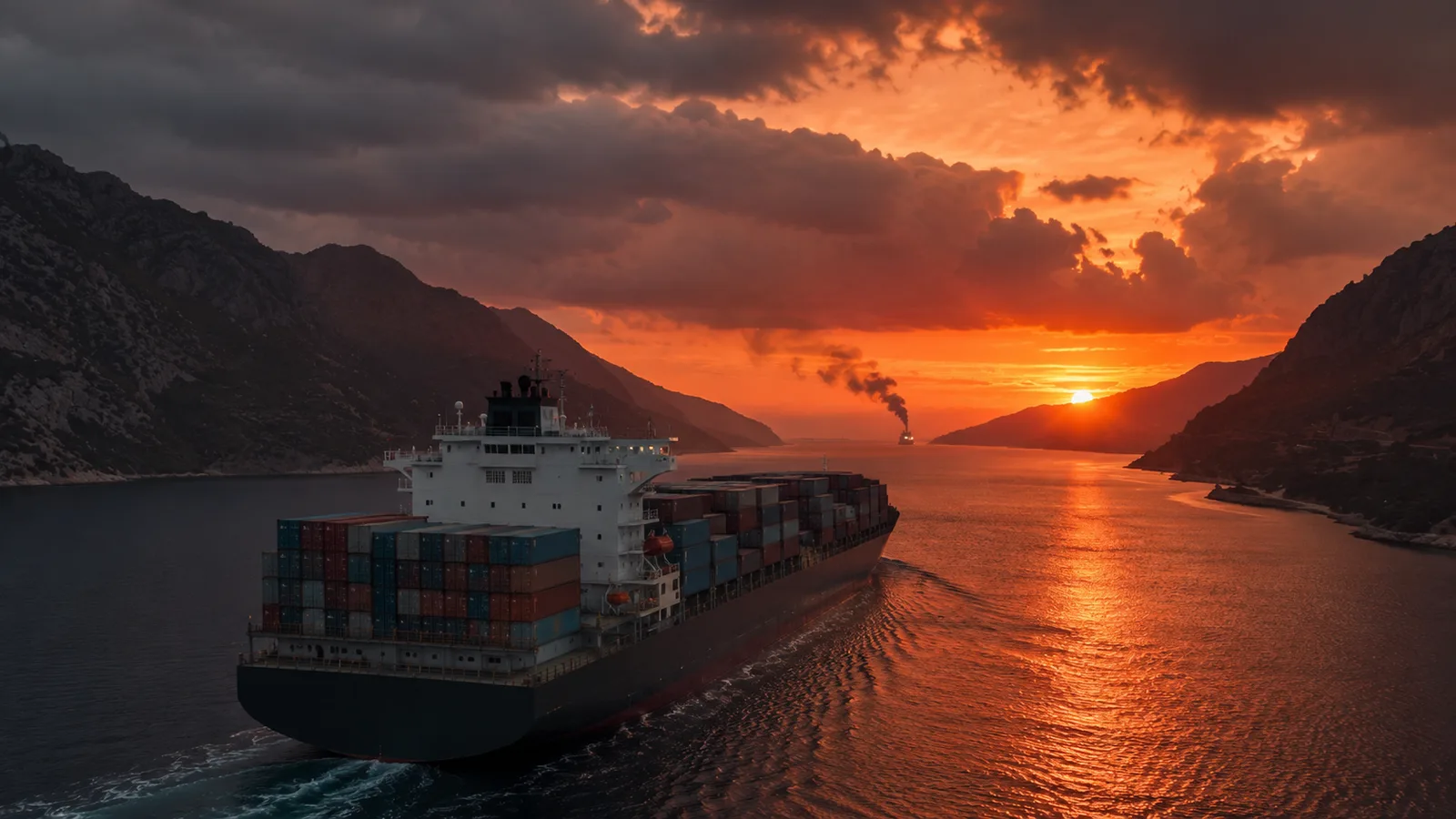
On May 4, 2026, the HMM Namu — a Panama-flagged cargo vessel operated by Korean carrier HMM — suffered an explosion and engine room fire while transiting the Strait of Hormuz. All 24 crew members, including six South Korean nationals, were unharmed. The fire was extinguished. According to South Korea's Ministry of Foreign Affairs, it remains unclear whether the incident was caused by an attack. That careful phrasing matters. The HMM Namu incident does not by itself change Korea's strategic position. What it does is bring the question of Korea's Hormuz exposure into public view at a moment when both military activity and diplomatic pressure are intensifying.
What We Know — And What Remains Officially Unconfirmed
The chronology of May 4 is now public record across multiple wire services. The HMM Namu was transiting the Strait of Hormuz when an explosion occurred in its engine room, followed by a fire. The vessel did not sink. The crew was evacuated to safety and there were no casualties. HMM, the Korean carrier, confirmed the engine room fire. South Korea's Ministry of Foreign Affairs confirmed the incident on May 5 and said the fire had been "completely extinguished."
What remains officially unconfirmed — by Korean government statement — is the cause. The possibilities include an Iranian attack, a sympathetic detonation from a nearby strike, mechanical failure aggravated by the operating environment, or other causes. We treat each as a hypothesis until investigation concludes. Confirming an attack would carry diplomatic implications Seoul is clearly weighing carefully, which is one reason the official posture remains cautious.
The wider context for May 4 is a single day of heightened activity rather than a unique escalation. According to US Central Command, US Apache and SH-60 Seahawk helicopters destroyed six Iranian small boats. Iranian forces fired cruise missiles, drones, and small craft at US Navy ships and at commercial vessels the US was escorting under Project Freedom — a new operation announced by President Trump intended to allow merchant traffic to exit the strait. Iranian drones struck the UAE oil port at Fujairah, which sits outside the strait and had been treated as the safer alternative. The UAE called it a "serious escalation" and reserved the right to respond. Multiple merchant vessels in the Gulf reported explosions or fires that day. The HMM Namu was one of them. Whether the day represents a turning point or part of the ongoing pattern of intermittent flare-ups since the February 28 outbreak is, for now, a matter of interpretation.
Korea's Hormuz Exposure: What the Data Actually Shows
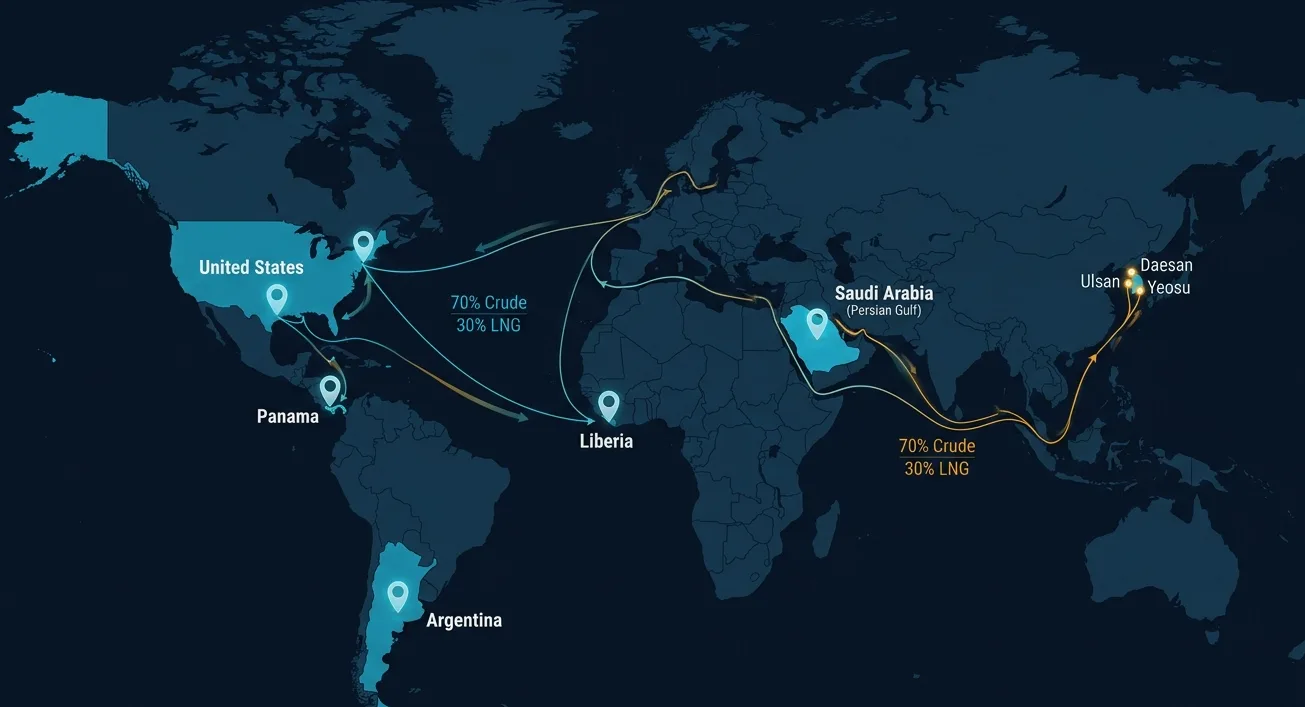
Public discussion of Korea's exposure to Hormuz often reduces to a single number. The reality is more layered. Below is a breakdown drawn from official sources — Korea Customs Service, Ministry of Trade Industry and Energy (MOTIE), Korea International Trade Association, and the IEA.
Two takeaways. First, Korea's crude oil exposure to the Middle East is real and significant — about 70%, and largely transiting Hormuz. Second, Korea's LNG situation is less concentrated than commonly assumed. Australia is the single largest supplier at 31% and growing; the US share has been rising under the October 2025 trade package. Qatar at 14.9% is the largest Middle East source but does not by itself dominate Korean LNG. This matters because it changes the shape of risk: a complete Hormuz disruption is a serious crude oil problem for Korea before it is a serious LNG problem.
Why the Diplomatic Position Has Become More Visible
Until the HMM Namu incident, Korea's preferred posture was a careful neutrality. Seoul condemned attacks on civilian shipping in general terms. It did not deploy naval assets to the Gulf, despite long-standing US requests dating back to the Trump first-term Sentinel coalition and the Biden-era Operation Prosperity Guardian. Korean diplomacy framed the Middle East as a region where Korean interests were narrow (energy supply) and where deeper military involvement carried unacceptable domestic political costs.
That posture is now under more visible pressure. Within hours of the HMM Namu fire, President Trump publicly stated that the incident should prompt South Korea to join American efforts to guide stranded ships through the strait. This shifted the conversation from quiet diplomacy to public framing. Korea's Ministry of National Defense responded on May 5 that it would "carefully review our position" and listed the criteria it would weigh: international law, the safety of international maritime routes, the US-Korea alliance, and the security situation on the Korean peninsula.
The last criterion deserves attention. It is a coded reference to North Korea. Any redeployment of Korean naval assets to the Persian Gulf carries an opportunity cost on the Korean peninsula, where deterrence remains the country's primary military posture. Seoul is unlikely to commit major naval assets in a way that creates a perceived gap in patrol coverage of the East Sea or West Sea.
Three Plausible Paths to Consider — Not Predictions
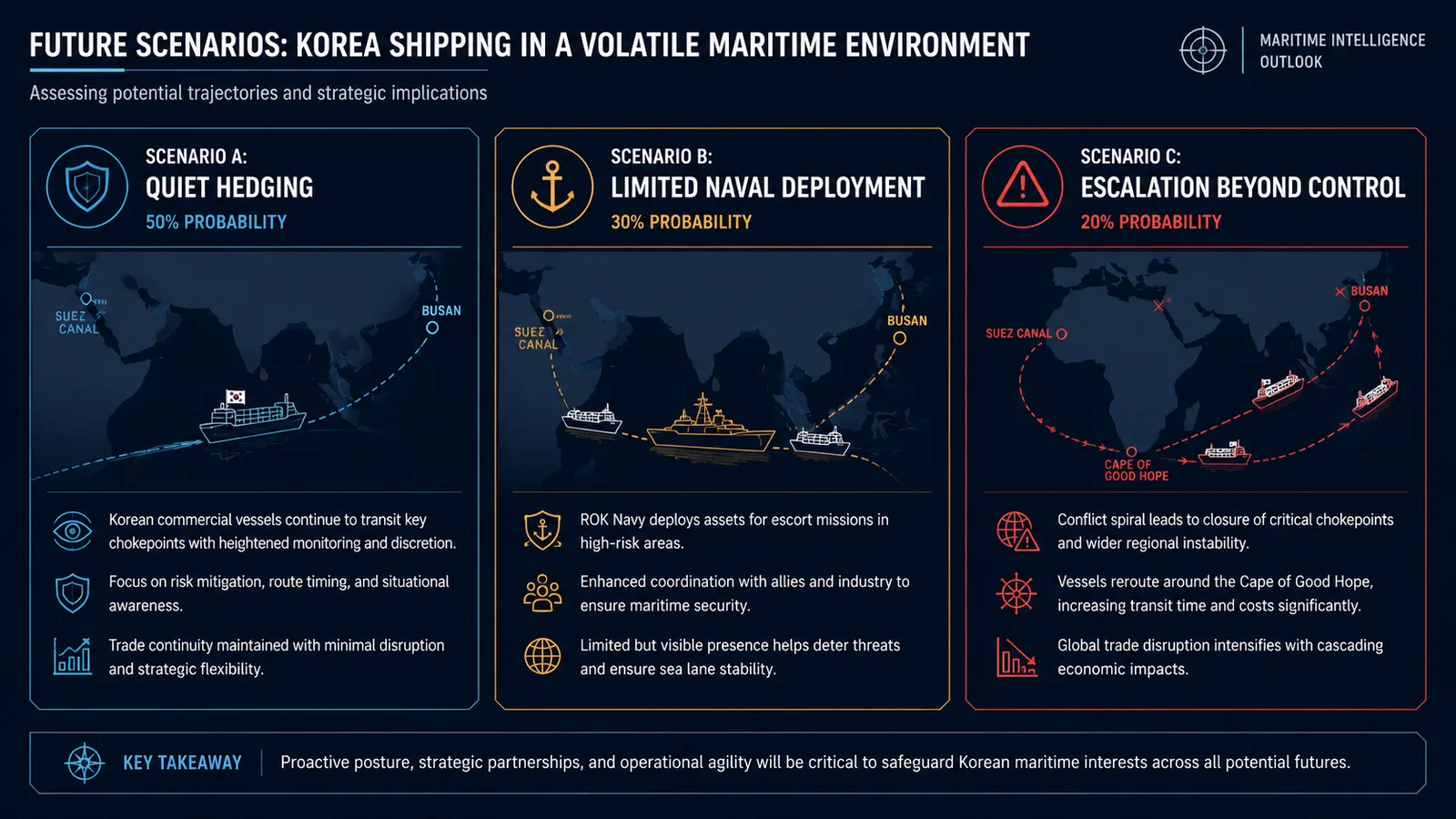
The three paths below are scenarios, not forecasts. Probabilities are subjective framings of relative likelihood, useful for stress-testing assumptions and not for trading. We weight them based on (a) revealed Korean government posture across past Gulf crises, (b) the current US administration's willingness to apply public pressure on allies, and (c) Iran's historical pattern of selective rather than nationality-based targeting.
A note on Scenario C: Iran's historical pattern in the strait has been selective and situation-driven rather than systematic targeting by nationality. This argues against assuming any one country's flag automatically becomes a primary target. What changes the calculus is association — how Korean assets are perceived to be operationally linked to US-led activity. This is the variable Seoul is managing in real time.
What Voyage Planners Are Adjusting Now
- War-risk insurance premiums for Hormuz transits have repriced sharply since late February. Hull war-risk rates on Gulf voyages quoted by Lloyd's underwriters have moved into materially higher ranges as a percentage of hull value compared with early 2026, though daily quotes vary by route, cargo, and operator.
- The Joint War Committee in London expanded its Listed Areas around Oman during March 2026. Vessels calling at Sohar, Salalah, or Duqm now incur additional notification and premium-trigger requirements that did not exist a year ago.
- Routing ballast voyages around the Cape of Good Hope adds 15-21 days for laden VLCC voyages from the Middle East Gulf to the Far East. The decision tree weighs voyage time delta against insurance premium delta and market freight rates — and after early May the insurance side has tilted further.
- Korean refiners have been increasing alternative-source crude (West African, US Gulf, Brazilian) over the conflict period, though at a notable premium to Middle East grades. Spot LNG into Korea trades at meaningful premiums to long-term Qatar contract baselines.
- For voyage cost modelling in the current environment, war-risk premium needs to be a first-order line item rather than a footnote. Bunker price assumptions should be updated weekly rather than monthly given the volatility window is wider than the typical budget cycle.
The Wider Pattern: A Maritime Order Under Stress
The HMM Namu incident does not exist in isolation. It sits inside a wider 2026 pattern of pressure on the rules-based maritime order: Iran's effective restriction of Hormuz transit, the US naval blockade of Iranian ports starting April 13, China's reported detention of Panama-flagged ships, Indonesia's short-lived but telling May 1 floating of a Malacca Strait toll, and the Joint War Committee's steady expansion of war-risk listed areas. Each event has a specific cause. Together they describe a maritime environment in which transit through international straits is increasingly governed by national interests asserting themselves over multilateral norms that have governed seaborne trade since the 1980s.
Korea's position in this environment is structurally exposed. The country's economy was built on the assumption that international straits are open, that shipping is governed by predictable insurance and legal frameworks, and that national navies stay out of commercial routing decisions. Each of those assumptions is being tested. The HMM Namu incident is a single data point in a longer pattern — but it is the data point that brought Korea's exposure into the daily news cycle.
Whether the incident proves to have been an attack, a sympathetic detonation, or a mechanical failure made worse by the operating environment, the underlying conclusion does not change much: Korea's shipping industry is now operating in a heightened risk environment, and the choices Korean carriers, refiners, insurers, and policymakers make over the next 60 days will shape outcomes well beyond a single vessel.
Reading List
For readers tracking the broader picture, our previous analysis on the Hormuz crisis remains the most direct reference: The 2026 Hormuz Crisis and Shipping Route Realignment. The geopolitical mapping of all major chokepoints under stress in 2026 is covered in Global Chokepoints 2026: A Shipping Risk Map. For the cycle context — where the tanker-bulker divergence sits in the broader shipping cycle — see The 2026 Shipping Cycle Diagnostic.
Live data on bunker prices, freight indices, and currency exposure across our 18 maritime currencies is available on the Maritime Data Hub. Voyage cost comparison across Suez, Cape, Panama, and NSR routes — including direct-to-Korea voyages — is available in our Ship ETA Calculator.