
Yesterday we wrote about the PGSA — Iran's Persian Gulf Strait Authority — and argued that what looks like a wartime extraction has the structural shape of a permanent toll. A war ends; a toll booth does not. That framing addresses one question: how does a sovereign claim over a chokepoint persist past the diplomatic moment that created it. It does not address the question operators are actually asking this week, which is the more practical one. What do I do instead?
Read the trade press right now and the answer is being assembled in pieces. A new container terminal opened in Sokhna in January. Another at Damietta in February. CMA CGM published multimodal land bypass options in March. Saudi Arabia and Egypt formalized a logistics corridor in April. Thailand's prime minister relaunched a $31 billion land bridge proposal at the end of April. Hapag-Lloyd announced GRI/GRA implementations for Indian Subcontinent and Middle East trade lanes in early May that explicitly acknowledged rerouting durability. Each headline reads as an event. Stack them together and they read as something else.
The thesis of this article is direct, and it cuts against most of the framing in the trade press right now.
Friction does not disappear when the chokepoint reopens. It gets redistributed into infrastructure that will outlast the chokepoint crisis itself.
This matters because most operator decisions over the next 18 months will be made on the assumption that “alternative corridor” means temporary workaround. That assumption is the wrong one to plan around. The infrastructure being commissioned right now does not get torn down when Hormuz normalizes. The bunker contracts being signed do not get retroactively rewritten. The shipper relationships forming around new transshipment points do not snap back to default routing on a press conference. What is being built is the durable geometry of the next decade of Gulf trade — and a meaningful share of it is being built while the war is still hot.
The Friction Conservation Principle
Start with the language problem. The way the trade press describes the alternatives makes them sound like solutions:
- — “Saudi–Egypt land bridge opens”
- — “Thailand revives land bridge plan”
- — “CMA CGM offers multimodal bypass”
- — “IMEC corridor accelerated”
Each of those headlines, taken on its own, implies that something is being removed by the new option — friction, cost, risk. Operators reading these as solutions will misprice voyages. The framing we propose is different. Friction in maritime trade is rarely destroyed by an alternative corridor. In most realistic configurations, it is redistributed.
- ● PGSA permit fee (variable, reportedly up to $2M)
- ● War risk hull AP 0.45–0.85% per voyage
- ● Singapore–Fujairah VLSFO spread ~$80/mt
- ● Latent risk of physical interception
- ● Designated corridor compliance (Larak Island routing)
- ● Ocean leg to Jeddah / King Abdullah / Yanbu
- ● Red Sea terminal handling
- ● Rail / road across ~1,200 km
- ● Customs at Saudi-Egypt border
- ● Transshipment at Sokhna or Damietta
- ● Mediterranean ocean leg to final destination
Whether the Saudi-Egypt total comes out higher or lower than the Hormuz total depends on cargo type, time sensitivity, the operator's insurance structure, and what charterers are willing to absorb. For some flows the answer favors Hormuz with the friction priced in. For others it favors the Saudi-Egypt detour. There is no general result, and the lazy framing — alternative equals cheaper — produces wrong decisions in both directions. The operator's real question is not whether to pay friction. It is which kind of friction matches the book.
Where the Friction Is Going — Four Concrete Movements
Four corridors are absorbing the redistribution. None of them are interchangeable. Each has a different cost structure, a different time profile, a different state of operational maturity, and — important point we'll come back to — a different set of intermediaries who get paid.
| Corridor | Status | Cargo fit | Time penalty | Maturity |
|---|---|---|---|---|
| Saudi–Egypt | Operating | Containers, breakbulk, project | +5–8 days | Live, scaling |
| China–Iran rail | Operating | Non-bulk, high-value | ~14–15 days end-to-end | Niche capacity |
| Thailand Land Bridge | Planned | Containers, energy (proposed) | N/A (not built) | Late 2030s target |
| IMEC | Planned | General + digital | N/A (not built) | Years out, politically fragile |
Saudi–Egypt land bridge — operating now. This is the only corridor functioning at meaningful commercial scale today. Cargo arrives at Jeddah Islamic Port, King Abdullah Port, or Yanbu on the Red Sea coast. It moves by rail and road across roughly 1,200 kilometers of Saudi territory, crosses into Egypt, and reaches either Sokhna on the Red Sea (for Mediterranean transshipment) or routes directly to Damietta or Alexandria. The Damietta Alliance Container Terminal — a joint venture of Hapag-Lloyd, Eurogate, and Contship Italia — began operations in February and is built to handle vessels up to about 20,000 TEU. Sokhna's Red Sea Container Terminal opened in January. Operators familiar with Gulf feeder trades will recognize the pattern immediately: once cargo changes transport mode more than once, predictability often matters more than nominal transit time, and the corridor's practical bottlenecks turn out to be customs coordination and rail capacity rather than ocean freight cost.
China–Iran rail — operating, limited. Functional in its current form since 2025. Service from Yiwu, China, transits Kazakhstan, Turkmenistan, and Iran, terminating at the Aprin land port near Tehran. Travel time is roughly two weeks end-to-end. Capacity is constrained — this is not a high-volume artery — and it does not address bulk crude, which remains the dominant Iran-China trade flow. The corridor functions as strategic insurance for non-bulk China-Iran trade and selected high-value flows. It should be modeled as a niche option for specific cargo profiles, not a general redirect for the broader Asia-Gulf complex.
Thailand Land Bridge — proposed. A $31 billion project to build a 90-kilometer rail-and-pipeline corridor across the Thai peninsula, linking deep-water ports at Ranong (Andaman Sea) and Chumphon (Gulf of Thailand). Field surveys are advanced, cabinet review is reportedly expected mid-2026, investor outreach reportedly opens in 2027, and the discussed completion target is the late 2030s. Worth noting plainly: this corridor does not exist yet, and will not exist for years. But political momentum behind it is real, and once route alignment and primary investors get fixed, contracts that lock in 10–20 year flows will start to form. For charter parties being signed in 2026 with delivery dates beyond 2030, the existence of this corridor in plan rather than in operation is already changing the calculus.
IMEC — India-Middle East-Europe Economic Corridor. Proposed in 2023, gaining renewed political momentum in 2026 as a Hormuz hedge. Multimodal: India by sea to UAE and Saudi Arabia, overland through Jordan and Israel, then to Europe via Greek and Italian Mediterranean ports. The corridor is at an earlier maturity stage than Saudi-Egypt but more advanced than Thailand. The structural problem with IMEC is what makes it strategically attractive — it requires sustained cooperation across at least four jurisdictions whose relationships are sensitive to exactly the Middle East geopolitical events that make the corridor desirable. We would not yet model IMEC as fixture-grade; we would track its political signals carefully.
The Concrete Has Already Been Poured
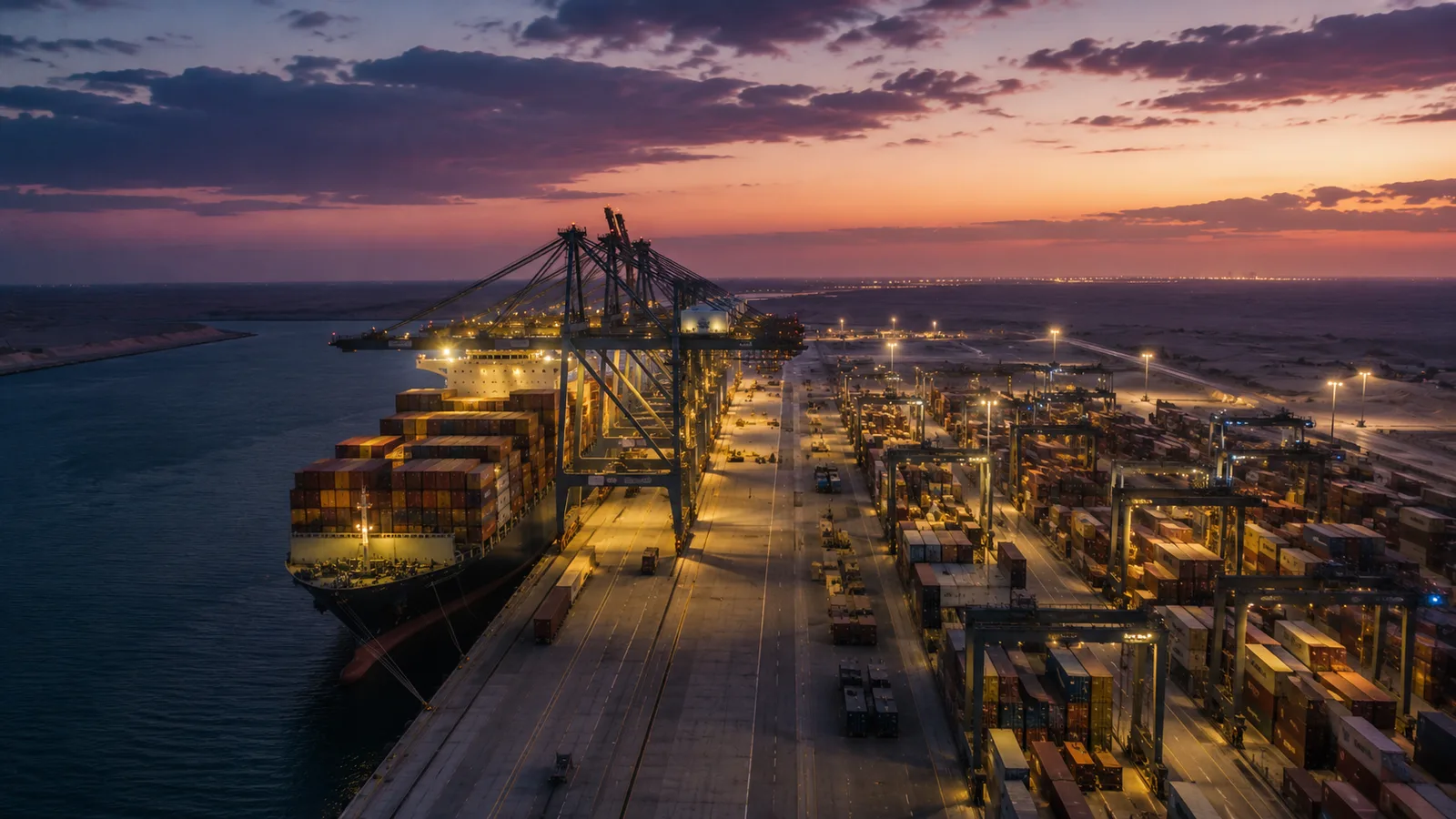
Compress the last four months and you can see the pattern.
None of this is reversible by a diplomatic announcement. A container terminal cannot be unbuilt. A multimodal service contract that has signed customers and operating warehouses develops a constituency. A GRI announced and accepted by shippers becomes the new floor — even if the conditions that justified it ease. The asymmetry is the structural point of this article.
We argued yesterday that the PGSA is sticky for institutional reasons — sovereign revenue mechanisms persist through staffing, budget lines, and bureaucratic interest. That stickiness is real, but it is negotiable in principle. A toll can be raised, lowered, or even lifted in a single political decision. The infrastructure being commissioned right now is sticky for a different and more durable reason: physical assets and contractual relationships do not unwind on the diplomatic clock. They unwind on the depreciation schedule.
The Redistribution of Rent
Here is the part of the analysis that matters most for understanding why the new geometry will not unwind, and that the trade press has not pulled apart cleanly.
When friction is concentrated at a single chokepoint, a small number of actors collect the rent associated with it. Pre-crisis Hormuz was an extreme example: the rent was diffused across the global oil market via prices, but the operational rent collectors — bunker suppliers in Fujairah, hull war underwriters at Lloyd's, the Iranian state on a routine basis — were a relatively short list. Concentration created political leverage, but it also kept the cake small enough to negotiate over.
Redistribute the friction across a multi-step corridor and you create something different.
Each new transfer point in a multimodal corridor is a new opportunity to monetize delay, coordination, or access. None of these intermediaries individually capture as much as the Hormuz friction at peak — but collectively they capture, in our estimation, a comparable share of total voyage cost, and they do so in a structure that is much harder to negotiate against. There is no single counterparty to call. The rent has been pluralized.
That pluralization is itself an argument for the durability of the new geometry. A coalition of rent collectors with overlapping interests is harder to dismantle than a single monopolist. Once the Saudi rail operator, the Egyptian terminal concessionaire, the customs broker network, and the multimodal forwarders all have revenue streams tied to the corridor functioning, the political economy of unwinding the corridor becomes adverse. Their interest is in the corridor remaining live, even if the original justification — Hormuz disruption — eases.
The Operator Decision Matrix

The matrix below is the practical synthesis. It is not a recommendation for any particular voyage; it is a structure for thinking through which corridor matches which cargo profile.
| Cargo type | Hormuz (PGSA) | Saudi–Egypt | Cape | China–Iran rail |
|---|---|---|---|---|
| Crude / LNG | Necessary | N/A | Viable | N/A |
| Containers (non-time-sensitive) | Possible | Strong fit | Possible | Limited |
| Containers (time-sensitive) | Priced in | Possible (dwell risk) | Too slow | Niche |
| Project / breakbulk | Case by case | Strong fit | Viable | Limited |
| High-value low-volume | Priced in | Viable | Too slow | Strong fit |
Three patterns surface from filling the matrix in. The first is that the redistribution does not yet help energy cargo. Pipelines outside Hormuz exist — the East-West pipeline through Saudi Arabia, the UAE Habshan-Fujairah pipeline — but their combined capacity is a small fraction of seaborne Hormuz volume. For crude and LNG, the operator's practical choices remain Hormuz-with-friction or Cape-with-friction. The redistribution helps everyone except the cargo class that originally drove Hormuz's strategic importance, which is its own kind of irony.
The second is that the math has actually shifted for non-energy cargo. A Hormuz transit currently carries war risk loading, possible PGSA exposure, and Singapore–Fujairah bunker disadvantage. A Saudi–Egypt routing carries handling fees, customs friction, and an extra 5–8 days of transit. For shippers prioritizing predictability over speed, the math now tips toward Saudi–Egypt; for shippers prioritizing speed and headline transit cost only, Hormuz remains competitive when war risk premium is paid in. This is not a narrow rebalancing. The volume of containerized and breakbulk cargo for which Saudi–Egypt is now operationally preferable is a meaningful share of the prior Hormuz container book.
The third pattern is the one that gets undercovered. For charter parties extending into 2027–2030, the future corridors — Thailand, IMEC — start to matter even though they do not yet exist. The optionality of routing through them, once available, is a contractual variable. Charter party clauses being drafted now should anticipate routings that do not yet operate, including how transit fees, bunker arrangements, and force-majeure language work when a corridor opens mid-charter. We have seen draft clauses that try to handle this; most of them are inadequate.
What Voyage Planners Should Do This Week
- Track terminal commissioning, not just freight rate indices. A new terminal opening at a transshipment node tells you more about long-run friction redistribution than a weekly rate index does. Throughput data at Sokhna, Damietta, and Jeddah is the structural read; the rate indices are the daily noise.
- Build the friction stack explicitly when evaluating fixtures. Hormuz friction is currently visible — PGSA fee, war risk AP, bunker spread. Alternative-corridor friction is currently less visible because it is distributed across handling, customs, and transshipment fees that don't show up as a single line item. The visibility gap creates margin opportunity for operators who model carefully.
- For charter parties extending into 2027 and beyond, write optionality language for routings that don't yet exist. Force majeure clauses, transit fee splits, and bunker arrangement defaults should not assume the corridor menu remains constant for the charter period. It will not.
- Watch the Singapore–Fujairah VLSFO spread daily, but watch terminal throughput at Sokhna and Damietta with equal weight. The bunker spread is the daily indicator of whether the May 6 oil reset is sticking. Terminal volumes are the structural indicator of whether the redistribution is sticking. Both should be tracked weekly.
- Do not assume diplomatic resolution returns the routing map to its prior shape. Even a complete Iran–US de-escalation does not unwind the Damietta terminal, the Sokhna terminal, the GRI baselines, or the customer relationships forming around them. Plan voyage economics for a 2026–2030 environment in which alternative corridors are part of the standard menu, not a temporary detour.
The Bigger Picture
Most of the analytical writing on the Hormuz crisis has framed the situation as a binary that will eventually resolve. Either the strait reopens to its prior status or it doesn't. We think that framing misses what is actually happening on the ground.
What is happening is more subtle, and more durable. The friction associated with the strait is being redistributed across new infrastructure, new corridors, and new contractual relationships. The redistribution survives the diplomatic resolution. The map of Gulf trade in 2030 will not look like the map of 2025, regardless of how the current crisis ends.
For operators paying attention, this is not bad news. It is, properly understood, a structural arbitrage window. The friction that was concentrated at one chokepoint is now distributed across many handlers, many corridors, many time horizons, and many rent collectors. Each of those layers is, on its own, mispriced relative to its long-run weight. Operators who model the redistribution carefully, charter into it deliberately, and avoid the assumption that “alternative” means “temporary” will price voyages more accurately than those who treat the May 6 oil reset as the all-clear.
The discipline that pays in this environment is the same discipline that pays whenever a market structure changes durably. Model the new geometry before the consensus does. By the time consensus catches up, most of the routing advantages worth having will already be priced in by someone else.
Reading List
For the institutional toll mechanism that the PGSA represents, see The PGSA Toll Booth — How a Hormuz Crisis Became an Institution. For the May 6 oil reset and the original two-clock framework, see The Ceasefire That Isn't. For the war risk insurance mechanics that govern the cost layer being redistributed, see War Risk Insurance: The Hidden Cost That's Closing Today's Shipping Map. For the bunker market response and the Singapore–Fujairah indicator, see VLSFO Compatibility: The Hidden Bunker Risk. For the original Hormuz crisis brief and routing implications, see Hormuz Crisis 2026: How Shipping Routes Are Adjusting.
Live data on Brent, WTI, Dubai, BDI, bunker prices across major ports, and the Singapore–Fujairah VLSFO spread is updated daily on the Maritime Data Hub. For voyage cost modelling that incorporates current war risk assumptions across Suez, Cape, Panama, and NSR routes, use the Ship ETA Calculator.