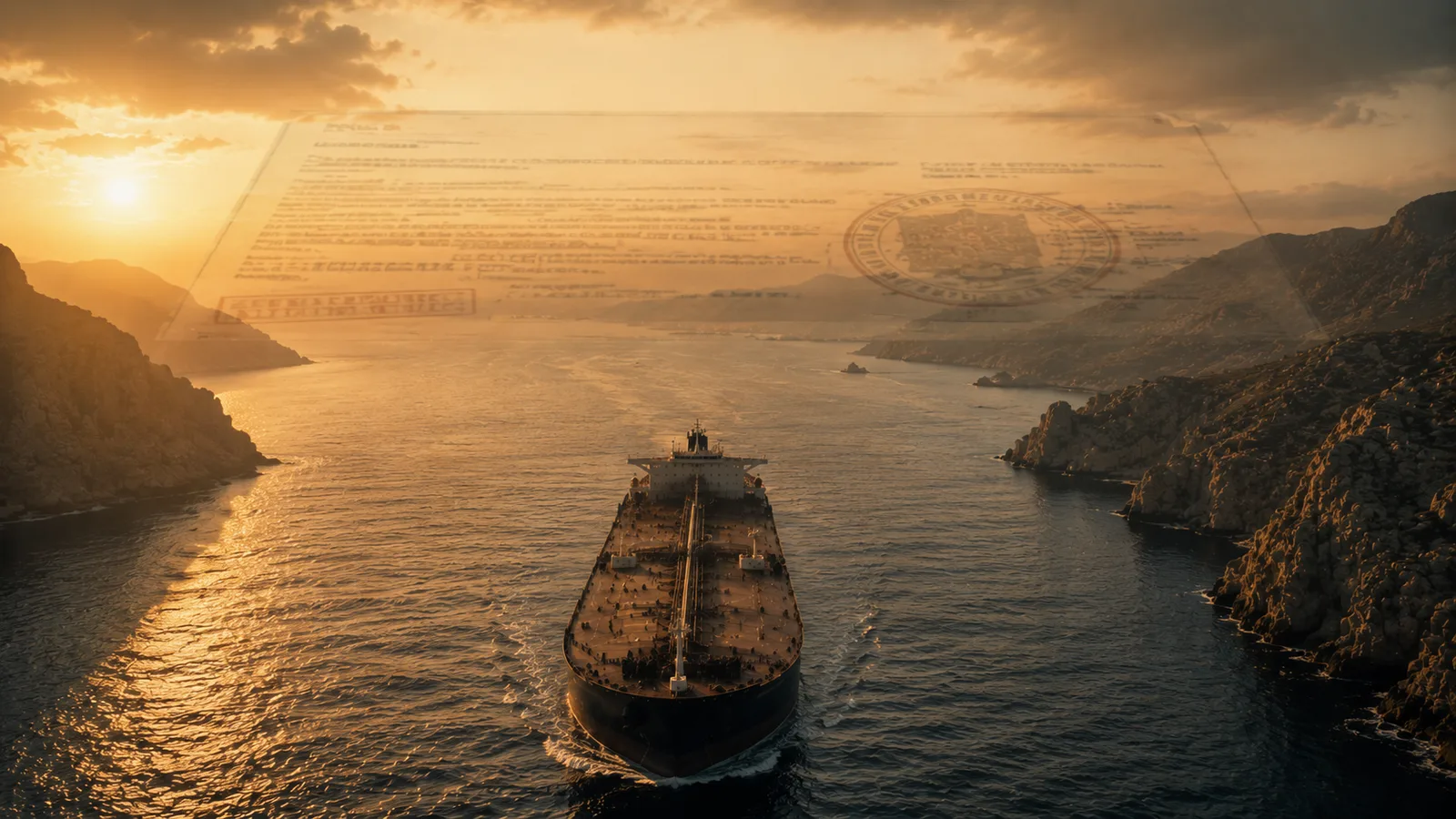
On May 5, 2026, Iran's Islamic Revolutionary Guard Corps Navy operationalized the Persian Gulf Strait Authority — the PGSA — through a single official email address, info@PGSA.ir, and a Vessel Information Declaration of more than 40 questions that transiting vessels are required to complete. CNN, working from documents shared by Lloyd's List, confirmed the form's existence and scope on May 7. Analyst estimates reported by major outlets place the per-vessel fee structure at up to two million dollars depending on flag, cargo, and operator linkages. Concurrently, US Treasury sanctions architecture — built around the IRGC's status as a US-designated foreign terrorist organization — positions any payment to Iranian entities for safe passage as unauthorized for US persons, US-controlled foreign entities, and US financial institutions. A war ends. A toll booth does not.
This is a different kind of event from anything the maritime industry priced through April or the first week of May. The crisis brought military risk, insurance repricing, and routing diversions — events that lie within the working memory of every chartering desk. The PGSA does something else: it institutionalizes the disruption. The May 6 oil reset, which we covered in The Ceasefire That Isn't, addressed the speed of the energy market versus the speed of the marine insurance market — what we called the two-clock problem. As of May 9, there is now a third clock to track. The PGSA is the first concrete attempt to make Hormuz risk permanent and revenue-generating rather than transient and event-driven. That layer appears only partially reflected in current pricing.
How the PGSA Came Together
The authority did not emerge from nothing on May 5. It is the operational endpoint of a process that started in March, when Iran first declared that vessels would need to pay for safe passage. That declaration was followed by a chaotic interim period in which scam operators offered fraudulent transit documents in exchange for cryptocurrency, creating both a legal mess and a reputational problem for Tehran. The PGSA — with its formal email address, published logo, designated routing corridors, and standardized declaration form — is the response to that mess. It gives the toll regime a single window and a bureaucratic interface, regardless of how the rest of the world judges its legitimacy.
info@PGSA.ir), published logo (“Persian Gulf Strait Authority — Islamic Republic of Iran”), and Vessel Information Declaration form circulated. Single window for transit applications established.What the PGSA System Actually Imposes
Operationally, what we know as of May 9 is the following: vessels intending to transit the strait are expected to send an inquiry to info@PGSA.ir and receive in response a Vessel Information Declaration. Reported reporting from CNN and the maritime trade press indicates the declaration runs to more than 40 questions, including the ship's name, identification number, any previous names, country of origin and destination, registered ownership and beneficial ownership, flag history, crew nationalities, cargo type and value, and voyage plans. Vessels with US, UK, or Israeli ownership, flag, or trading linkages are reportedly excluded from clearance outright. For other vessels, the response includes a designated transit corridor — reported to route ships around Iran's Larak Island rather than through the previously standard international corridor — and, in some reported cases, a fee schedule. Press reporting cites analyst estimates of fees ranging from materially elevated handling charges up to approximately $2 million per transit for higher-risk profiles.
info@PGSA.ir. 40+ questions including ownership, flag history, crew nationalities, cargo value, voyage plans.Lloyd's List traffic monitoring, cited by CNN, found that Hormuz transits collapsed from a pre-crisis baseline of approximately 120 vessels per day to roughly 40 transits in the entire week ending May 3. Several thousand ships and tens of thousands of crew are reportedly stranded inside the Persian Gulf, unable to leave on terms the operators are willing to accept. Transits have not yet rebounded to pre-crisis levels, even as the May 6 diplomatic signals improved. The bottleneck is no longer purely military; it is administrative, legal, and financial in roughly equal measure.
The Three Clocks

The framing we offered on May 8 was that the oil market reprices Hormuz events in hours, while marine war risk reprices them in weeks. As of May 9, neither market has fully absorbed the PGSA, because the PGSA is not the kind of event either market is built to price in real time. The PGSA is institutional. It runs on a third clock that ticks in years rather than weeks or hours — and it is the clock that matters most for fixtures and routing decisions stretching into 2027 and 2028.
Each market is pricing a different question. The oil market prices the probability of physical disruption to flow; it reset on May 6 because the headline probability of an immediate closure dropped. The war risk market prices the probability of incidents to insured hulls and cargo; it has held its elevated stance because the underwriting evidence for de-escalation requires weeks of incident-free transits, which have not yet accumulated. The institutional layer prices something neither of the others measures: the durability of a sovereign claim over the strait. A market built to price that durability does not yet exist in any concentrated form, which is exactly why this layer is hard to read on day one.
Why “Permanent” Is the Right Word
There is a structural reason why the PGSA, once established, is unlikely to be fully reversed even if the current diplomatic track produces a settlement. Sovereign revenue mechanisms are sticky. Once a state has built an institution, issued a form, designated fee schedules, and begun collecting, the operational and political cost of dismantling that institution rises sharply. The institution acquires staffing, budget lines, regulatory infrastructure, and bureaucratic constituencies whose interests are aligned with continuation.
Maritime history is consistent on this. The Suez Canal Authority emerged from a crisis-period nationalization and has continued to collect transit dues for nearly seventy years through every regional upheaval. The Panama Canal Authority took over from US administration in 1999 and has never returned to the prior arrangement. The Bosphorus and Dardanelles operate under the Montreux Convention's permit-and-notification regime that has survived two transformations of the Turkish state. Once a transit authority exists, it tends to persist; only the headline price and the diplomatic temperature around it change. The PGSA is younger and more contested than any of these comparators, and there is genuine probability — perhaps the highest single-scenario probability — that it does not stabilize in its current form. But the framing matters. The question is no longer “when will Hormuz be free again” but “what kind of institution governs Hormuz transits in 2027 and 2028, and at what cost.”
The OFAC Bind
The US sanctions exposure introduces a structural conflict that deserves its own analysis. For US-flagged, US-owned, US-controlled, and US-financed vessels — a category that touches a meaningful share of the global tanker fleet's beneficial ownership chain — the PGSA framework is not simply a fee schedule. The IRGC's status as a designated foreign terrorist organization means payments routed to it, directly or indirectly, are not authorized under existing US sanctions architecture. The choices, in stylized form, reduce to three.
Standard charter party language was not designed for this kind of sovereign third-party transit fee imposed by a sanctioned entity. War risk clauses, sanctions clauses, and unlawful payment language collectively cover parts of the situation, but the combinations created by the PGSA — particularly the interaction between charterer-mandated routing, owner-mandated compliance, and a fee that is unlawful for some counterparties to pay but available to others — are not cleanly addressed by the standard wording. New fixtures into the second half of 2026 will need to be drafted with explicit language for sovereign transit fees, not merely for war risk premium reimbursement.
What the Bunker Market Is Telling Us
We have argued previously, in VLSFO Compatibility: The Hidden Bunker Risk, that bunker prices in regional ports respond to physical risk faster than freight rates and lag oil prices on the way down. The clearest read on whether the market believes the May 6 reset is the Singapore–Fujairah VLSFO spread. As of May 7, that spread sat at roughly $78 per metric ton, with Fujairah at $940/mt and Singapore at $862/mt.
Fujairah is the principal Persian Gulf bunker hub. A spread of nearly ten percent over the Singapore reference is not a normal regional differential. It reflects bunker traders pricing the cost of holding inventory in a port whose resupply depends on Hormuz transit, while also pricing the operational risk of vessels needing to bunker in a region where transit clearance is no longer routine. If the May 6 reset were a genuine all-clear, this spread should have begun to compress within 24–48 hours. As of May 9, it has not. That fact, on its own, is the cleanest available read on whether the market consensus has actually shifted, or whether only the oil price has.
What Voyage Planners Should Do
- Add an institutional-clock line item to your Hormuz voyage cost model. Even at a low probability weighting, the expected value of a sovereign transit fee layer is non-zero, and the expected duration of any such institution is multi-year.
- For vessels with US ownership, financing, flag, or charterer linkages, do not assume that diplomatic resolution alone reopens Hormuz transits. The sanctions exposure is independent of the diplomatic track and does not automatically rescind on de-escalation.
- Charter party drafts for fixtures that cover Persian Gulf-loading cargo through the second half of 2026 should include explicit language for sovereign transit fees, not only war risk premium reimbursement. Existing standard clauses were not designed for this.
- Track the Singapore–Fujairah VLSFO spread as the cleanest daily indicator of whether the market believes the May 6 reset. A sustained narrowing below $40/mt would signal genuine normalization. A spread above $60/mt indicates the underlying disruption is intact.
- For voyages within Asia and Europe that do not transit Hormuz, do not assume Hormuz dynamics are fully isolated. Bunker availability, insurance pricing, and vessel positioning have second-order effects on Cape and Asia–Europe trades.
- Update assumptions weekly, not monthly. The institutional layer can shift on a single PGSA pronouncement or a single sanctions update; a monthly cycle is too slow for the current environment.
The Bigger Picture
The Hormuz crisis is no longer a binary “open or closed” question. It is a layered operational environment with three timing systems running in parallel: the energy market on hours, the war risk market on weeks, and the institutional layer on years. Each clock is real. Each prices a different aspect of the same underlying disruption. Voyage planners who model only the fastest clock will misprice the actual transit cost. Those who model only the slowest clock will overpay for short-duration fixtures during diplomatic windows.
The discipline that pays in this environment is the same discipline that pays in any market with multiple time horizons: model each clock separately, do not let movement on the fastest clock dominate decisions that depend on the slowest, and maintain explicit assumptions for each layer that you update on each layer's natural cadence. This is not closure. It is institutionalization. The boring work of treating insurance, sanctions exposure, and routing decisions on their actual underwriting timelines — rather than on the energy market's — is the discipline that distinguishes careful operators from those who priced May 6 as the all-clear.
Reading List
For the May 6 oil reset and the original two-clock framework, see The Ceasefire That Isn't. For the war risk insurance mechanics that govern the second clock, see War Risk Insurance: The Hidden Cost That's Closing Today's Shipping Map. For the bunker market response and the Singapore–Fujairah indicator, see VLSFO Compatibility: The Hidden Bunker Risk. For the original Hormuz crisis brief and routing implications, see Hormuz Crisis 2026: How Shipping Routes Are Adjusting.
Live data on Brent, WTI, Dubai, BDI, and bunker prices across major ports — including the Singapore–Fujairah VLSFO spread — is updated daily on the Maritime Data Hub. For voyage cost modelling that incorporates current war risk assumptions across Suez, Cape, Panama, and NSR routes, use the Ship ETA Calculator.