
Across Europe, dozens of power stations that used to burn coal now burn wood. The largest examples sit in the United Kingdom and Denmark; smaller versions of the same conversion can be found in Belgium, the Netherlands, Japan, and South Korea. Together they consume tens of millions of tonnes of wood pellets every year. Almost none of those pellets grow where the power station does. Most cross an ocean to get there.
On paper, this is renewable energy. On the water, it is a roughly 4,500-nautical-mile voyage from the US Gulf Coast to a European port, burning conventional marine fuel oil. From July 1, 2026, the United Kingdom's new emissions trading rules begin to charge the ships delivering these “carbon-neutral” cargoes for the emissions they produce in port. The two accounting systems — one for the cargo, one for the carrier — were written separately, under different policy logics. They are now starting to meet, and the freight market is where that meeting becomes visible.
§1 — First, what is biomass?
Biomass means fuel that comes from living things, or from things that were very recently living. Wood, agricultural waste, food scraps, even animal manure can all be classified as biomass. What matters is that the carbon in the fuel came from plants growing in the relatively recent past, not from oil or coal that has been underground for millions of years.
This distinction is what drives the energy industry's interest in biomass. A coal plant burns carbon that was last in the atmosphere during the age of the dinosaurs. A biomass plant burns carbon that was in the atmosphere a few decades ago, before a tree was harvested. If a new tree grows where the old one was cut down, it pulls roughly the same amount of carbon back out of the air. Burn, regrow, burn, regrow — and the net effect on atmospheric carbon, in theory, approaches zero over time.
That theory is the basis for how almost every European energy regulator now treats sustainable biomass: as a renewable fuel, with combustion emissions counted as zero in national greenhouse gas inventories.
The theory is also contested. Critics point out that burning a tree releases its carbon instantly, while regrowing a forest takes decades, sometimes a century. Defenders argue that as long as forests are managed sustainably, and as long as harvest is matched by regrowth across the broader landscape, the long-term carbon balance still holds. The debate is academic, ethical, and increasingly political. The regulatory framework, for now, treats the question as settled — which is why coal plants across Europe have spent the past decade rebuilding themselves to burn wood instead.
§2 — And what is a wood pellet?
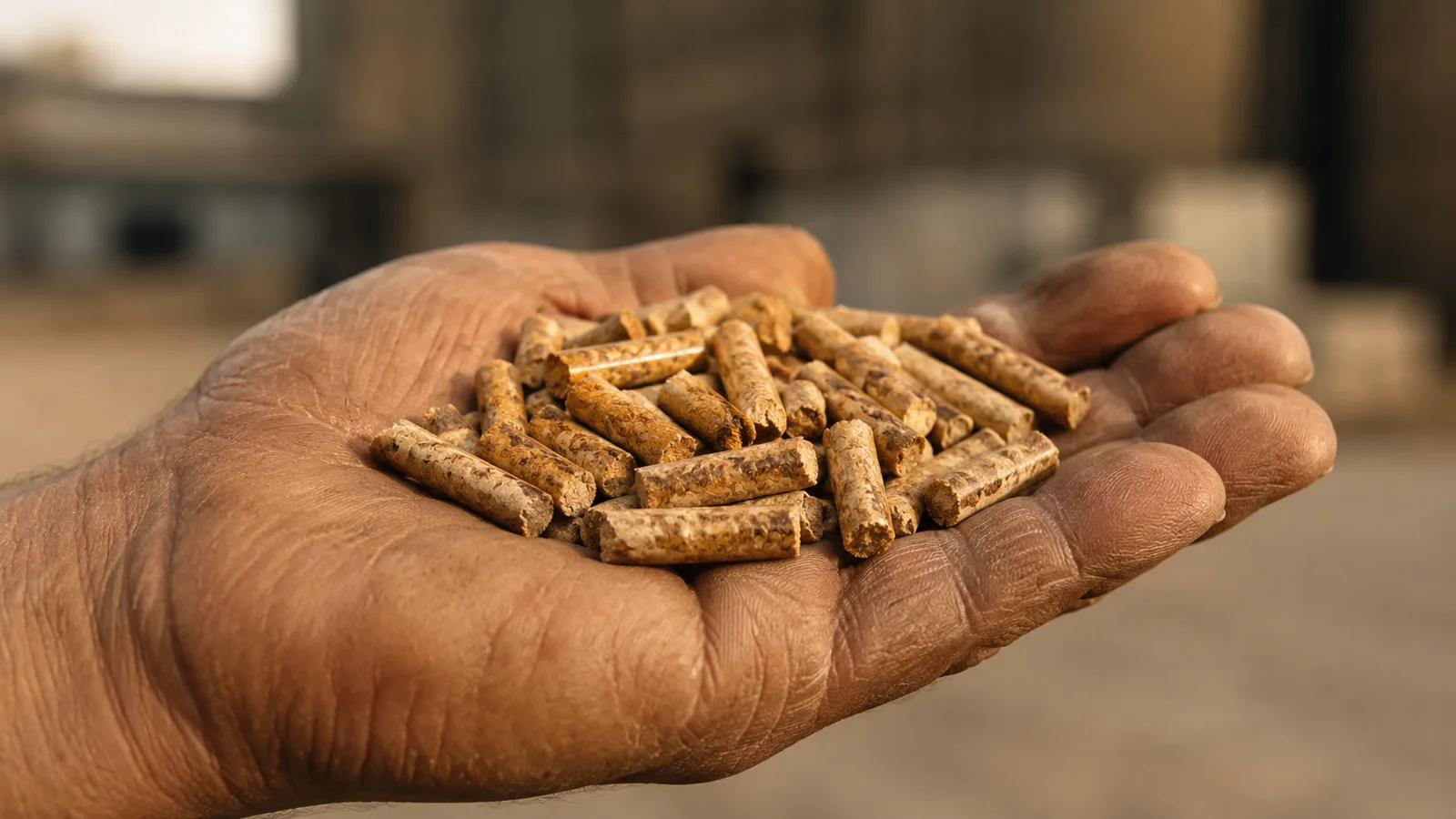
A wood pellet is not a log. It is a small, dense, uniformly shaped cylinder of compressed wood, typically about 6 to 8 millimetres in diameter and one to four centimetres long. Light brown, hard enough that you cannot crush one with your fingers, engineered to burn at a predictable rate and produce a predictable heat output.
The manufacturing process is straightforward. Sawmill waste — sawdust, wood chips, bark, and low-grade logs not suitable for furniture or construction — is dried, ground into fine particles, and compressed under high heat and pressure. The heat softens lignin, a natural binder present in wood, which then hardens as the pellet cools and holds the cylinder together. No artificial glue is required. The process is similar in principle to how animal feed pellets are produced: compress an organic material under heat, let its own internal structure hold the shape.
The point of making pellets, rather than burning whole logs or raw wood chips, is logistics. Pellets are roughly four times denser than untreated wood waste, contain very little moisture, and flow through automated handling systems the same way grain does. A bulk carrier can be filled with pellets the way it would be filled with wheat or coal. A power station can feed pellets into its boilers through the same kinds of conveyor and pulveriser systems that used to handle coal. For an industrial-scale energy operation, the pellet is not the fuel of choice because it is romantic or natural — it is the fuel of choice because it can be moved at scale.
§3 — The plants that turned to wood
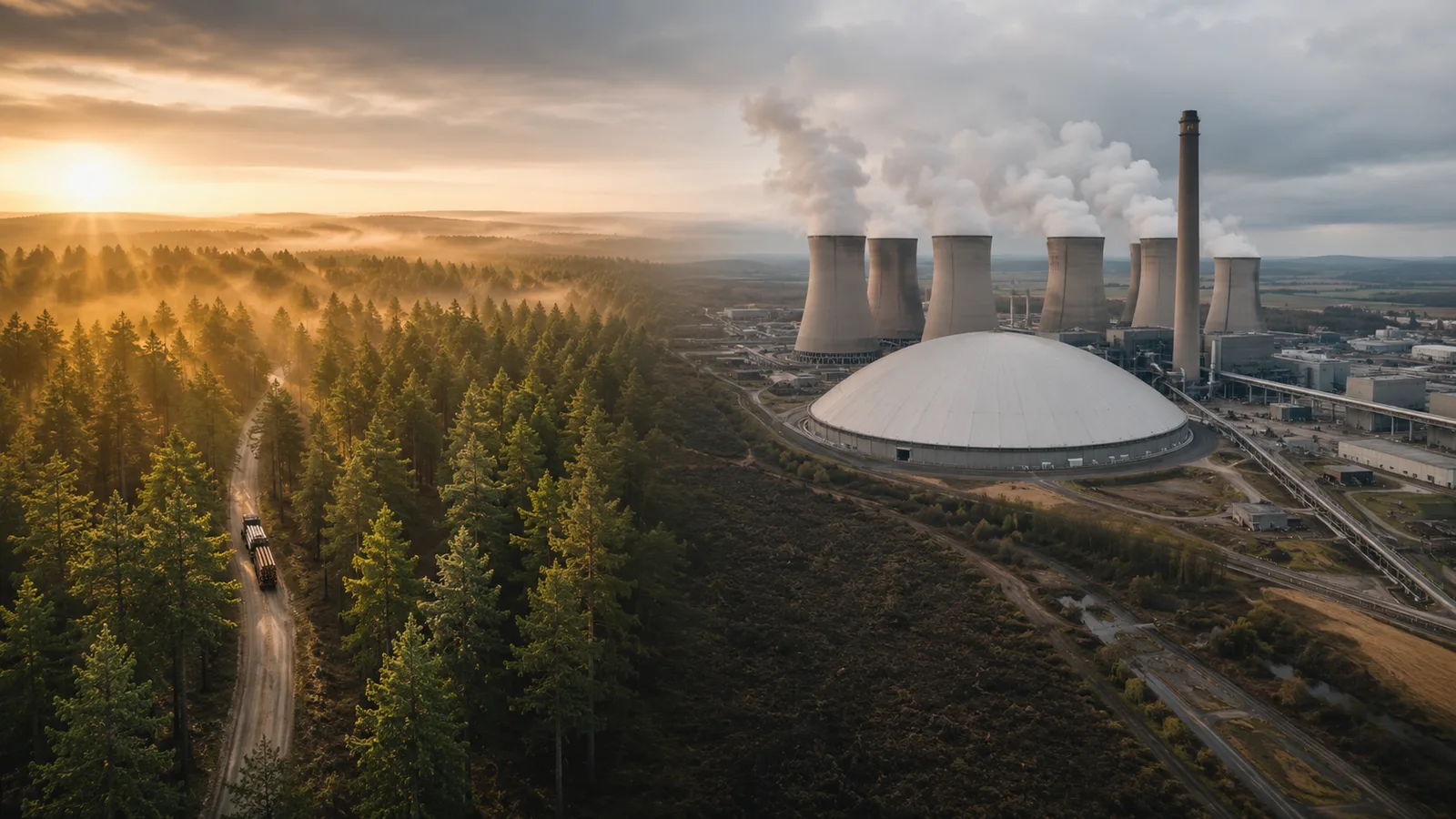
Across Europe, the past fifteen years of climate policy have produced a quiet but substantial repurposing of the continent's coal fleet. Rather than retire the plants outright, many were converted — boilers, fuel handling systems, and grinding mills reworked to burn wood pellets instead of coal. The economics of conversion depend almost entirely on government subsidies that recognise sustainable biomass as renewable energy. Where those subsidies existed, plants converted. Where they did not, plants closed.
The largest single example is Drax Power Station, on the River Ouse in North Yorkshire, England. With 2.6 GW of operating capacity (out of an installed 3,906 MW including its now-closed coal units), Drax produces approximately 6% of UK electricity by burning wood pellets. Four of its six generating units were converted to biomass between 2013 and 2018; the remaining two coal units closed in 2021. At an annual intake of 6 to 7 million tonnes of pellets, Drax is the biggest single buyer of industrial wood pellets in the world.
Denmark has converted on a comparable per-capita scale. Ørsted's Asnæs station near Kalundborg was converted to biomass for combined heat and power generation; HOFOR's Amager plant in Copenhagen completed full conversion in 2020, replacing coal with sustainable wood chips and pellets to support the Danish capital's carbon-neutral commitments. Avedøre, also operated by Ørsted, converted alongside the others. Denmark's last remaining coal plant, in Aalborg, is scheduled for closure in 2028.
Belgium converted Rodenhuize. The UK also converted Lynemouth (now operating on biomass) and retired others — Tilbury, Ironbridge — that could not secure the subsidy required to make conversion economic. In East Asia, Japan and South Korea have begun their own waves of conversion under domestic feed-in tariffs for biomass — JERA in Japan, GS EPS and others in South Korea — though most of these projects remain at the pilot or first-unit stage.
The common thread across all of these is the fuel itself. None of the converted plants produce wood pellets locally at the volumes their boilers consume. The pellets come from somewhere else.
§4 — What this looks like on the water
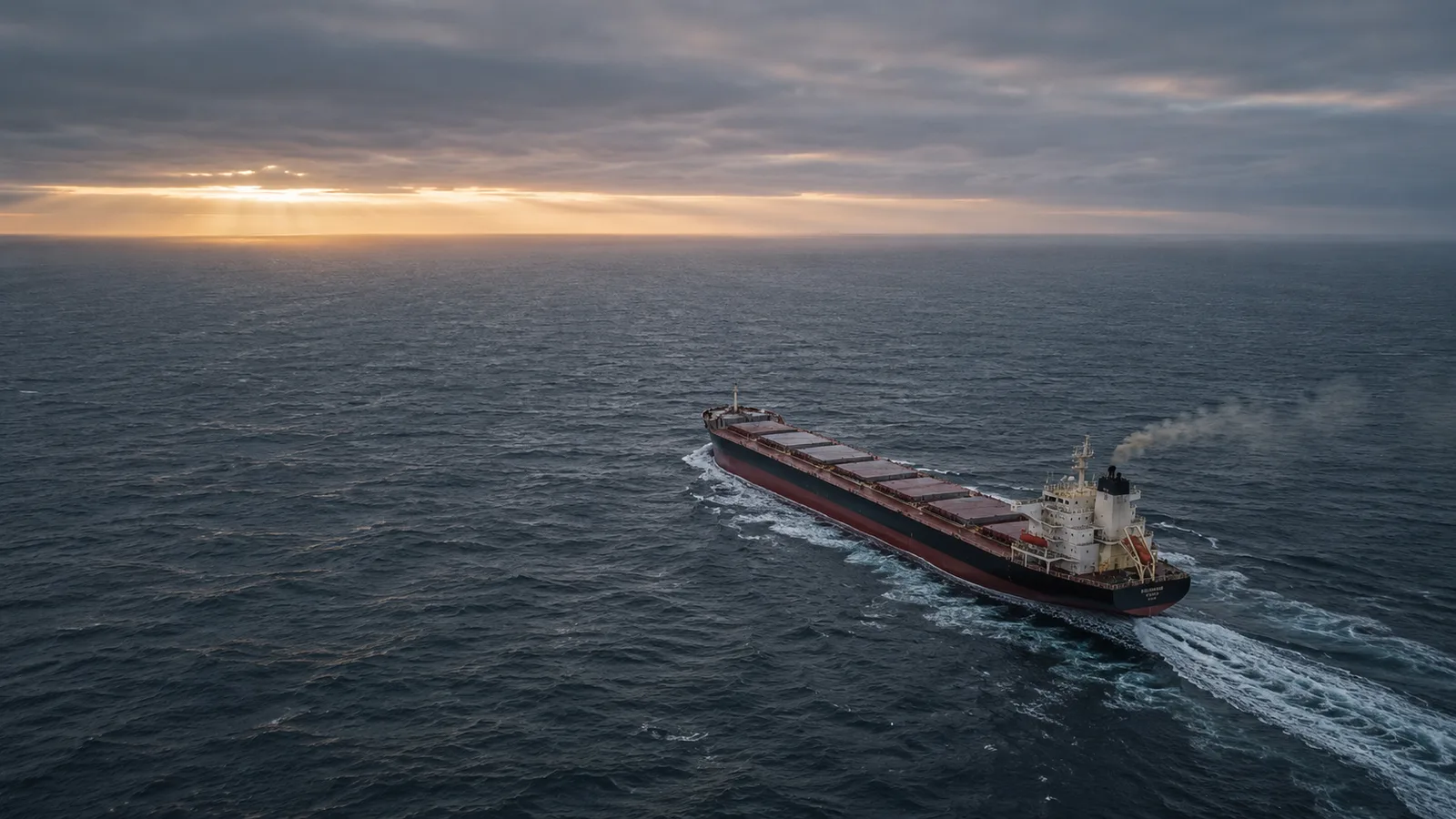
The bulk carrier of choice for wood pellet shipments at this scale is a Panamax — a vessel of roughly 60,000 to 70,000 deadweight tonnes, originally sized to fit the locks of the Panama Canal. Bigger vessels exist, but the trade has standardised around the Panamax for reasons of port access at both ends.
The largest pellet export terminals sit on the US Gulf Coast — concentrated in Louisiana, Mississippi, Alabama, and Georgia, where the southern pine forests of the United States feed an industry of pellet mills built specifically for the European and Asian export market. Smaller volumes ship from British Columbia (Canada), the Baltic states (Estonia, Latvia, Lithuania), and Brazil. The combined pellet flow into Europe — Denmark, the UK, Belgium, the Netherlands — runs to several hundred Panamax voyages annually. The flow into East Asia adds another major leg.
These voyages are highly engineered, automated, and continuous. The supply chain runs all year — there is no seasonal variation, because the power stations do not have a season. From the US Gulf Coast to a UK or Northern European port is approximately 4,500 nautical miles, or roughly two weeks at typical Panamax speed. From British Columbia via the Panama Canal, the same voyage runs around 10,500 nautical miles, or close to a month. The ships burn conventional very-low-sulphur fuel oil (VLSFO) along the way — the same fuel used by container ships, oil tankers, and almost every other ocean-going commercial vessel.
This is the part where the accounting gets interesting.
§5 — The two books that don't match
Under European and UK climate regulation, sustainable biomass is treated as zero-carbon at the point of combustion. The wood pellets burned each year by Europe's converted coal plants produce, by national accounting, approximately zero tonnes of CO₂. This is not an oversight. It is a deliberate policy choice based on the regrow-and-rebalance theory of biomass carbon, codified in the EU Renewable Energy Directive (RED III) and mirrored in the UK's equivalent framework.
Under the same European and UK regulation, the fossil fuel burned in the bunker tanks of a Panamax bulk carrier is not zero-carbon. From July 1, 2026, the United Kingdom's emissions trading scheme — UK ETS — extends to vessels of 5,000 gross tonnes and above operating on UK domestic voyages or sitting in UK ports. Every tonne of VLSFO burned by a Panamax discharging pellets at a UK port, while alongside, generates a carbon liability. The shipowner — or, depending on the contract, the charterer — has to surrender emissions allowances to cover those emissions. The EU ETS already does the same on the EU side, with international voyages calling at EU ports surrendering allowances on 50% of their voyage emissions.
So one cargo, one supply chain, two completely different carbon treatments. The pellet itself, sitting inside the ship's hold, is treated as carbon-neutral. The fuel burning in the ship's engine, propelling that pellet across the ocean, is not.
Picture a delivery system where the package is taxed at zero because of what it contains, while the truck delivering it pays full duty because of what it runs on. The package's carbon status does not transfer to the vehicle. The two systems were written separately, under different policy logics, and they apply at the same time to the same trip.
This is not technically arbitrage, and it is not a loophole. It is what happens when two different ways of accounting for carbon meet at a single supply chain. And the freight market is the place where that meeting first becomes visible.
§6 — What changes in 2027 (and beyond)
Several shifts are about to ripple through the converted-coal-to-biomass supply chain. They matter to the broader bulk freight market, not just to individual plants.
First, sourcing patterns are reorganising. The UK's largest biomass operator announced in February 2026 that from 2027 it will stop sourcing wood pellets from Canada and rely entirely on the United States. The Canadian pellet output will redirect to East Asian buyers — particularly Japan and South Korea, where biomass demand is growing as their own coal-to-biomass conversion programmes scale up. Pellets that used to cross the Pacific to Asia and the Atlantic via Panama to Europe are reorganising into two cleaner streams: transatlantic to Europe, transpacific to Asia.
Second, demand is set to contract on the European side. The UK government has capped its largest biomass operator at 27% of maximum capacity from 2027 (down from 65 to 70% historically), with the subsidy framework scheduled to be renegotiated in 2031. Denmark's biomass conversions are mature but not expanding meaningfully. The European biomass freight flow, in aggregate, is more likely to plateau or decline through the late 2020s than to grow.
Third, the carbon accounting frame is tightening. The UK government has signalled that from 2028 it may extend UK ETS to cover not just in-port emissions but international voyages calling at UK ports. The EU ETS already prices 50% of international voyage emissions at EU port calls. If the UK proposal is confirmed, the entire transatlantic voyage delivering pellets from the US Gulf to a European port will sit inside the carbon accounting framework. The “free” portion of the journey — the long ocean leg — will no longer be free.
For the pellet trade, the combination of demand contraction in Europe and a new cost layer on the voyage means the economics of moving biomass at scale are about to change. Charter contracts, freight rates, and the choice of source basin all start to look different when the voyage has a carbon price attached.
§7 — A small test bed for a much larger question
The global seaborne biomass pellet trade is around 25 to 30 million tonnes per year. That makes it small by the standards of dry bulk — coal is hundreds of millions of tonnes, iron ore over a billion. But what happens in this niche is structurally informative for everything else.
Biomass is the first cargo type where the policy framework treats the cargo and the carrier as belonging to different carbon worlds. The cargo's renewable status is established at one regulatory layer (the energy directive). The carrier's bunker emissions are charged at another (the maritime emissions trading scheme). These two layers were not designed to interact. They now do, every voyage.
The pattern will repeat as more cargoes acquire similar regulatory status. Sustainable aviation fuel feedstocks — used cooking oil, advanced biodiesel components — already sit in the same accounting tension. So do some renewable hydrogen carriers (ammonia, methanol) that may emerge later this decade. Each of these is “green” by the framework of its end-use sector and “fossil-burdened” by the framework of the maritime sector that delivers it.
The freight market is the first place this tension shows up because it is the most measurable. A carbon allowance has a price. A voyage has a fuel consumption. Multiply the two, and you have a number that can be added to a charter party. Once that number exists, every other accounting question downstream — who pays, who passes through, who optimises by re-sourcing — becomes a commercial decision rather than a regulatory abstraction.
Pellets are the first cargo to make this tangible at scale. They will not be the last.
Closing
Europe's converted coal plants were rebuilt to make electricity cleaner. On the accounting terms set by the EU and UK policy frameworks, the conversion worked: a meaningful share of European power generation now counts as zero-carbon at the point of combustion.
The wood that makes that possible crosses an ocean. The ships that carry it do not run on zero. The freight market has begun to price the seam — at port today, at international voyages by 2028, and across an expanding range of cargoes in the years that follow.
Carbon is counted where the policy says it is counted. Fuel burns where the ship sails. Those are not the same place.