§1 — What Changes on July 1
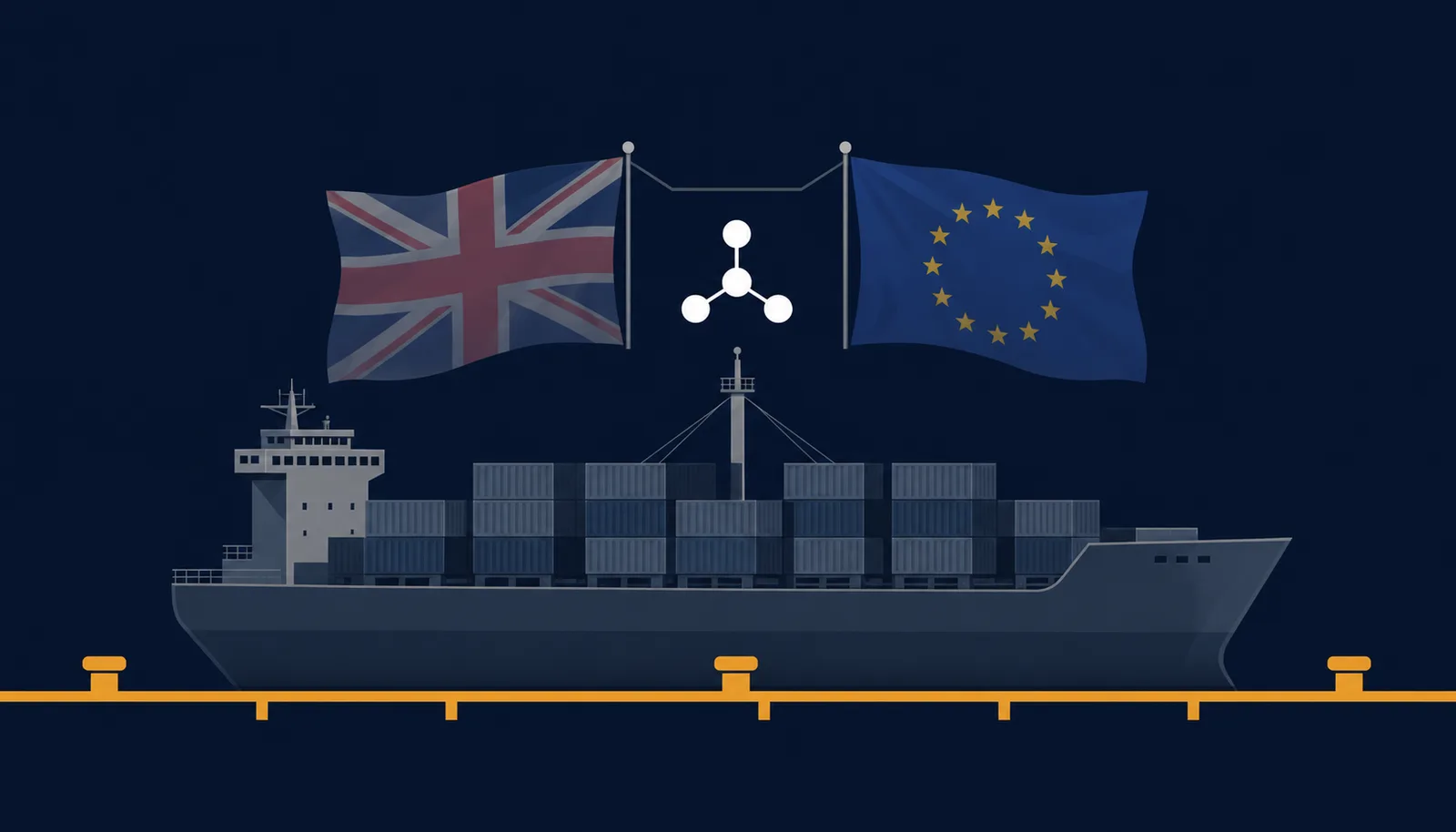
On July 1, 2026, the United Kingdom's Emissions Trading Scheme expands to cover maritime transport. The change applies to any vessel of 5,000 gross tonnes or above that calls a UK port. The obligation is precise: operators must surrender UK Allowances (UKAs) for in-port emissions at any UK port, and for 100% of emissions on domestic voyages — voyages where both the departure and arrival ports are in the UK.
International voyages — arriving from or departing to a non-UK port — are currently out of scope for the voyage leg itself. But in-port emissions at the UK end are in scope from day one. A container ship calling Felixstowe on a service from Shanghai owes nothing for the 20,000-mile ocean crossing. It owes allowances for every hour the engines run at berth.
The greenhouse gases covered are CO₂, CH₄, and N₂O, measured on a tank-to-wake basis — from the fuel in the tank through to combustion. The UK Monitoring, Reporting and Verification (MRV) Regulation, which previously required annual emissions reporting for large vessels, was revoked on April 2, 2026. It is replaced by the UK ETS MRV framework from July 1.
The minimum vessel size threshold — 5,000 GT — means the scheme covers commercial ferries, container ships, bulk carriers, tankers, cruise ships, and most large ro-ro vessels. It does not cover fishing vessels, naval vessels, or most coastal supply vessels below the threshold.
§2 — UK ETS vs EU ETS: Two Markets, Different Rules
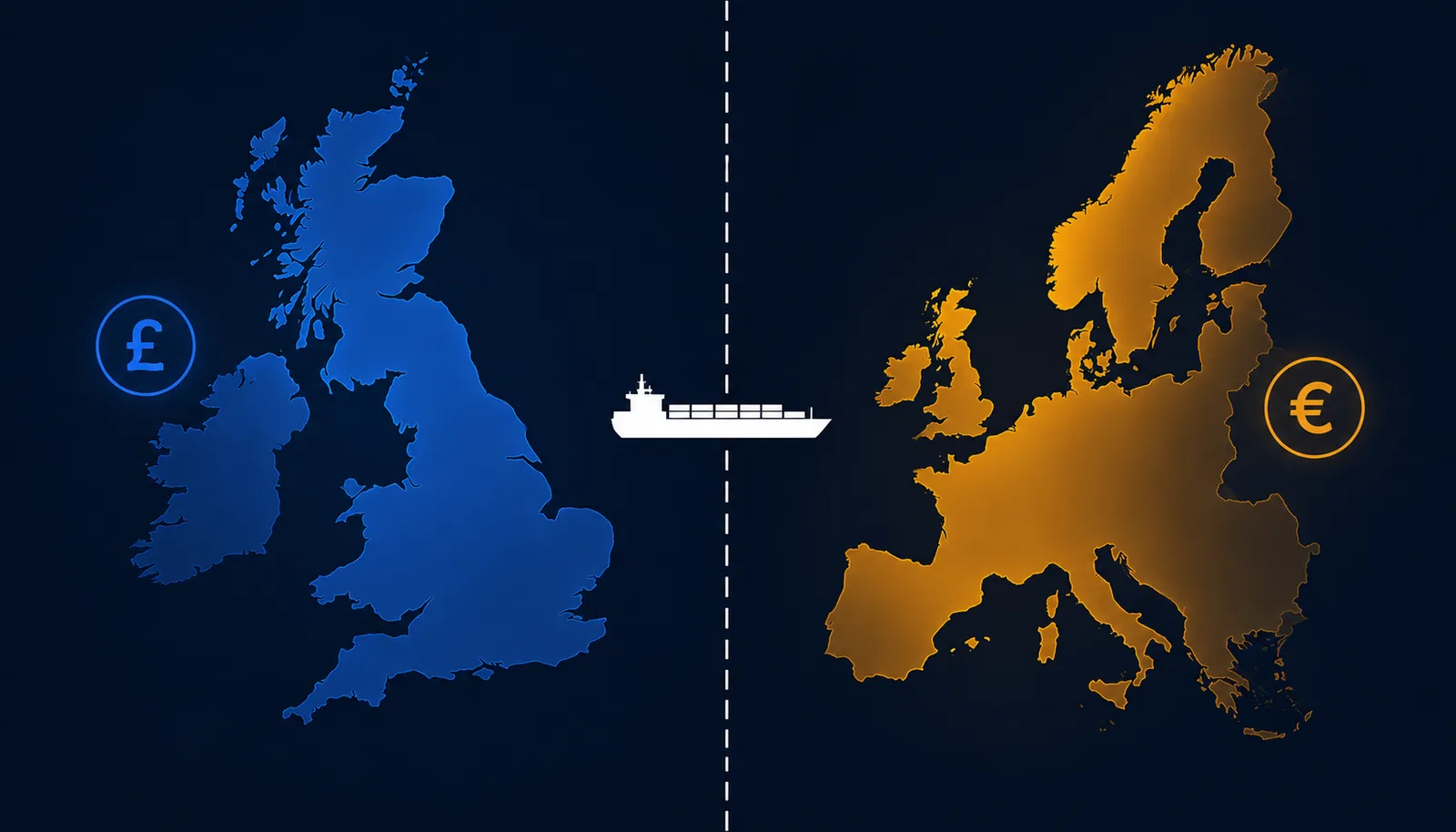
The most important operational fact about UK ETS is that it is entirely separate from EU ETS. UK Allowances and EU Allowances are not interchangeable. A vessel that surrenders EUAs for Rotterdam cannot apply those same allowances to Felixstowe.
Think of the two systems as parking meters at different car parks. The Rotterdam meter takes euros. The Felixstowe meter takes pounds. Arriving at Felixstowe with a pocket full of euros does not help. A ship calling both ports on the same roundtrip voyage — Hamburg, Rotterdam, Felixstowe, Le Havre — owes allowances in two separate currency-denominated markets, bought from two separate registries, surrendered on two separate deadlines.
The price differential matters commercially. UK Allowances have traded in the £30–£55 range through 2025–2026. EU Allowances have traded €65–€85 over the same period. At current exchange rates, UK carbon is roughly 30–40% cheaper per tonne than EU carbon. For a vessel making regular UK calls, the split compliance obligation means two sets of accounts, two sets of purchases, and two sets of deadlines — but the UK side is currently the cheaper obligation.
The surrender deadlines also diverge. EU ETS requires surrender by September 30 each year. UK ETS requires surrender by April 30 — one month after the Annual Emissions Report deadline of March 31. For the first two scheme years (2026 and 2027), UK ETS has granted a combined deferral: operators surrender for both years by April 30, 2028. This is a one-time administrative relief, not a permanent feature of the scheme.
§3 — The Compliance Machinery
The compliance cycle has four steps. The first is the Emissions Monitoring Plan (EMP) — a document setting out how the operator will measure emissions. The EMP must be submitted to the UK ETS Authority within 42 days of the first qualifying maritime activity from July 1. Operators who have already registered under the UK MRV system may be able to adapt their existing monitoring methodology.
The monitoring methodology must cover three greenhouse gases on a tank-to-wake basis: CO₂, CH₄, and N₂O. The “tank-to-wake” boundary starts at the fuel storage tank and ends at the exhaust — it includes combustion in main engines, auxiliary engines, and boilers. Fuel consumption data is the primary input. Sustainable fuels — biofuels and RFNBOs (Renewable Fuels of Non-Biological Origin) — are zero-rated from the start of the scheme.
The Annual Emissions Report (AER) must be submitted by March 31 of the year following the reporting period, and must be verified by a UKAS-accredited independent verifier before submission. Allowances must be surrendered by April 30 — one month later. For 2026 and 2027, both years are covered by a single combined deadline of April 30, 2028.
Operators that miss the surrender deadline face a civil penalty. The 2026 reference price for the civil penalty calculation is set at £49.41 per tonne — meaning non-compliance is priced at roughly market rate, not as a punitive multiplier. The UK ETS Authority has indicated it will follow a proportionate enforcement approach during the initial transition.
A specific carve-out applies to voyages between Northern Ireland and Great Britain. Because Northern Ireland remains within the EU single market for goods through the Windsor Framework, NI-GB voyages would otherwise face double pricing — once under EU ETS, once under UK ETS. The UK ETS Authority addresses this by applying a 50% surrender deduction to NI-GB voyages: operators surrender allowances for only half the emissions on the voyage leg itself. In-port emissions at both Northern Irish and British ports remain at the full 100% obligation. The deduction applies only to the voyage between the two jurisdictions, not to time at berth — a detail that matters for ferry operators like Stena Line and P&O on the Belfast-Liverpool and Belfast-Cairnryan routes.
For operators who have not yet registered: the Environment Agency is currently supporting early onboarding into METS, free of charge, with the aim of getting EMPs approved before July 1. The process is digital and can be initiated through the METS platform or by contacting the EA maritime team directly. Operators who arrive at July 1 without an approved EMP are not in breach — the 42-day grace window applies from the date of first qualifying activity. But the monitoring obligation starts on Day One regardless. Data must be collected from the first qualifying port call, whether or not the EMP has been approved.
§4 — What It Costs: A Voyage-Level View
The cost of UK ETS compliance is not uniform across vessel types. For a VLCC arriving at Milford Haven on an international crude voyage, the obligation is limited to in-port emissions during the discharge call. A 72-hour berth with auxiliary engines running generates roughly 75 to 115 tonnes of CO₂. At £50 per UKA, that is £3,750 to £5,750 — a real but manageable addition to a voyage generating hundreds of thousands of dollars in freight.
A container ship calling Felixstowe on a Far East–Europe loop faces a similar structure. The voyage from Shanghai is exempt; the 36-hour terminal call is in scope. With reefer cargo and substantial auxiliary load, in-port emissions might run 38 to 57 tonnes — a UK ETS cost of £1,900 to £2,850 per call. For a ship making 12 UK calls a year, that is £23,000 to £34,000 — worth building into route economics.
The domestic coastwise trade carries a heavier obligation. For a Handysize bulk carrier making a domestic coastwise voyage — for example, loading iron ore at Immingham for the Tata Steel works at Port Talbot, or loading biomass at Liverpool for the Drax power station — the cost includes both the voyage emissions and the in-port emissions at both ends. A two-day coastwise voyage at 12 knots burning 25 tonnes per day, plus two port calls of 36 hours each, might generate 200 to 280 tonnes of CO₂. At £50 per tonne, the UK ETS cost is approximately £10,000 to £14,000 ($12,500 to $17,500) — a material addition to the voyage economics.
For ro-ro and ferry operators on routes like Dover-Calais or Cairnryan-Belfast, the frequency of UK port calls makes ETS a standing operating cost rather than a voyage-by-voyage item. Operators on these routes are expected to integrate UKA purchasing into their fuel procurement cycle — buying forward against anticipated emissions, as EU ferry operators have done under EU ETS since 2024.

§5 — What Comes Next
The July 2026 scheme is Phase One. It covers in-port emissions and domestic voyages. International voyages — the ocean crossings — are currently exempt from the voyage leg. But Phase Two is already in consultation.
In November 2025, the UK ETS Authority published a consultation proposing to expand UK ETS to cover international voyages from 2028 — following the EU model of 50% coverage initially, phasing to 100%. If adopted, a container ship arriving from Singapore would owe UK ETS obligations for half the voyage emissions from the last non-UK port, not just for berth time. The consultation closed in early 2026; the Authority's response is expected before the end of 2026.
The more significant structural development is the proposed UK–EU ETS link. In May 2025, the UK and EU committed to exploring the linking of their respective ETS systems. A linked system would allow UKAs and EUAs to be treated as equivalent — eliminating the dual-registry, dual-deadline, dual-currency compliance burden for operators trading across both jurisdictions. For shipping, where a single vessel may call a dozen EU ports and eight UK ports in a month, a linked system would simplify compliance considerably.
No implementation date for the link has been confirmed. ETS linkage negotiations are technically and politically complex — the EU's previous link with Switzerland took over a decade to implement. Industry bodies, including the Chamber of Shipping and the International Chamber of Shipping, have identified ETS linkage as a priority ask in post-Brexit maritime relations.
In the meantime, operators face two separate compliance obligations. The immediate priority for any operator calling UK ports who has not yet registered with the UK ETS Authority and submitted an Emissions Monitoring Plan is to do so before July 1 — or as quickly as possible thereafter. The 42-day window for EMP submission runs from first qualifying activity, not from a centrally assigned date. For operators already active in UK ports, that clock may already be running.

- UK Government (DESNZ), UK ETS Authority Main Response: Scope Expansion to Maritime (November 2025)
- DNV, “The UK ETS expands to maritime from 1 July 2026” — implementation guide (June 2026)
- Lloyd's Register, Class News: Key requirements for domestic transport under the UK ETS (June 2026)
- UK Government, UK ETS Carbon Price for Civil Penalties 2026 (£49.41/tonne reference, November 2025)