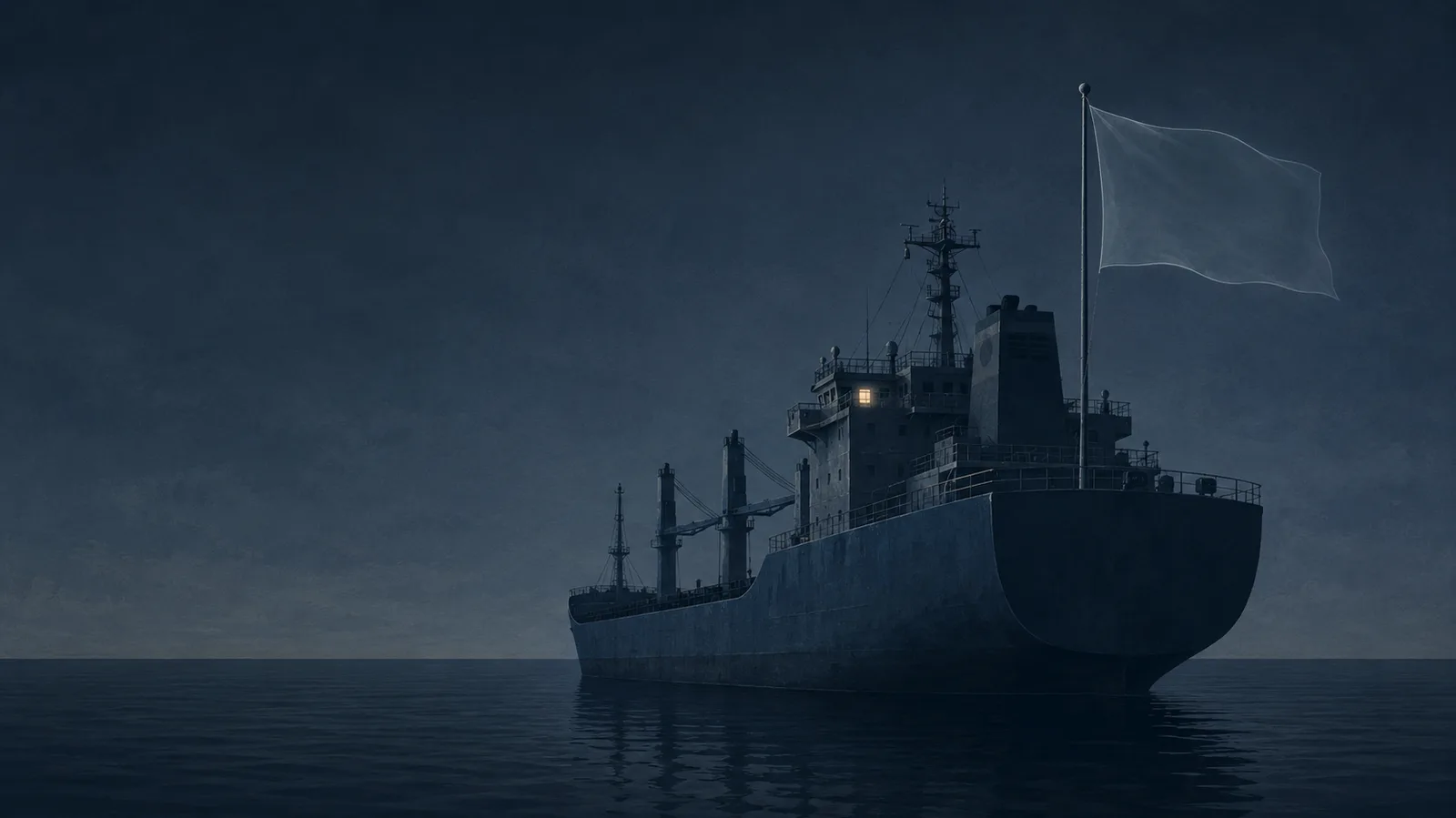
In 2024, an Indian seafarer was stranded for months on a vessel anchored at Hodeidah Port in Yemen while air strikes flashed in the night sky around him. The operating company stopped communicating, stopped paying. The crew had no wages, no relief, no clear way home. Charities sent food. He eventually came home. Many in similar positions did not.
His case is not unusual. In 2025, the International Transport Workers' Federation recorded 6,223 abandoned seafarers across 410 vessels. It is the worst year ever documented for vessel abandonment, the sixth consecutive record, and the fourth straight year of record-high seafarer counts. Year-on-year, ship abandonments rose 31% and abandoned seafarers rose 32%. The aggregate unpaid wages reached USD 25.8 million. The ITF has so far recovered USD 16.5 million through interventions and legal action. USD 9.3 million remains outstanding.
The instinct, when reading numbers like this, is to treat them as a humanitarian story. They are. But they are also a market signal. The abandonment data describes a specific failure mode in the international shipping system, and it describes that failure mode with enough precision now to read it as a commercial risk variable, the way one reads bunker volatility or chokepoint exposure. The reading below takes that view.
The argument is structural and it has three parts. First, the global seafarer workforce is concentrated in a small number of supplier countries. Second, the abandonment events are concentrated in an almost entirely different set of places. Third, the connecting tissue between the two — the flags of convenience system — is doing the thing it was designed to do, which is to make liability difficult to locate. The two maps of maritime labour do not overlap, and that gap is exactly what the FOC system rents out.
The First Map — Where Crews Come From
The global seafarer workforce, according to the BIMCO and ICS Seafarer Workforce Report 2021 (the most recent comprehensive edition; the 2026 update is in preparation), stands at approximately 1.89 million STCW-certified seafarers. About 857,540 of them are officers and 1,035,180 are ratings. Five countries supply 44% of the total: the Philippines, the Russian Federation, Indonesia, China, and India.
The Philippines is the single dominant supplier. By 2024, the country had deployed 504,057 sea-based workers on foreign-flagged vessels. Those workers sent home USD 6.94 billion in remittances that year. Sea-based remittances make up roughly a fifth of the Philippines' total overseas-worker remittance flow, and total OFW remittances together account for around 8–9% of national GDP. The Maritime Industry Authority in Manila has reported deployment levels of around 40,000 seafarers per month at peak. There is no other country that operates a maritime workforce at this scale relative to its own economy.
Behind the top five is a long tail. Ukraine was historically the sixth-largest officer-supplier — a position significantly disrupted since 2022, when the war shifted recruitment patterns across the Black Sea. Russian seafarers, also a top-five supplier in the 2021 data, have similarly seen reduced uptake by Western owners due to sanctions and insurance complications. India and the Philippines have absorbed most of the gap. India in particular has grown into a dominant supplier of engineering officers and cadets — a fact that will become important again later in this piece.
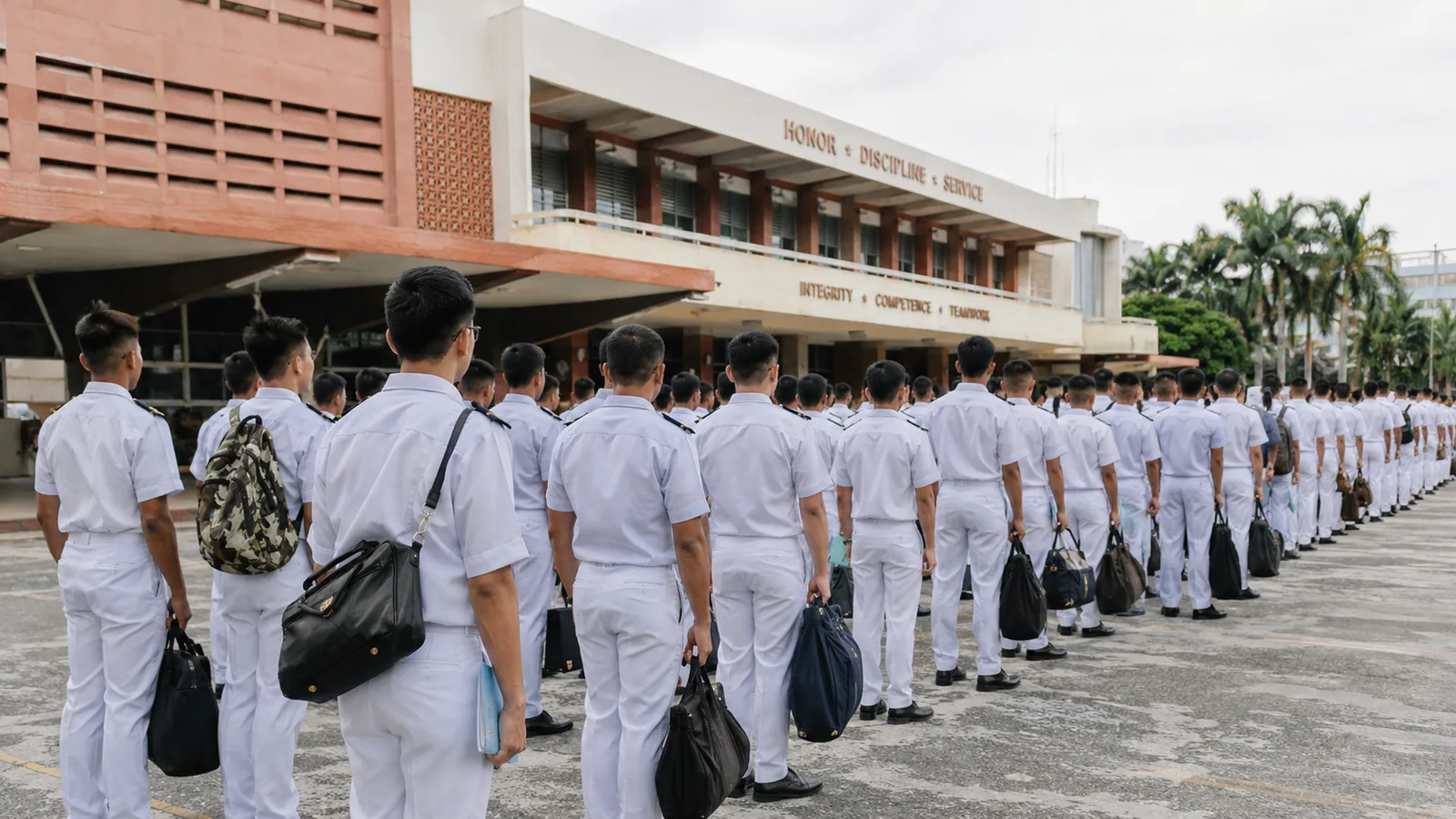
The geographic concentration matters. The shipping industry is not, despite its global reach, drawing on a uniformly distributed labour pool. It is drawing on a small number of specific national workforces, each with its own training infrastructure, its own deployment agencies, its own remittance dependence, and its own bargaining position when something goes wrong at sea.
The Second Map — Where Crews Get Stranded
The second map looks nothing like the first.
The ITF's 2025 data shows that the Middle East accounted for the highest regional share of abandonment cases globally. Within that, the United Arab Emirates appears repeatedly in case files, with port agents and welfare organisations documenting clusters of stranded vessels at anchorages around the Gulf — 54 vessels in 2025 alone. Türkiye recorded 61 vessels, the highest single-country count for the year, and remains outside the Maritime Labour Convention framework, which it has yet to ratify. Together, the two countries accounted for around 28% of all abandonment cases in 2025.
Asia Pacific, despite being the home region of most supplier countries, accounts for a far smaller share of abandonment events. The Philippines, Indonesia, India, and China are sending crews out. They are not, by and large, the places where those crews get stranded.
This is the central geometric fact of the modern seafarer abandonment problem. The labour is exported from one set of countries and the liability collects in an entirely different set. The crews leave Manila and arrive, eventually, at an anchorage in Sharjah or at a layup berth in Tuzla. When the operator stops paying, the crew is far from the legal infrastructure of their home state and far from the port-state enforcement of any MLC-aligned regime.
The disproportionality is sharper than the supplier map alone suggests. India sits fifth on the supplier ranking but first on the abandonment ranking. Indians made up 1,125 of the 6,223 stranded seafarers in 2025 — roughly 18% of the total, against India's roughly 12% share of the global seafarer workforce (per India's Directorate General of Shipping). The explanation is not random distribution. India is the dominant supplier of engineering officers, and engineering officers are exactly the role profile that crews the small bulk carrier and product tanker segment where most abandonment events take place. The supplier-mix and the abandonment-mix are correlated, but not through the path most observers would assume.
The 82% Rule — The Flag of Convenience System
Between the two maps sits the flag of convenience system, and the system explains the gap with uncomfortable precision.
82% of the vessels involved in 2025 abandonment cases — 337 of the 410 ships — were registered under flags of convenience. FOC vessels make up an estimated 30% of the global merchant fleet by count. They produced over four-fifths of the abandonment events. The numbers do not just lean against FOC vessels. They overwhelm.
Panama remained the single most-cited registry on the 2025 abandonment list, with 68 vessels — far ahead of any other flag state. The composition behind Panama is more interesting than the headline. St. Kitts & Nevis abandonment cases rose 150% year-on-year in 2025, the largest single increase in any registry and the only newcomer to the top five. Cases involving vessels with unknown or unverified flags more than doubled. Smaller registries with the thinnest enforcement capacity continue to expand their share, and the proportion of cases the ITF can categorise at all is shrinking.
The flag of convenience system is, by design, a structure that allows beneficial owners in one country to register their vessels in another country with weaker oversight, lower operating costs, and looser enforcement of labour standards. Some FOC registries function as serious maritime administrations. Many do not. The ones that consistently appear on the abandonment list are, almost without exception, the ones with the thinnest enforcement capacity, the lowest registration costs, and the most permissive attitude toward owner anonymity.
The flag is the document. The geography is the product. A registry with thin enforcement sells the second while appearing to provide the first. The vessel owner pays for the flag. The crew, when the owner walks away, pays for the distance.
This is what the 82% figure is actually telling the market. It is not that flags of convenience cause abandonment. It is that flags of convenience are the legal infrastructure that allows abandonment to happen at scale without triggering the enforcement mechanisms that would otherwise stop it earlier.
The Cases Underneath the Aggregate
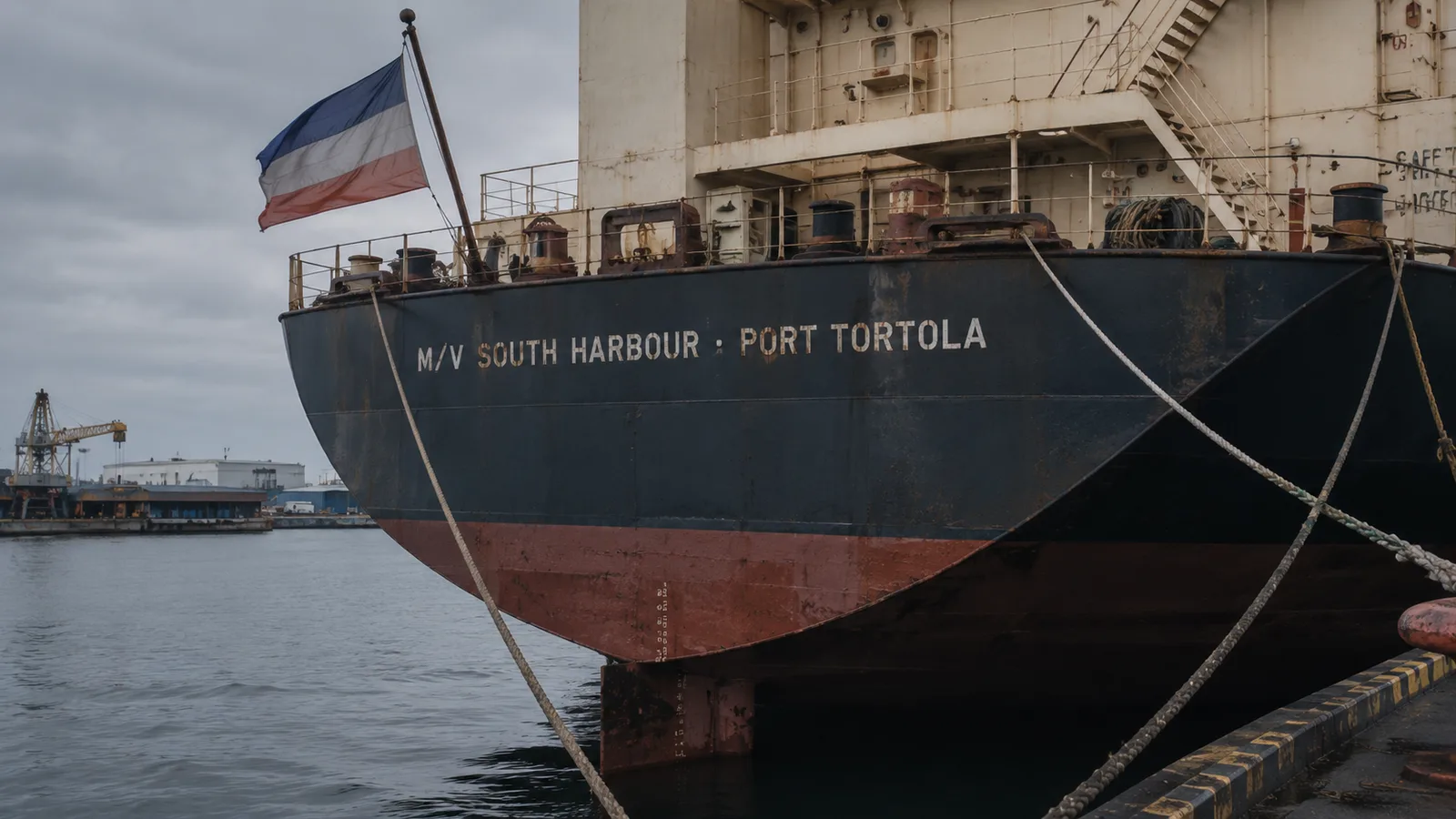
The case files contain the kind of structural absurdities that get lost in the aggregate. In November 2025, an oil tanker carrying approximately 750,000 barrels of Russian crude — roughly USD 50 million worth — was abandoned at anchor off the Chinese coast. The crew had not been paid for months. The cargo sat in international waters while the ITF negotiated wages, food, and water deliveries from shore. The vessel had sailed from a Russian export terminal in November on what appeared to be a routine voyage, and ended it as an unpaid floating storage unit in disputed legal status.
The case is not exceptional. General cargo ships accounted for 164 of the 410 abandoned vessels in 2025 — 40% of the total, by far the largest vessel-type category. Bulk carriers, product tankers, and the smaller end of the chemical tanker fleet make up most of the rest. The list is dominated by ships that operate on thin margins, with limited insurance cover, often under sanctions-affected or compliance-distant ownership structures. These are precisely the vessels that the marginal-owner segment of the global fleet has been built around.
What Is Actually Driving the Trend
The 2025 numbers are not a single-year spike. They are the aggregation of structural conditions that have been building since at least 2020. The record-each-year pattern is the giveaway. Cycles produce spikes. Structures produce trends.
Several forces are at work simultaneously. The shipping cycle has produced a multi-year period of high freight rate volatility, in which medium-sized owners with thin margins have been particularly exposed. Bunker prices have remained historically elevated, compressing profitability on older tonnage. Sanctions enforcement against shadow-fleet operators has added compliance pressure that some owners have responded to by simply walking away from vessels rather than paying for arrest releases. And the FOC registries that absorb these vessels have, in many cases, not strengthened enforcement proportionally.
The cumulative effect is that the marginal owner — the one operating a single second-hand bulker or a small product tanker under a low-cost flag — has been the dominant source of abandonment events. When market conditions tighten or sanctions hit, that owner's economic model collapses, and the crew is the part of the model that absorbs the loss.
What This Means for the Commercial Side
For charterers, shippers, insurers, and operators upstream of the affected crews, the abandonment data has become a diligence input. It was not previously treated this way. The shift has been slow. The direction is clear.
Three commercial implications follow from the structural reading above.
The first is flag risk in chartering decisions. A charterer fixing a voyage on a vessel registered under a high-abandonment FOC registry is now taking on a non-trivial reputational and operational risk. If the owner stops paying the crew mid-voyage, the cargo can be detained, the vessel can be arrested, and the charterer can find themselves party to a humanitarian situation they did not contract for. Several large commodity houses and oil majors have, over the past two years, quietly tightened internal vessel vetting criteria around FOC registry and prior abandonment history. The aggregate dataset is the empirical backbone of that vetting.
The second is insurance pricing. P&I clubs already factor abandonment exposure into premiums for certain flag registries, but the granularity is increasing. Underwriters are starting to ask not just which flag, but which owner, which manager, which historical record of port state control deficiencies. For some segments — small bulk and product tankers in particular — the premium gap between top-tier flags and high-abandonment FOC registries is widening, and that gap is beginning to flow through to charter rate differentials.
The third is route exposure. Voyages that terminate at anchorages in the Arab World or layup zones in the Eastern Mediterranean carry, on a probabilistic basis, a higher abandonment risk profile than equivalent voyages terminating in MLC-strict ports. This does not mean those voyages should be avoided. It means they should be priced. In most freight markets today, they are not.
The Backstop That Is Not the State
One more structural observation. The recovery mechanism that actually pays abandoned crews — to the tune of USD 16.5 million in 2025 — is the ITF inspectorate. It is a non-governmental network of port-side inspectors, welfare officers, and legal advisors operating under the auspices of the International Transport Workers' Federation. It is not a state apparatus. It does not have police powers. It works through pressure on shipowners, P&I clubs, and port authorities, and through legal action in the few jurisdictions where action is possible.
The state-level enforcement that the Maritime Labour Convention notionally provides is, in most of the high-abandonment regions, either absent (Türkiye not ratified), or under-resourced (parts of the Arab World), or wilfully thin (the worst FOC registries). The 2022 MLC amendments and the 2023 IMO resolution LEG.6(110) have improved coordination on paper. The day-to-day work of getting unpaid wages into the hands of stranded crews is still being done by an NGO with charitable funding.
A second backstop is beginning to emerge from an unexpected direction — the supplier states themselves. In September 2025, the Indian Directorate General of Shipping identified 86 vessels linked to repeat abandonment cases, port detentions, and unidentifiable beneficial ownership, and blacklisted them. Indian crewing agencies are now banned from deploying Indian seafarers on those vessels. It is, effectively, supplier-state enforcement filling the gap left by flag-state enforcement. The ITF formally submitted the 2025 abandonment dataset to the IMO ahead of its 113th Legal Committee session in April 2026, where the matter was added to the standing agenda. The ITF has called on other supplier countries — the Philippines is the obvious next candidate — to follow India's lead. If that pattern spreads, the labour map starts to develop its own defensive geometry, and the FOC registries lose some of the regulatory distance they currently sell.
What 2025 Is Actually Showing
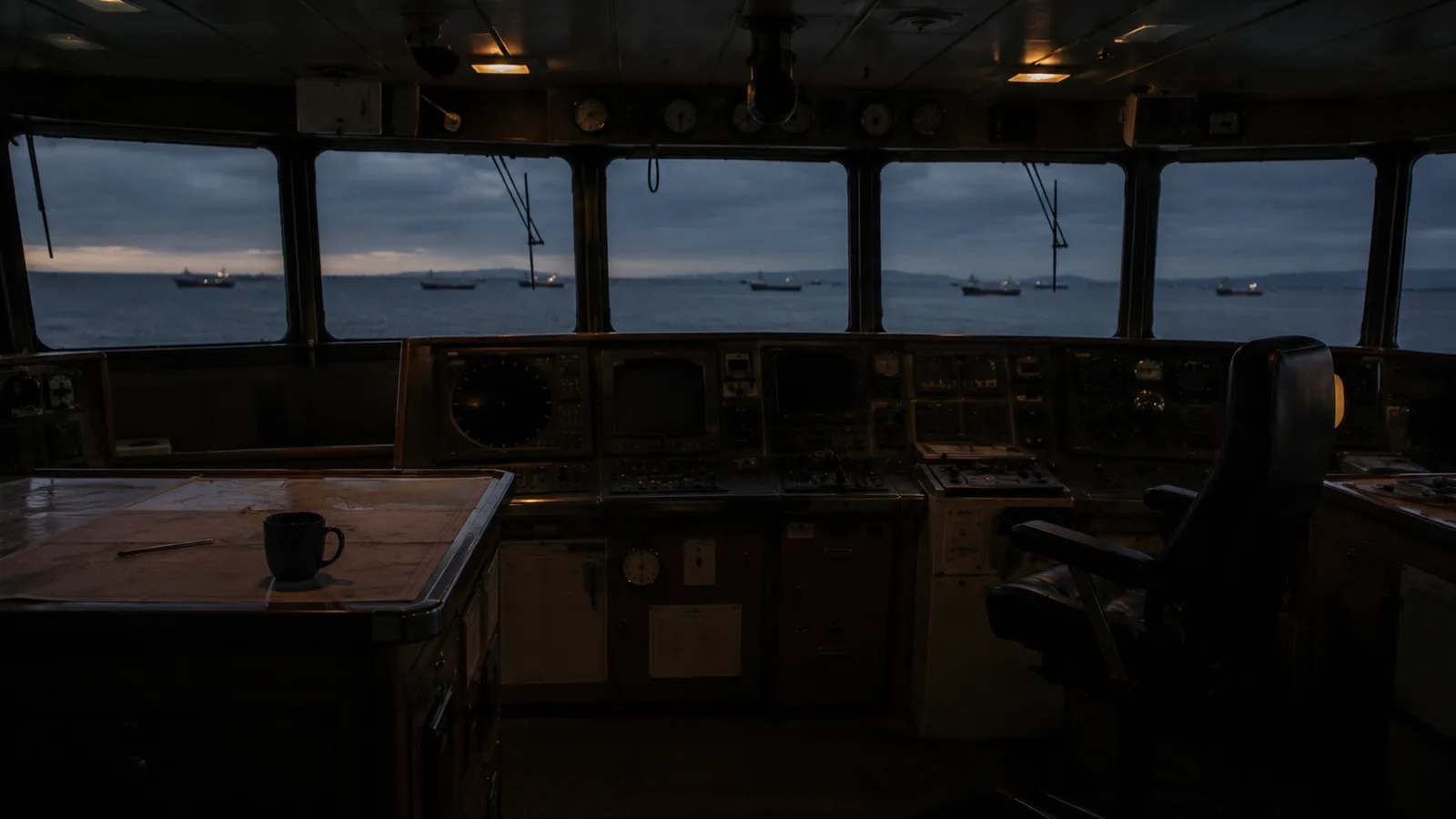
The 2025 abandonment figures are not an anomaly. They are the visible tip of a structural process that has been building since at least 2020. The conditions that produced them — high freight volatility, sanctions pressure, fragmented FOC enforcement, and a labour supply concentrated in a small number of countries with limited diplomatic leverage in the ports where their workers end up — show no sign of unwinding.
The likely trajectory through 2026 and 2027 is more of the same, with the additional pressure of the EU ETS phase-in and the upcoming IMO net-zero framework adding further cost compression on the marginal-owner segment that produces most of the abandonment events. The 2026 BIMCO/ICS Seafarer Workforce Report, when it lands, will likely show the labour supply continuing to concentrate in the same small set of countries, with new pressures on retention as the abandonment record becomes more visible to prospective recruits.
The two maps will continue not to overlap. The system, including the FOC layer between them, is functioning exactly as designed. The cost of that design is now legible enough that it has started to enter commercial decisions. Markets that operate on borrowed backstops eventually reprice. This one is at the early stage of doing so.
The 2026 figures, in mid-year, already point in the same direction. By the end of May 2026, the ITF had recorded 158 abandonment cases involving 222 vessels and 2,280 seafarers, with USD 13.1 million in unpaid wages — a 30% year-on-year increase on the same period in 2024. The trajectory implied is another record. The “sixth consecutive record year” framing may, by January 2027, become seventh.
A 02:47 berth, as we wrote yesterday, is the cheapest hour the port could give the ship. A crude tanker anchored without pay off the Chinese coast for months, in the same accounting, is the cheapest crew the flag could give the owner. Both are optimization outcomes. Both are also, eventually, a price that someone else pays.
Read on flag-state structures and routing risk? Why Ships Arrive at Strange Hours or try the Calculator.