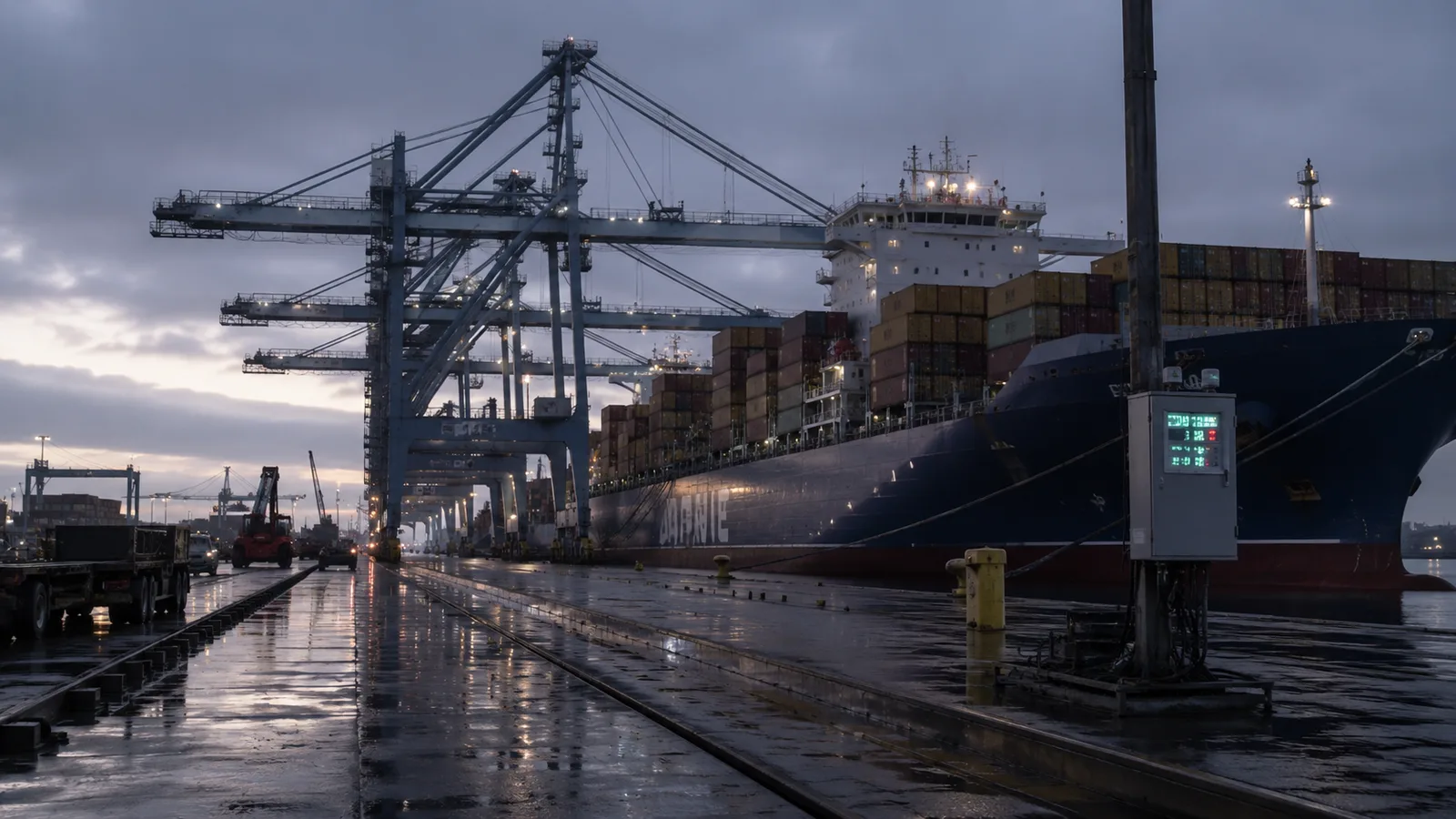
The United Kingdom's Emissions Trading Scheme extended to maritime on July 1, 2026. The legislation had been confirmed since November 2025. The registry platform — the Maritime Emissions Trading System (METS) — had been open for voluntary onboarding since early 2026. DNV, Skuld, and the major classification societies had published compliance guides weeks in advance. The auction calendar was revised on July 1 itself to account for the additional volume.
Nothing visibly changed on the water.
No vessels diverted from UK ports. No charter fixtures repriced overnight. No spot rates moved on a UK ETS signal. The week of July 1 to July 4 — shortened by the US Independence Day holiday — produced no freight market commentary that attributed any rate movement to the new scheme.
The silence is not an accident. It is a product of how the scheme was designed.
The two-year runway
The single most important feature of the UK ETS maritime extension is its surrender timeline. Operators who accrue carbon liabilities from July 1, 2026, do not need to hand over any UK Allowances until April 30, 2028. That deadline covers both the 2026 scheme year (July 1 to December 31) and the full 2027 scheme year. Two years of emissions, one surrender date.
This "double surrender" arrangement was a deliberate policy choice. The Authority's November 2025 consultation response indicated that the deferral was intended to reduce compliance pressure during the transition period and give operators time to establish monitoring systems, engage verifiers, and build familiarity with the METS platform.
The practical effect is that no UKA needs to be purchased, transferred, or surrendered until Q2 2028. An operator calling at UK ports today is accruing a liability — a number in a monitoring system — but is not yet writing a cheque. The financial signal exists on paper. It has not yet reached the treasury department.
What the scheme covers (and what it does not)
The scope of the maritime extension is narrower than its EU counterpart.
UK ETS maritime covers domestic voyages — port to port within the United Kingdom — and emissions generated while vessels are in UK ports, including at berth and at anchorage. For a vessel transiting from, say, Immingham to Grangemouth, 100% of voyage emissions are in scope. For a vessel arriving from Rotterdam and berthing at Felixstowe, only the in-port emissions are covered. The international voyage leg is free.
This is the critical distinction from the EU ETS, which already prices 50% of international voyage emissions on routes between EU and non-EU ports, plus 100% of intra-EU voyage and port emissions under the fully phased-in 2026 surrender obligation. A Panamax arriving at Rotterdam from the US Gulf Coast surrenders EUAs on half the transatlantic voyage. The same Panamax arriving at a UK port from the same origin surrenders UKAs only on what it burns while alongside.
The UK government has signalled that this gap will close. A consultation launched in November 2025 proposes extending UK ETS to international voyages from 2028, with a 50% surrender obligation on international voyage emissions — mirroring the EU structure. If confirmed, the economics of calling at UK ports versus EU ports will converge. Until then, UK ports carry a lower carbon cost than their Continental equivalents.
The price gap
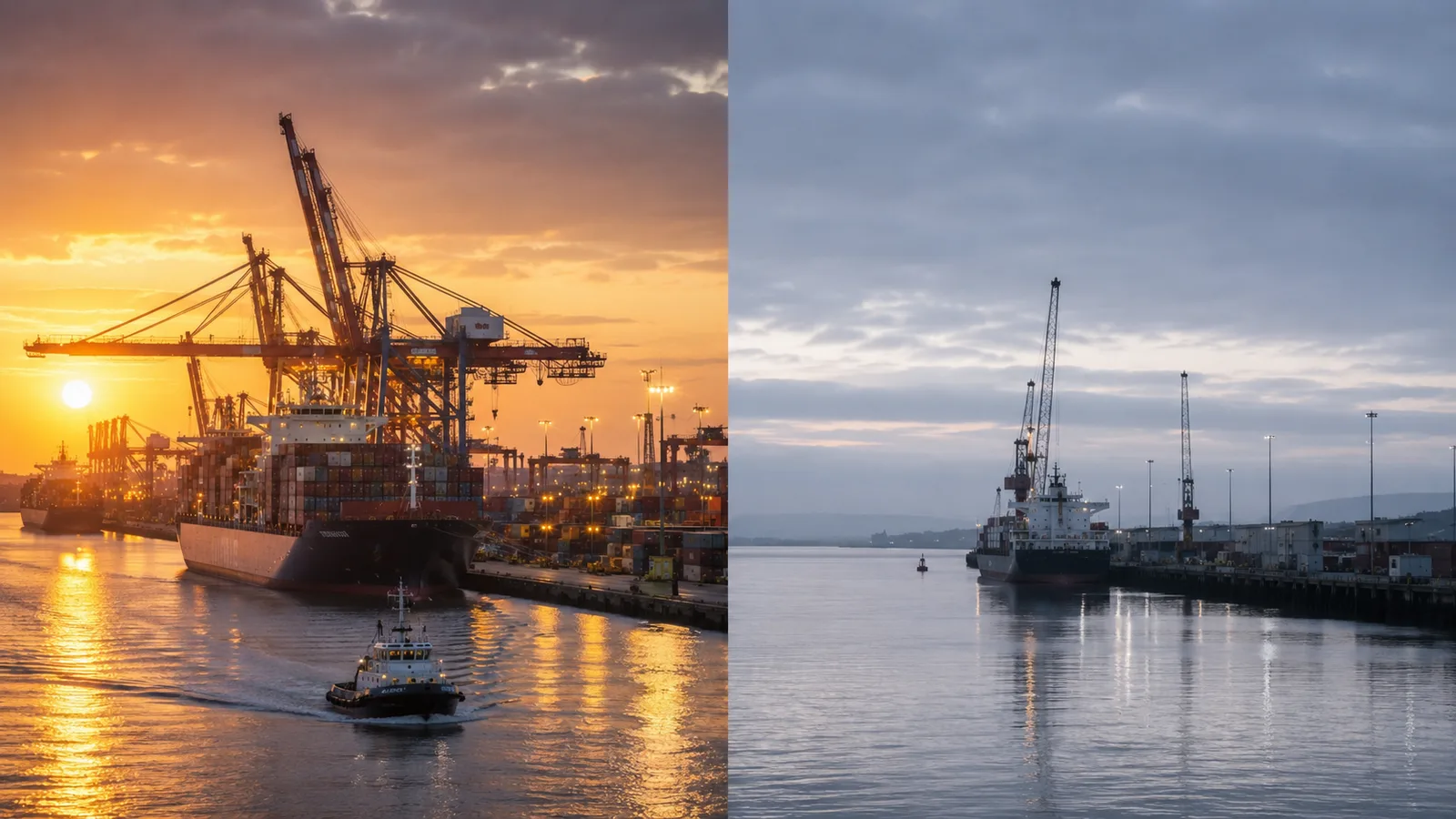
UKAs traded in the £48-52 range during the week of July 1 on the ICE secondary market. EU Allowances traded at approximately €78-82 over the same period, converting to roughly £65-69 at prevailing exchange rates. The gap — around 25% — is structural, not temporary.
The UK carbon market is smaller, less liquid, and has carried a surplus of allowances relative to compliance demand since 2023. UKA prices dropped from approximately £100 in early 2023 to record lows in 2025 before recovering modestly. The Auction Reserve Price — the floor below which bids are rejected — was raised from £22 to £28 in April 2026, but remains well below market levels.
For a shipowner or charterer calculating the cost of a UK port call, the arithmetic is straightforward. A Panamax-size vessel burning approximately 3 tonnes of VLSFO during a standard 24-hour berth stay produces roughly 9.3 tonnes of CO₂, applying the IMO emission factor of 3.114 tonnes CO₂ per tonne of fuel (MEPC.364(79)). At approximately £50 per UKA, the carbon cost for that port call is around £465 — about $590 at current exchange rates.
The same vessel at Rotterdam, now under fully phased-in EU ETS with a 100% surrender obligation on port emissions as of 2026, would pay approximately €744 for the equivalent in-port emissions — roughly £620 or $790.
The difference is not large enough to reroute trade flows. But it is large enough to appear in a charter party cost comparison — and that is where carbon pricing first becomes commercially visible.

Who pays
The UK ETS assigns the compliance obligation to the "maritime operator," which by default is the registered owner. If the registered owner is not the ISM company, the obligation may be delegated. In practice, the question of who pays is not a regulatory question — it is a commercial one, settled in the charter party.
On time charters, the owner typically bears the capital and regulatory costs, while the charterer pays for fuel. Carbon allowances sit awkwardly in between. The allowance cost is triggered by fuel consumption (a charterer expense) but the surrender obligation falls on the owner (a regulatory burden). The market has not yet settled on a standard pass-through mechanism for UK ETS costs. Some fixtures are adding carbon-cost clauses; most, so far, are not.
The EU ETS produced similar ambiguity when it extended to maritime in 2024. The market took roughly 12 to 18 months to develop standard contractual language. BIMCO published its Emissions Trading Scheme Allowances Clauses (ETSA-Voy and ETSA-TC) in 2022, with updates in 2024, which have seen moderate adoption. A UK-specific equivalent does not yet exist — though the underlying logic is the same.
The two-year deferral reduces the urgency. When no money is due until 2028, the incentive to negotiate cost-sharing now is weak. That will change.
The £465 port call and the 2028 cliff
The quiet first week is exactly what the policy was designed to produce. A scheme that began with immediate surrender obligations and international voyage coverage would have met resistance — from industry, from port authorities, and from trading partners who might have viewed it as a unilateral cost imposition.
Instead, the UK launched with the lightest possible touch. Domestic voyages only. Port emissions only. Two-year deferral on surrender. A carbon price 25% below the EU benchmark. The scheme is present but not yet pressing.
The pressing part arrives in stages.
First, March 31, 2027 — the reporting deadline for the 2026 scheme year. Operators must submit verified annual emissions reports through the METS platform. This is the administrative test: does the monitoring system work, does the verifier sign off, does the data flow.
Second, April 30, 2028 — the first surrender deadline. Two years of accrued liabilities become due. If UKA prices remain near £50, the aggregate cost for the UK's domestic fleet and visiting international tonnage will be modest. If prices rise — driven by UK-EU ETS linkage negotiations, tighter caps, or expanded scope — the bill could be materially larger than what today's price implies.
Third, 2028 (date unconfirmed) — the proposed extension to international voyages. If confirmed, every international vessel calling at a UK port will surrender UKAs on 50% of its inbound voyage emissions. The scope of the scheme — and its cost — would roughly triple.
The market is not wrong to have stayed quiet this week. The scheme as launched is small. The scheme as planned is not.
Different clocks
UK ETS and EU ETS are now both live for maritime. They charge different prices, cover different scopes, settle on different timelines, and report through different platforms. A vessel calling at both Rotterdam and Felixstowe on the same voyage now accrues liabilities under two separate carbon pricing systems — one European, one British — with no mechanism for offsetting one against the other.
This is a "different clocks" problem. The two schemes look similar from a distance. Up close, every parameter diverges: the allowance unit (EUA vs UKA), the price (€80 vs £50), the international voyage coverage (yes vs not yet), the surrender timing (annual vs double-year deferred), the registry (THETIS-MRV vs METS). Operators with vessels trading between UK and EU ports must run two parallel compliance workstreams.
The UK and EU are negotiating a potential ETS linkage — a mutual recognition arrangement that would allow UKAs and EUAs to be used interchangeably. If that linkage materialises, the price gap closes and the compliance burden simplifies. If it does not, the two-system friction becomes a permanent feature of the UK-EU trade lane.
The market priced July 1 as a non-event. It was correct — for now. The bill has arrived. The payment terms are generous. The question is what the bill looks like when the terms expire.
Structure becoming visible.
Sources
- UK Department for Energy Security and Net Zero — Greenhouse Gas Emissions Trading Scheme (Amendment) (Extension to Maritime Activities) Order 2026; November 2025 Authority Response on maritime scope, double-surrender arrangement, and international voyage consultation
- DNV — The UK ETS Expands to Maritime from 1 July 2026 (June 2026; implementation timeline, EMP requirements, METS platform, scope details)
- Skuld — UK Emission Trading Scheme for Maritime Entering into Force on 1 July 2026 (July 2026; UKA surrender mechanism, compliance deadlines, exemptions)
- ICE Futures Europe / GOV.UK — Revised 2026 Auction Calendar (published July 1, 2026; +983,000 UKA volume increase for maritime inclusion; Auction Reserve Price £28)