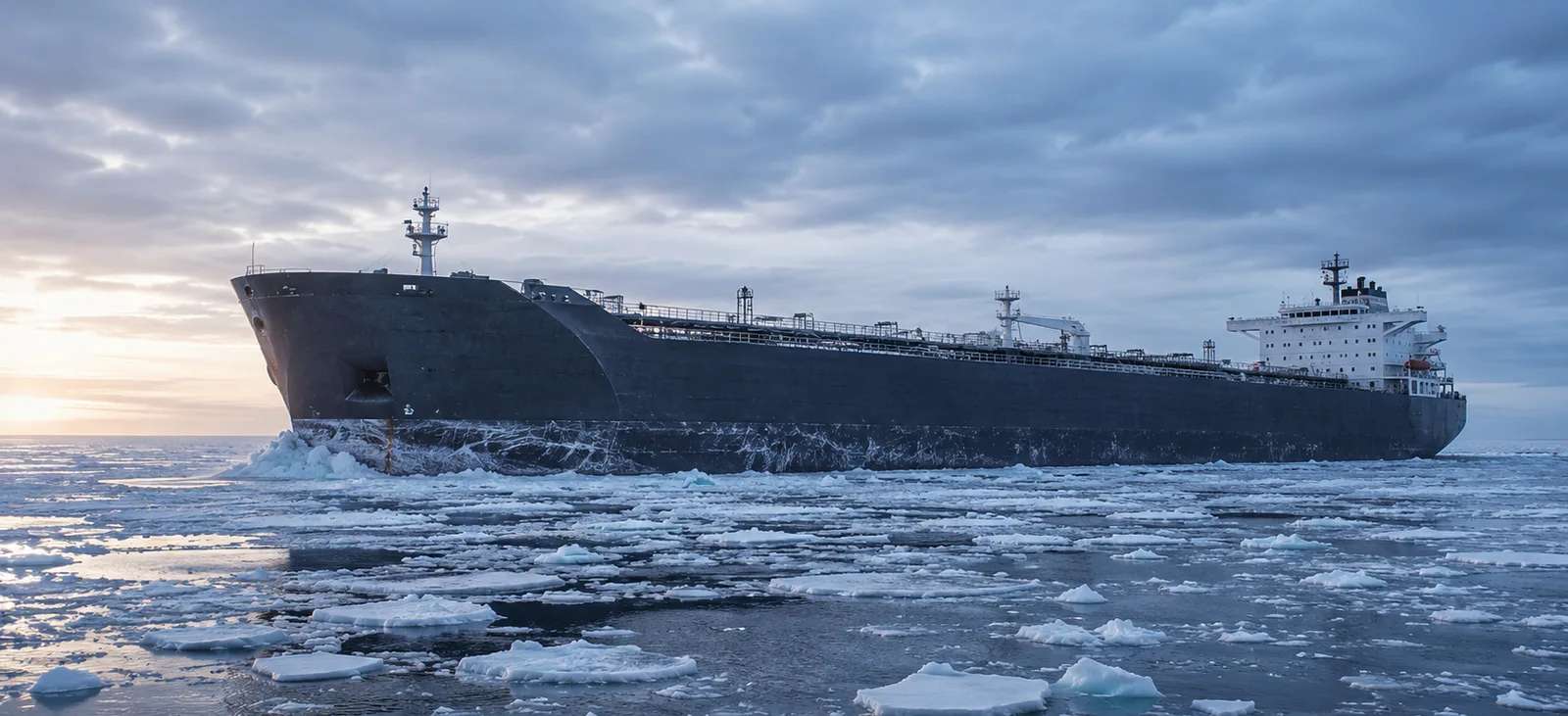
Spring is when the ice ships wake up. Through April and May, the Gulf of Bothnia thaws, the southern fringes of the Arctic open, and a small slice of the world fleet — the ships built to operate in frozen water — comes back into use. Their charterers care about something most shipowners never think about: an ice class. To outsiders the labels look like a code. 1A Super. PC6. Arc7. They sound interchangeable. They aren't, and confusing them can either put a ship into the wrong sea or keep one out of a sea it could in fact handle.
Ice class is the official notation a classification society or national authority gives a ship to certify that the hull can handle a defined level of frozen water. Behind it sits thicker plating, stronger steel, reinforced framing, redesigned propellers, heated fuel tanks, and several other quiet engineering choices that don't pay off anywhere south of cold latitudes. A relatively small share of the world fleet carries any ice class at all — mostly ships in Baltic, Arctic, or sub-Arctic trade. The labels tell you which kind, and three different rulebooks share the work.
Why ships need ice class in the first place
A normal steel hull is engineered for waves, not for the slow, sustained crushing pressure of pack ice. When ice presses against an unreinforced bow, it concentrates load on a few square meters of plating — enough to buckle, puncture, or in extreme cases sink a ship. The first formal ice-class rules appeared in the early twentieth century for Finnish and Swedish coastal trade in winter, when the northern Baltic regularly froze and the alternative was shutting ports for four months a year.
A century later, the rules have settled into three main families. Regional Baltic rules — the Finnish-Swedish system. Global polar rules — the IACS Polar Class. And the older Russian rules built around the Northern Sea Route. Each was designed for a different problem. None was designed to replace the others, which is why they coexist, and why a single ship often carries notations under two systems at the same time.
Finnish-Swedish Ice Class — the Baltic standard
The Finnish-Swedish Ice Class Rules, usually abbreviated FSICR, are the oldest and the most commercially common ice-class system today. They were designed not for the Arctic but for winter trade across the northern Baltic, where the sea routinely freezes between December and April and ports from Helsinki to Luleå need to stay open year-round.
The system is built around a specific engineering test: each rating requires a ship to maintain at least five knots through a defined brash-ice channel — the broken-ice path left behind by an icebreaker. The thicker the channel, the higher the rating.
- 1A Super (also written IA*) — Must hold five knots through a one-meter channel of broken ice with a refrozen crust about ten centimeters thick on top. The strongest Baltic rating, and the only one whose ships routinely handle a hard winter on their own — though even they call for icebreaker support during the worst weeks.
- 1A — Five knots through a 1.0-meter brash-ice channel (no consolidated layer required). Designed for icebreaker-assisted operation in heavy winter. The most common ice rating in the world.
- 1B — Five knots through a 0.8-meter brash-ice channel. Lighter winter operations, frequent reliance on icebreakers.
- 1C — Five knots through a 0.6-meter brash-ice channel. Marginal strengthening, suited to early winter or the southern Baltic.
- II — A steel-hulled vessel with no real ice strengthening; capable only of very light ice. Largely a legacy designation.
- III — Barges and similar craft that don't fit any other category.
Two things matter about FSICR. First, these are Baltic ratings — built around the broken-channel ice conditions of the northern Baltic, not the solid pack ice of the polar regions. A 1A Super tanker can run Helsinki to Rotterdam in February without trouble. The same ship is not certified for a transit from Murmansk to Yokohama via the Northern Sea Route. The ice conditions are different and the regulatory framework is different.
Second, FSICR drives Baltic traffic restrictions in winter. When Finnish authorities post a restriction reading “ice class 1A, 2000 DWT” for a port, only ships meeting that threshold or higher are entitled to icebreaker assistance. Below it, you wait — or you go elsewhere. A large share of Finnish-registered tonnage carries 1A Super for exactly this reason — far higher than in any other national fleet.
IACS Polar Class — the global polar standard
The International Association of Classification Societies, IACS, published its Unified Requirements for Polar Class Ships in 2007, after roughly a decade of effort to harmonize a previously fragmented mix of national rules. The seven Polar Class ratings — PC1 the strongest, PC7 the lightest — apply globally, are recognized by every major class society, and form the structural baseline that underpins the IMO's Polar Code.
- PC1 — All polar waters, any season, including multi-year ice over three meters thick. The territory of heavy icebreakers.
- PC2 — Year-round operation in moderate multi-year ice. Extremely rare in commercial use.
- PC3 — Year-round in second-year ice, which may include multi-year inclusions. Research, coast guard, and the strongest commercial cargo ships.
- PC4 — Year-round in thick first-year ice with old-ice inclusions.
- PC5 — Year-round in medium first-year ice. The lower threshold for confident year-round polar operation.
- PC6 — Summer and autumn operation in medium first-year ice. The most common rating for expedition cruise ships and seasonal Arctic cargo.
- PC7 — Summer and autumn operation in thin first-year ice. The lightest Polar Class — capable in shoulder seasons, not in winter.
The key word in every PC definition is the season. PC1 through PC5 are year-round ratings. PC6 and PC7 are summer-autumn ships — capable of polar work, but only when the ice is thinner and seasonal. The IMO's Polar Code uses that split directly: Category A ships cover the PC1 to PC5 range and face the strictest manning and equipment rules; Category B covers PC6 and PC7 with moderate rules; Category C describes ships with little or no ice strengthening, which the Code restricts to open-water polar operation only.
Most polar commercial traffic — expedition cruise ships, the bulk carriers serving Arctic mines, the seasonal voyages along the Northern Sea Route — runs at the lighter end of the PC scale, usually PC6 or PC7. Above that, the population thins quickly. Heavy icebreakers carry PC1. PC2 is so rare in passenger service that the single example, France's Le Commandant Charcot, is the world's only PC2 cruise ship — capable of pushing through multi-year ice that even most heavy icebreakers find demanding.
Russian Arc and Ice classes — the Northern Sea Route's own system
The Russian Maritime Register of Shipping, known as RMRS, keeps its own ice-class rules, predating both the Finnish-Swedish and IACS systems by decades. They divide into three tiers: Ice1 through Ice3 for non-Arctic ships, Arc4 through Arc9 for Arctic ships, and Icebreaker6 through Icebreaker9 for purpose-built icebreakers. The higher the number, the stronger the hull and the more demanding the ice it's certified for.
This system matters because it is the one that actually governs the Northern Sea Route. Russian authorities, not IACS, decide who transits and under what conditions. A foreign-flagged PC6 container ship asking permission for a summer NSR voyage gets evaluated under Russian rules. A PC notation is treated as broadly equivalent to a corresponding Arc rating — but the equivalency is approximate, and the final permit comes from Rosatomflot, which specifies operating windows, escort requirements, and ice condition limits that the original class certificate doesn't cover.
The most consequential commercial fleet built to Russian Arc rules is the Yamal LNG carrier series — fifteen Arc7 icebreaking LNG carriers built by Daewoo Shipbuilding & Marine Engineering in South Korea between 2016 and 2019, at a reported total cost of about US$4.8 billion. Each ship carries 172,600 cubic meters of LNG, can break ice up to roughly 2.1 meters thick, and uses a Double Acting Ship design — bow forward in open water, stern forward through heavy ice. The lead vessel, Christophe de Margerie, was delivered in late 2016; year-round Yamal LNG exports began the following year. These are not Polar Class ships; they are Arc7, and the difference matters in every operating permit they hold.
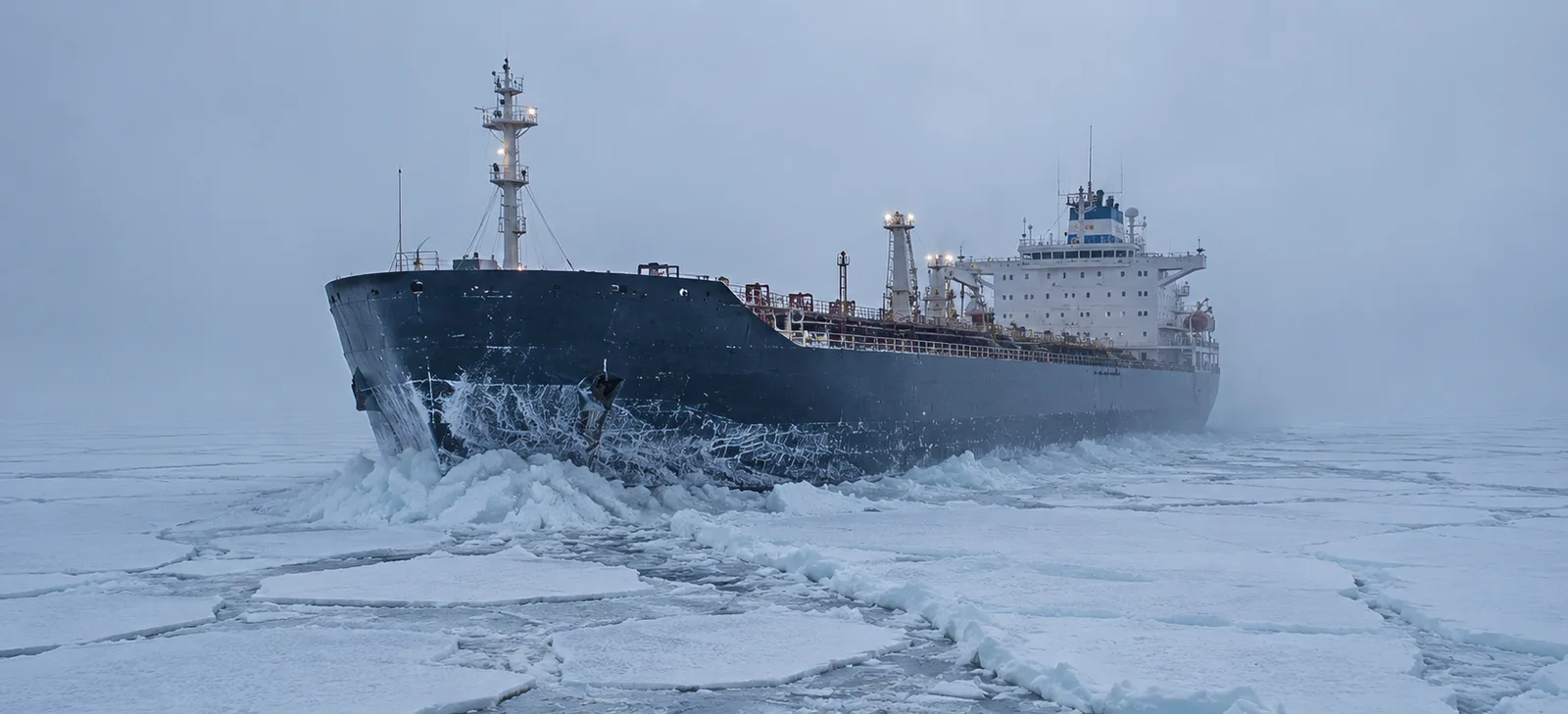
The practical upshot: even a properly ice-classed ship can't simply enter the NSR. The class notation is a precondition. The permit is the gate. Both are needed.
How the three systems relate
The three systems are not interchangeable. Class societies publish equivalency tables, but they're approximate, and most port or route authorities want the specific notation they require — not a converted one. Where the two systems meet, the overlap is approximate: 1A Super behaves close to a PC6, and 1A sits in roughly the same range as PC7. The middle Arc range corresponds approximately to PC4 or PC5. But these comparisons hide real differences in hull design, propulsion redundancy, and operational testing that the rulebooks treat differently.
A useful way to think about the three systems is as winter-tire categories. All-season tires are fine in light snow but illegal on some mountain passes. Studded winter tires are required in parts of Scandinavia from November to April. Studded ice tires designed for glare-ice rally driving are something else entirely — overkill on a city street, essential on certain surfaces, and not what you fit by default. Ice class works the same way: a Baltic-trade ship fitted to 1A Super has the right tire for its road; an NSR transit ship fitted to Arc7 has a different tire for a different road; and the open-water fleet doesn't need either.
For most operators, the important thing isn't memorizing equivalencies. It's knowing which system governs the trade being planned. Baltic winter — Finnish-Swedish. Polar or Antarctic — IACS PC. Northern Sea Route — Russian Arc, even for a non-Russian ship.
What ice strengthening actually costs
The strongest reason most ships don't carry any ice class is money. Building a hull to a meaningful ice rating typically adds roughly 10 to 25 percent to the newbuild cost compared to an equivalent conventional vessel, with the figure varying by vessel type, target class, and yard. The reinforcement is thicker shell plating, stronger frames, propeller strengthening, ice-friendly rudder design, heating arrangements for fuel and ballast tanks, and a stronger forward structure. None of it pays off in tropical or temperate water.
The penalty is also permanent. An ice-class vessel carries more steel than it needs in mild seas, which means it burns more fuel per nautical mile every day of its 25 to 30 year working life. A bulk carrier built to 1A Super and running mostly between Brazil and China is paying an ice-class premium on every voyage even though it never sees ice. This is why ice-class ships tend to be specialists: built and chartered for trades where the rating actually pays back. The Yamal Arc7 fleet, at roughly US$320 million per ship, is the clearest illustration — those vessels exist only because year-round Arctic LNG export needed them, and they would never have been ordered for any other trade.
Spring season is when those specialists go to work. The Baltic icebreakers stand down. The Gulf of Bothnia opens up. The Arctic shoulder season begins. Ships that have spent the last six months running ballast voyages or tramping warm-water routes start finding their charter books fill. By June, the Northern Sea Route's permit window opens, the Yamal Arc7 carriers continue their year-round duty, and a small but steady stream of seasonal cargo begins moving along routes that most of the world fleet simply doesn't have the steel to follow.
Reading the label
The next time a ship description includes an ice notation, you'll know what to look for. The system tells you the operating world. The number tells you the depth of capability. The two together explain a surprising amount about what the ship was built to do and where its owners expect it to earn its keep.
The systems exist because the ice does, and because ice doesn't follow national boundaries — but the rules about who can cross which ice still do. Knowing which rating governs which water is what separates a romantic look at the Arctic map from a navigable voyage plan.
The 30-Second Version
- Ice class is the rating that says a ship can handle frozen water. Three systems coexist: Finnish-Swedish (Baltic), IACS Polar Class (global polar), Russian Arc (Northern Sea Route).
- FSICR rates ships by performance in a brash-ice channel: 1A Super (1.0 m + 0.1 m consolidated layer), 1A (1.0 m), 1B (0.8 m), 1C (0.6 m). All assume a 5-knot minimum speed.
- IACS Polar Class runs PC1 (heaviest icebreaker, multi-year ice) to PC7 (thin first-year, summer only). PC1 to PC5 are year-round; PC6 and PC7 are summer-autumn.
- Russian Arc7 — not PC — is the rating on the 15 Yamal LNG carriers built in South Korea for year-round Arctic LNG export.
- 1A Super ≈ PC6 ; 1A ≈ PC7. The systems overlap but are not interchangeable; each route authority demands the specific notation.
- Ice class adds roughly 10–25% to newbuild cost and a permanent fuel penalty. Most of the world fleet doesn't carry one.
Closing
Ice class is one of those bits of industry shorthand that look forbidding from the outside and turn out to be straightforward once you see the logic. The labels encode a specific test — a ship's ability to maintain speed through a defined kind of ice — and they organize a few thousand specialized vessels into a handful of operational categories.
Most maritime headlines you'll read about Arctic shipping or the Baltic in winter mention an ice notation, and the notation is doing work. Knowing whether you're reading about a 1A Super tanker, a PC6 cruise ship, or an Arc7 LNG carrier tells you which sea is involved, which season is implied, and roughly what economic decision was made when the ship was ordered.
For a deeper look at when Arctic routing actually beats the southern alternatives — and when the headline distance argument falls apart — see our analysis of the Northern Sea Route economics in 2026. Compare any port pair across Suez, Cape, and NSR routing in the Voyage Calculator.
Sources
- Traficom and the Swedish Transport Agency — Finnish-Swedish Ice Class Rules and the winter traffic restrictions issued under them
- IACS — Unified Requirements for Polar Class ships
- IMO — International Code for Ships Operating in Polar Waters
- Russian Maritime Register of Shipping — Arc ice class notations