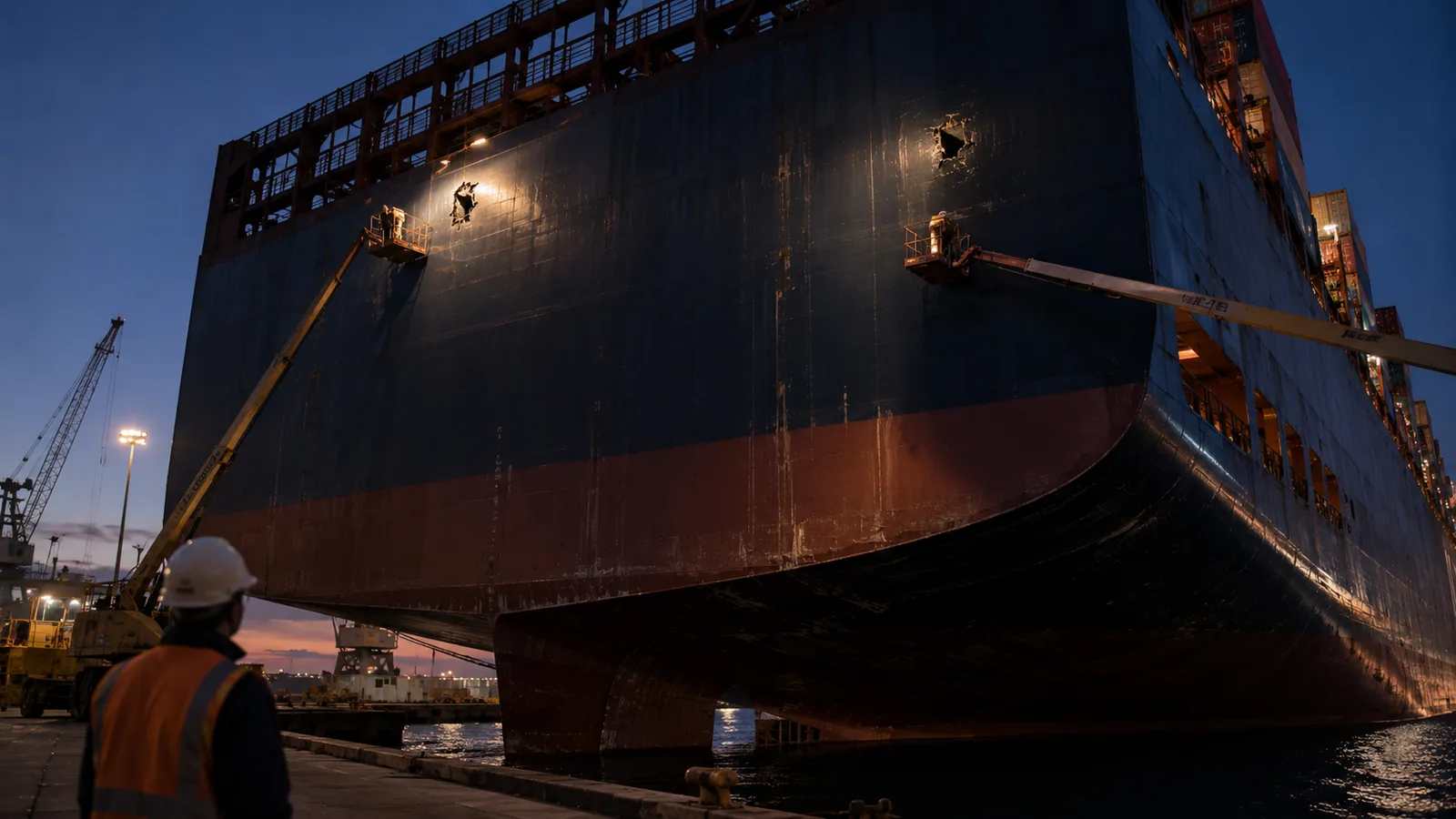
Engine room fires on commercial ships have a small set of well-understood causes. The damage pattern on the HMM Namu does not fit any of them. The reports from May 4 did not look like one. On Sunday, May 10, South Korea's Ministry of Foreign Affairs concluded a six-day investigation into the incident aboard the HMM Namu by stating that “unidentified airborne objects” had struck the vessel — two impacts, roughly one minute apart, breaching the upper hull from outside. The finding ended a week of conflicting framings: a fire, an explosion, an internal malfunction, an Iranian attack, a stranded ship, a diplomatic test for Seoul. Six days. One sentence.
For anyone who has spent time in a marine engine room, the headline ought to have been written on May 4. A newbuild ship, less than a year out of yard, sitting at anchor with main propulsion idle, presents one of the lowest fire-probability profiles a commercial vessel will ever experience. Industry experience matters here in a way that policy commentary does not: the conditions that produce engine room fires — pressurized fuel leaks onto hot surfaces, electrical insulation aged to failure, maintenance debt accumulated across years — require time, motion, and wear. None of those conditions apply to a vessel newer than a fixture's notice period, in a state of mechanical rest.
What we are watching, in other words, is not the discovery of facts. It is the diplomatic processing of facts already known. The engineering verdict was available on day one. The political verdict needed six days, four allies, and one quiet Iranian statement to arrive.
This article walks through the engineering case first, the diplomatic timeline second, and what the gap between the two actually means.
The 0.11% Number
Marine fires happen. Engine room fires happen. The annual rate is well-documented and the patterns are well-understood. None of them describe what happened to the HMM Namu.
The Gard data is drawn from a global hull-and-machinery claims book covering thousands of vessels and is, to industry, the cleanest available rate. The MDPI per-hour figure comes from an academic risk-assessment study using fuzzy fault tree analysis and converges on the same order of magnitude. Both are referenced against vessels under way — running engines, pressurized fuel systems, hot surfaces, and the operational variables that produce most fires.
The HMM Namu was not running.
The phrase “engine room fire” carries a specific implication: that something inside the room — fuel, oil, electrical insulation, hot machinery — initiated combustion through one of a small number of well-understood ignition pathways. The Gard claims data, the DNV technical guidance, the Wartsila operator notes, and the academic literature all converge on the same hierarchy of root causes. None of those causes match the HMM Namu profile.
The Causes That Don't Apply
Engine room fires on commercial ships typically require one of the following conditions.
| Cause | Typical condition | HMM Namu | Match |
|---|---|---|---|
| Pressurized fuel/oil leak | Fuel pump running, hot exhaust nearby | Engines idle, surfaces cool | N/A |
| Hot surface ignition | Sustained operation, oil mist present | Anchored, no operational load | N/A |
| Electrical short, insulation aging | 5+ year insulation, deferred maintenance | Newbuild, sub-1-year operation | N/A |
| Maintenance debt accumulation | Long-running deferred work orders | Yard-fresh delivery condition | N/A |
Each of these is, in the published claims data, a leading explanation for how engine room fires actually start. Approximately seventy percent of recorded engine room fires are attributable to leaks from pressurized fuel or oil systems coming into contact with hot surfaces — the classic spray-onto-exhaust scenario.
DNV technical guidance issued in 2023, following the post-2019 spike in container-ship engine room fires, focuses overwhelmingly on what auditors observe in older, harder-worked fleet segments: dirty engine rooms, missing insulation, deferred screening on oil piping, components substituted away from manufacturer specifications.
These are the patterns of accumulation. They describe a ship that has been operated, neglected, or both, for long enough that small problems compound. They do not describe a ship a year out of the yard, sitting still in protected anchorage waters with main propulsion shut down.
A working engineer reading the May 4 reports would have noticed something else. The DNV guidance specifically recommends that thermographic examinations be incorporated into newbuild specifications and conducted during sea trials precisely because the goal is to identify hot-spot risks before delivery. A class-surveyed newbuild, properly trial'd, lands at its first anchorage with the lowest fire-probability profile of its operating life. The HMM Namu in early May 2026 sat at the bottom of its own probability curve.
That is the engineering case for what the fire was not. The case for what it was begins with the damage pattern itself.
The Pattern That Doesn't Fit
The most operationally telling fact about the HMM Namu, reported by the South Korean National Security Adviser Wi Sung-lac on May 6, was what did not happen. The vessel suffered no flooding. The vessel did not list. The fire was extinguished within roughly four hours. The hull retained sufficient structural integrity that the ship was towed to Drydocks World–Dubai four days later.
In practice, a vessel that retains auxiliary continuity and stable trim after an engine-room incident is classified differently than one with uncontrolled flooding or propulsion loss. The HMM Namu reportedly transitioned from incident to towed under attendant arrangements within four days — a profile inconsistent with the catastrophic damage signatures associated with floating mines or torpedoes. That single fact narrows the hypothesis space considerably.
| Hypothesis | Expected damage pattern | Match? |
|---|---|---|
| Internal fire | Burn marks, smoke staining, damage outward from origin | No fire signatures on hull exterior |
| Floating mine | Below-waterline lateral force, large breach, fast flooding | No flooding, no listing reported |
| Torpedo | Submerged impact, catastrophic below-waterline damage | Ship sailed under attendant arrangements to Dubai |
| Lateral missile | Near-waterline side impact, large entry wound | Damage reported on upper hull, above waterline |
| Above-waterline aerial impact | Top-down angle, small precision penetration, hull retains trim | Consistent with reported facts |
Each of these eliminations is straightforward physics. A floating mine, drifting in surface currents, contacts a hull at or near the waterline and detonates laterally; the breach is below or near the waterline, water enters, the ship lists within minutes. A torpedo travels submerged and detonates below the waterline, with catastrophic flooding that usually disables propulsion entirely. A horizontally-launched missile of the kind used against tankers in the past leaves a large entry wound on the side of the vessel, typically near the waterline because that is the geometry of a sea-skimming flight path.
None of these patterns produce a ship that retains trim, suffers no flooding, and sails under attendant arrangements to a repair yard four days later. What does produce that outcome is a top-down impact on the upper portion of the hull — well above the waterline, small enough not to compromise structural integrity, angled steeply enough to penetrate the upper plating from above. That damage geometry is most operationally consistent with above-waterline aerial impact, of the kind that drone or comparable airborne munitions could produce. With the May 10 finding of “unidentified airborne objects” and the reported pattern of two impacts one minute apart, it is the only hypothesis remaining on the board that does not require working against the available facts.
The MOFA announcement did not need to specify what kind of airborne object, or whose. The damage pattern specified it for them.

Six Days, Five Signals
If the engineering verdict was available on May 4, the political verdict was not. What happened in the six days between the incident and the announcement is, taken together, the most important piece of context for understanding the announcement itself.
Read these in sequence and the announcement makes sense in a way it does not in isolation. On May 4, Korea was being publicly pressed by an ally to join a contested military operation, on the basis of an attribution Korea itself could not yet confirm and had no operational interest in confirming under pressure. On May 5, the operation Korea was being pressed to join was paused — for reasons that had little to do with diplomatic progress and a great deal to do with regional allies refusing to host it. On May 6, Wi Sung-lac stated, accurately for that moment, that no clear signs of attack had been found — a finding that gave Seoul cover to step back from the participation question while preserving forensic neutrality. On May 8, the same President who had pressed Korea four days earlier publicly de-escalated his ask in a single phrase. On May 9, Iran offered Korea something unusual: a public statement that read, to anyone watching the diplomatic register, as a non-aggression signal in exchange for Korea's continued non-participation.
By May 10, the diplomatic ground was prepared. The investigation had time to reach its conclusion without that conclusion becoming a forcing function in any direction Seoul did not choose. The announcement could state the engineering reality — external strike — while attributing the strike only to “unidentified airborne objects,” preserving the diplomatic optionality the previous five days had earned.
Physical damage can be assessed relatively quickly. Public attribution usually cannot — it involves more variables than physics alone, and runs on a slower clock.

What “Unidentified” Really Means
The May 10 announcement is precisely worded. The investigation team did not say “unknown.” It said “unidentified.” The distinction is small in ordinary English and large in diplomatic English. Unknown is a description of the world. Unidentified is a description of an action — specifically, the action of not yet identifying. It implies that identification is possible, perhaps even has been done internally, but has not been performed in public.
What makes this set of options unusual is that they were obtained simultaneously, through the act of investigating slowly and announcing precisely. A faster announcement on May 4 — when the political pressure was highest — would have collapsed several of these options. An attribution to Iran would have foreclosed Option 5 and forced Korea closer to the Project Freedom question on Option 4. A finding of internal fire would have required Korea to publicly disagree with President Trump's social media post — useful neither domestically nor diplomatically. A finding of “unknown cause” would have left Options 1 and 3 unsupported by official record. Only the precise phrasing actually used preserves the full set.
Diplomatic language is not always surgical. But in high-stakes incidents involving sovereign actors, allied alliances, and significant commercial exposure, the wording chosen is rarely accidental.
What This Means for Operators
The HMM Namu incident produces several practical adjustments for operators with vessels in or near the Persian Gulf, and a few less-visible considerations for the parties holding the policies.
For underwriters, the May 10 finding sits in an unusual claims posture. War risk and hull-and-machinery clauses respond to different triggers, and an “external strike” finding without designated attribution complicates which policy responds first. Whether HMM Namu's repair scope at Drydocks World remains within hull-and-machinery thresholds or escalates toward constructive-total-loss territory will determine which underwriter set absorbs the cost — and the unattributed nature of the strike will likely slow that determination. Operators with vessels in the broader region should expect claim adjudication timelines to lengthen until the attribution question resolves one way or the other.
- Newbuild reliability is not the same as port security. A vessel less than one year out of the yard, with a clean class record and current thermographic survey, faces external risks at a contested anchorage that build quality cannot mitigate. Charter party assumptions about hull condition do not extend to anchorage strike probability.
- Hormuz risk is not only transit risk. Stationary anchorage near the strait now carries measurable strike probability — the HMM Namu was not transiting when it was hit. Operators with vessels stationed in regional anchorages awaiting clearance should reconsider position relative to the most contested zones.
- Korea–Iran de facto non-aggression is implicit, not contractual. Operators of Korean-flagged or Korean-operated vessels should not assume that the protection signaled in early May extends to later incidents or to vessels with mixed flag-and-ownership profiles. The signal was conditional; conditions can change.
- Insurance claim timing matters. With external strike confirmed but attribution withheld, war risk underwriters are processing claims without a designated aggressor. Adjudication may be slower, settlement structures less predictable, and exclusion clauses parsed more carefully than usual.
- For 2026–2027 fixtures touching Persian Gulf anchorages, charter party clauses should explicitly address stationary-vessel war risk. Standard transit AP language was not drafted for vessels struck at anchor.
- Track terminal and anchorage advisories, not only Lloyd's listing notices. The operational pattern of risk has shifted from purely transit-based to anchorage-inclusive, and the available daily indicators have not yet caught up with that shift.
To Be Continued
The analysis offered here stops at the engineering verdict, the diplomatic timeline, and the preserved leverage of the May 10 announcement. It does not yet attempt the question that follows naturally from the cui bono tradition: in this configuration of events, with these specific outcomes, who structurally benefits, and at whose expense?
Each actor in the strait — Iran, the United States, Israel, the Gulf states, Korea — closed the first ten days of May with something to defend, something to gain, or something carefully avoided. The pattern of who gained what, and the question of whether such a clean alignment of outcomes is fully consistent with coincidence, is a separate analytical exercise that warrants its own treatment.
The next piece in this series will take that question seriously, applying the same operational lens used here — not to assign blame, but to map incentives. In maritime geopolitics, as in any domain where multiple actors operate within a constrained system, structure tends to reveal more than statements do.
Reading List
For the broader diplomatic context of the May 6 oil reset and the original two-clock framework, see The Ceasefire That Isn't. For the institutional layer the PGSA introduced one day after this incident, see The PGSA Toll Booth — How a Hormuz Crisis Became an Institution. For the redistribution of trade friction across alternative corridors, see The Friction Doesn't Disappear — It Just Moves. For the war risk insurance mechanics that govern how strikes like this are priced, see War Risk Insurance: The Hidden Cost That's Closing Today's Shipping Map. For the original HMM Namu situation report at the time of the incident, see HMM Namu and the Strait of Hormuz — Korea's Mid-May Exposure.
Live data on Brent, WTI, Dubai, BDI, bunker prices across major ports, and the Singapore–Fujairah VLSFO spread is updated daily on the Maritime Data Hub. For voyage cost modelling that incorporates current war risk assumptions across Suez, Cape, Panama, and NSR routes, use the Ship ETA Calculator.