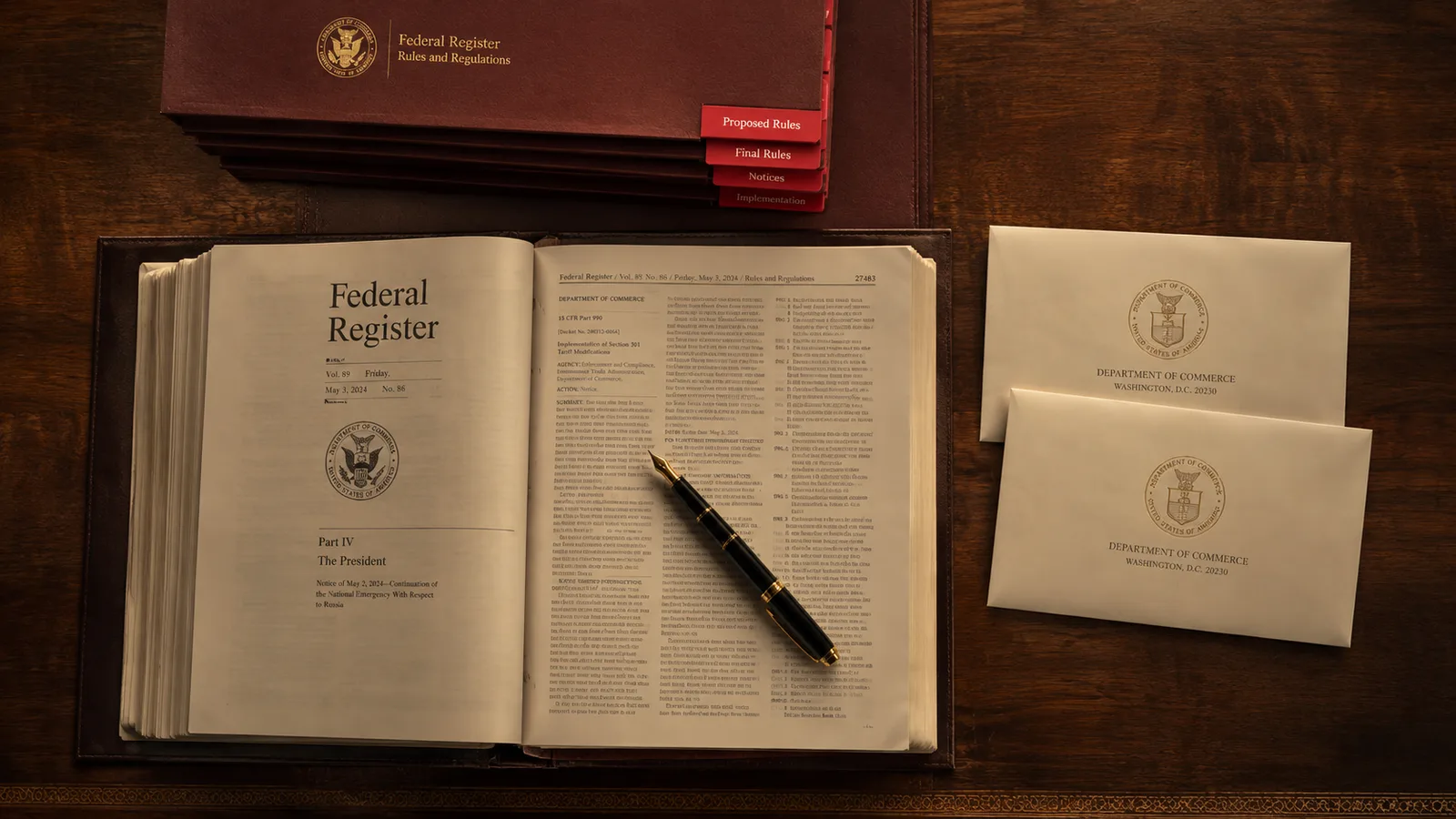
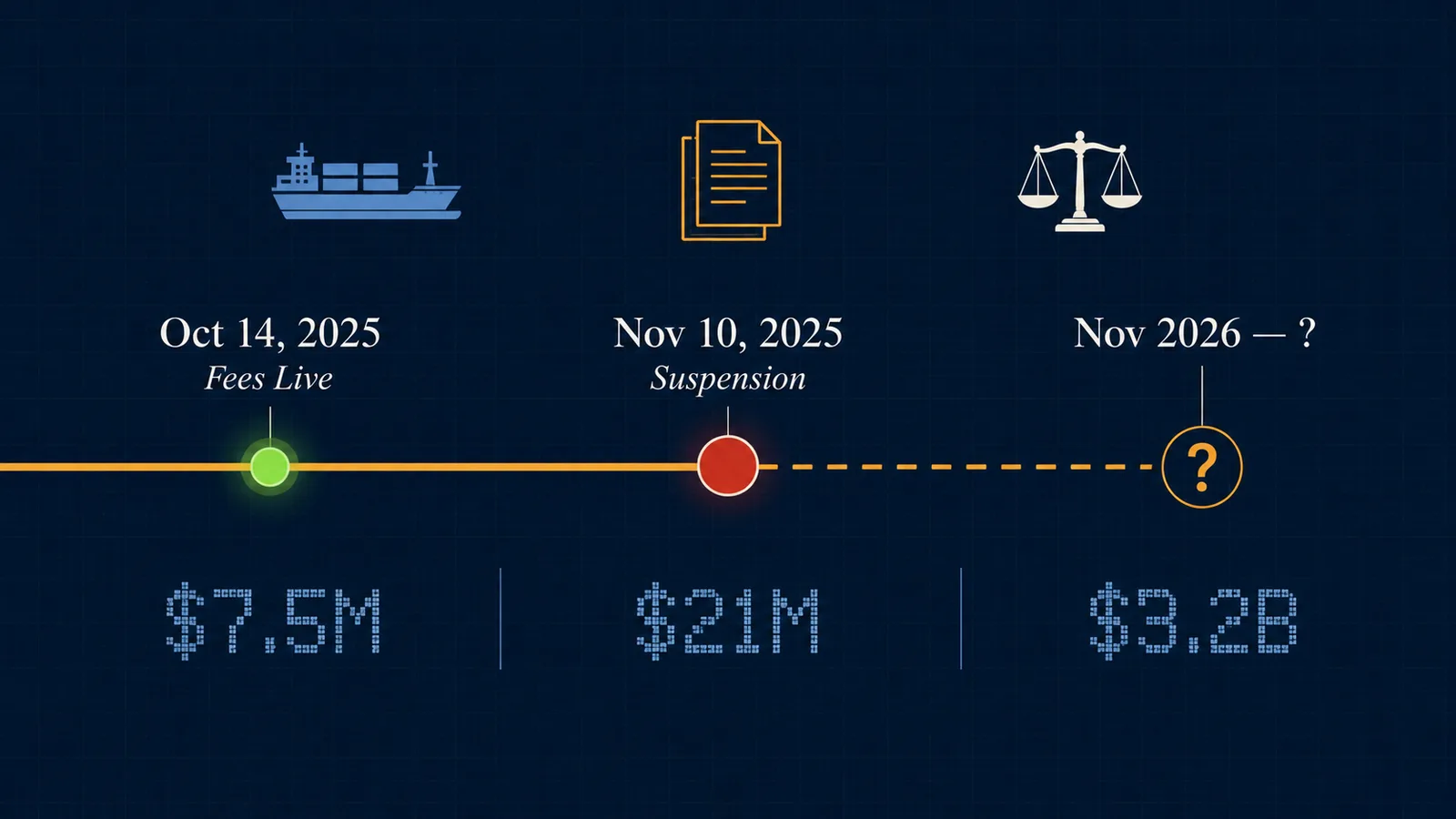
The USTR's Section 301 maritime service fees took effect on October 14, 2025. They were suspended on November 10 — three and a half weeks later. Most operators read the second headline as a reprieve. Contracts signed since then have continued to price in the fees as if they were still live.
This is a different kind of gap from the one between freight indexes and physical voyages, or between Hormuz headlines and dry bulk fundamentals. It is more institutional, and it sits closer to the lawyer's side of the desk than to the broker's. The fees were imposed under a statutory finding that has not been withdrawn. The Federal Register annexes that define the schedule remain published. Whatever administration occupies the relevant office in November 2026 can re-impose the fees on substantially the same legal basis used to impose them the first time. The contracts being drafted today already reflect that.
What Was Paused, What Was Not
The Section 301 fee schedule, before suspension, layered three regimes onto vessels calling US ports. Annex I applied to Chinese-owned or operated vessels — a flat $80 per net ton per voyage at activation, capped at five voyages per vessel per year, with the rate escalating annually through 2028. Annex II covered non-Chinese operators of Chinese-built vessels — the higher of $23 per net ton or $154 per TEU, with similar caps and annual escalation. Annex III set a $46 per net ton fee on foreign-built vehicle carriers. The combined regime was designed to make Chinese maritime supply chains progressively more expensive over four years, with the explicit goal of incentivizing US-built tonnage and US shipbuilding investment.
On October 14, the fees became live. Three and a half weeks later, the Trump administration announced the one-year suspension, taking effect November 10. The Federal Register schedule did not disappear. The annexes remain published. The underlying USTR finding — that China's targeting of the maritime sector meets the threshold for responsive action under Section 301 — remains on the record. The fees stopped being collected. The regulatory finding underneath them did not.
Two operational consequences followed immediately. China's retaliatory port fees, announced on the same October 14 date, were paused on a corresponding basis. And the deferral mechanism USTR had introduced for certain gas and vehicle carriers — payment deferrals running to December 10, 2025 — became moot. The fees neither came due nor were they cancelled.
The $3.2 Billion Number
The working figure across trade press coverage has been Alphaliner's late-2025 estimate: roughly $3.2 billion in 2026 fees across the ten largest container carriers, assuming each carrier maintained its existing US-bound fleet deployment when the schedule reactivated. The number is constructed by applying the published per-net-ton rates to each carrier's qualifying vessel calls, capped at five voyages per vessel, and aggregating. It is a deployment snapshot priced against the published rate card, not a forecast.
What the headline does not capture is how unevenly the burden falls. Alphaliner's carrier-by-carrier breakdown was published in October 2025, and the deployment data has not shifted enough since the suspension to materially change the relative weights.
COSCO carries roughly half the total exposure on its own. ZIM, despite its smaller fleet, sits second because of how heavily it leans on chartered Chinese-built tonnage on US lanes. Maersk, the world's largest carrier by revenue, registers at $17.5 million — less than ZIM's exposure on a fleet many times larger. Evergreen and HMM, with predominantly Korean and Taiwanese-built fleets on US routes, would pay nothing.
Per-TEU, the asymmetry is starker. Alphaliner's calculation puts the cost of US-bound shipments at $2,121 per TEU for COSCO's services and $26 per TEU for Maersk's. That is an order-of-magnitude gap on the same trade lane, between carriers nominally competing for the same containers. The schedule, if reactivated, does not just raise costs uniformly. It redistributes competitive position.
Three Contracts That Priced the Fee Anyway
The suspension started on November 10. Within weeks, contractual practice had separated from the headline. Three categories of long-tenor maritime contract have continued to embed the fee structure in their terms.
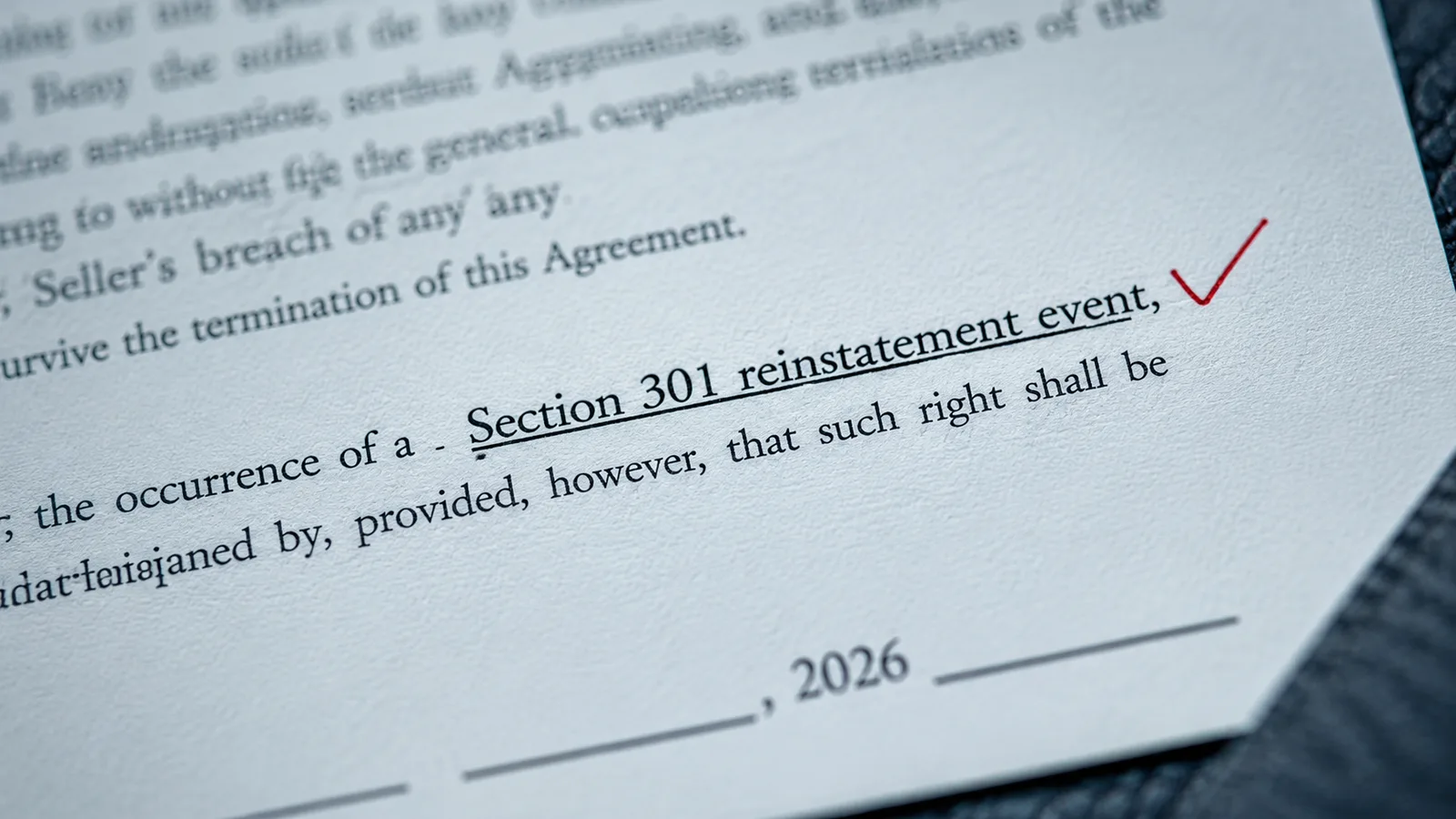
Long-term LPG carrier charters were affected first. The Section 301 modifications proposed in October 2025 included a targeted coverage provision for LPG and other liquefied gas carriers under 20-year-or-longer charters signed before December 31, 2027 — under that provision, the charter is treated as the operator's vessel for fee purposes. The provision survives the suspension as a published proposal. New 20-year LPG charters being negotiated since November have routinely included clauses allocating the cost — between owner and charterer — of any reinstated Annex I fees during the 20-year tail. Brokers report that the clause language is increasingly standardized rather than negotiated case by case.
Newbuild slots for 2027-2028 delivery from Chinese yards are the second category. The fee schedule's 2027 and 2028 escalation steps apply to vessels ordered before the suspension if those vessels enter service after re-imposition. Owners taking 2027 delivery from a Chinese yard are now negotiating both fee pass-through to operators on time charter, and yard-side rebates contingent on fee reinstatement. The orders are still happening — the Chinese yard order book continued to grow through Q1 2026 — but the terms have tightened.
Fleet refinancing forms the third. Vessel financing structured around long-tenor charters has begun pricing Section 301 reinstatement scenarios into rate covers and covenant packages. Loans against Chinese-built tonnage in 2026 carry slightly tighter loan-to-value ratios and explicit covenants tied to fee-event protections. The credit market did not wait for the suspension to expire before adjusting.
What these three categories share is a long tail. They are signed today and live for years. The administration that signed the suspension cannot bind the administration that may inherit it. Practitioners on both sides of these contracts have read the architecture and concluded that pricing the fee in is the conservative position, regardless of whether the fee is currently being collected.
What “Expiry Not Renewed” Actually Means
The suspension is structured as a one-year pause, ending in November 2026. Public legal commentary in the weeks after the November announcement noted that the suspension order did not specify the subsection of Section 301 being invoked to authorize the pause once fees had been imposed under a finding that remained in force. As a result, the mechanism for ending the suspension is less than fully defined.
There are at least three procedural paths from here. The first is straightforward expiry: the relevant office takes no action by November 2026 and the fees resume on the published schedule. This is the path most carriers are pricing into 2027 planning, on the basis that it requires the least affirmative action by any party. The second is explicit renewal — a new fact sheet or executive order extending the pause, which would itself be subject to the same authority question raised about the original suspension. The third is a negotiated resolution paired with China's reciprocal pause on its October 14 retaliatory fees, restructuring the Section 301 finding itself rather than just its application.
Operators are pricing all three. The relative weights they assign are where competitive positioning currently happens.
The Regulatory Clock
The freight market and the regulatory market read Section 301 on different calendars, and the difference matters more than the gap between the two numbers suggests.
The freight market reads the suspension the way it reads any contingent event with a probability and a timeline. Working consensus on reinstatement sits somewhere between 45 and 65 percent for November 2026, tilting lower if a US-China negotiation track produces a substantive interim agreement before then. Spot freight rates today embed only a small fraction of that contingent cost. The market can re-price within hours of any reinstatement announcement, and most participants are content to wait.
The regulatory market reads the same event as a binary. Either the fees are payable on a future date or they are not. Both states have legal architecture. Conservative drafting requires both states to be addressed in any contract that survives the date. The asymmetry is that the freight market can re-price quickly when the picture changes; the contracts cannot. Whatever language sits in a charter party or a financing agreement when the suspension ends, that language governs from that day forward.
Implications for the Back Half of 2026
A few observations, for operators planning into Q3 and Q4.
November 10, 2026 is not a soft date. Unlike the Q3 reversion the FFA market is pricing for tanker freight — covered separately in our TD3C analysis — the Section 301 reinstatement date sits on a published basis. Operators with US-bound rotations on Chinese-built or Chinese-operated tonnage should treat it as a date that requires a positioned response, not one that will resolve itself.
Time charter renewals between now and Q4 should price the contingency. The cost of doing so is small compared to the cost of being on the wrong side of fee allocation when reinstatement occurs. Brokers report that Section 301 risk allocation clauses have moved from a negotiating ask to the default starting point. Operators not raising the question are accepting the default risk position by silence.
Newbuild ordering decisions involving Chinese yards now carry a structural hedging premium that did not exist a year ago. The escalation curve through 2028 means that an order placed today for 2027 or 2028 delivery sits inside the most expensive years of the schedule, if reactivated. Yard-side rebate negotiations and fee pass-through clauses have become standard parts of the order package. The orders themselves continue. The terms underneath them do not look like they did in early 2025.
Closing
The suspension is real. The fees are not being collected. The November 10, 2025 announcement did what it announced.
What it did not do is dismantle the regulatory architecture underneath. The finding stands. The schedule is published. The annexes remain in the Federal Register. A future administration — including the one that signed the suspension, after November 2026 — can re-impose the fees on substantially the same legal basis used to impose them originally.
The $3.2 billion figure that anchored the trade press is the headline cost of a clean reinstatement. The harder number to write down is the cost of the uncertainty itself, which is being paid right now in clauses and covenants and revised loan-to-value ratios. The fees were paused. The pricing of the fees was not.