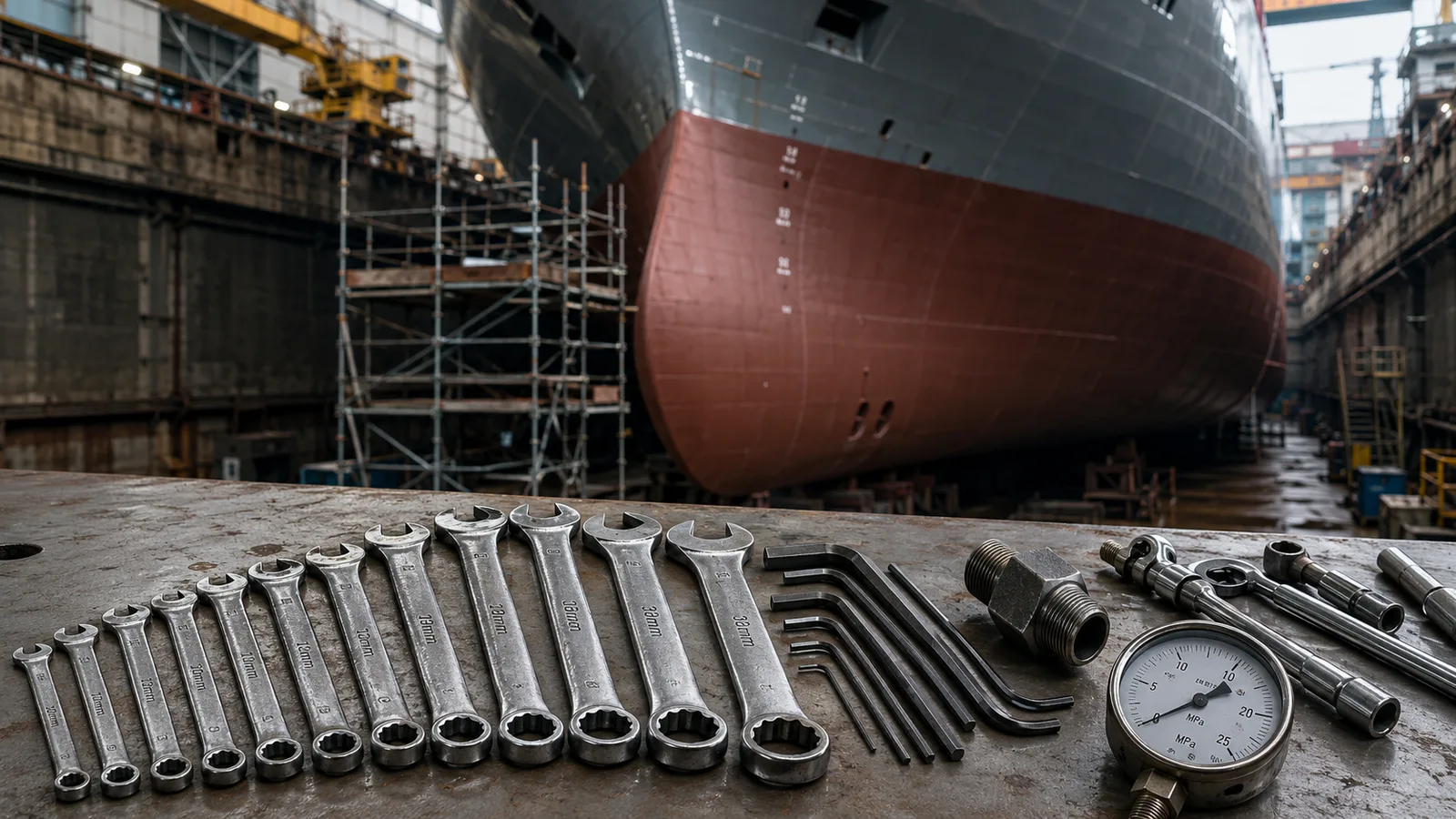
Board two ships of the same class in the same port and the engine-room tool inventories don't quite match. On one, the spanner rack follows one series. On another, the series is subtly different — enough that some fasteners on board fit tools from one set but not from the other. The Allen keys may be metric on most vessels, but on some older tonnage they come in fractions of an inch. The pressure gauges may read in bar, or psi, or kilograms per square centimetre, depending on which equipment was originally installed.
The differences run deeper than crew preference or historical accident. They trace back to the origins of the main engine, the auxiliary machinery, the pumps, the fittings, and the countless smaller components that were sourced into the ship at newbuild — components made in yards, factories, and workshops across different national fastener systems, each carrying its own conventions from a different industrial tradition.
Same class of ship. Same international trade routes. Same regulatory framework. Different fittings, different tools.
Why?
The short answer is that global shipbuilding has been standardized — but only about halfway, and deliberately so. What had to be unified for safety and international trade was unified, decades ago, and now works so seamlessly that most people never notice it exists. What didn't have to be unified was left alone, and each ship still carries the fingerprints of the national industries that built its engines and supplied its components.
This isn't a story of standardization failure. It's a story of where standardization stopped, and why.
What is standardized
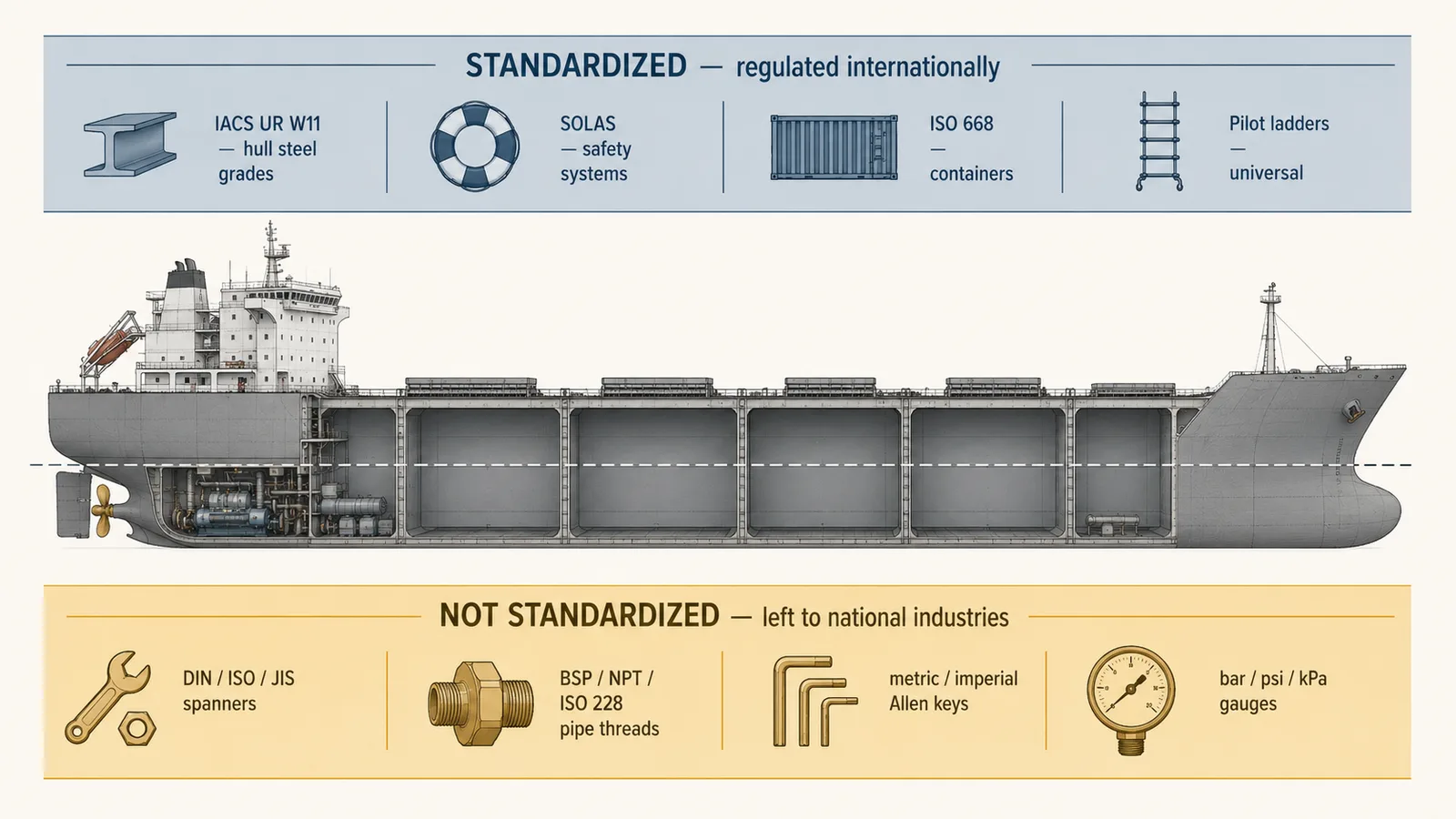
The parts of a ship that are standardized worldwide are the parts where lack of standardization would kill people, sink cargo, or break international trade.
Hull steel is the clearest example. Under IACS Unified Requirement W11, the structural steel used to build ship hulls is classified into a handful of internationally recognized grades — A, B, D, E for ordinary strength, and AH32 through FH40 for higher-strength applications. A shipyard in Ningbo, Nagasaki, Rotterdam, or Trieste is building from the same grade specifications. This is why an LNG carrier built in one country can be dry-docked in a second country for its five-year special survey, and steel-renewed in a third country ten years later, without any question of material compatibility. The steel is the same steel, everywhere.
The safety systems on board follow the same pattern. SOLAS — the International Convention for the Safety of Life at Sea — sets uniform requirements for lifeboats, fire safety, navigation lights, radio equipment, and emergency signals. SOLAS was first adopted in 1914 in response to the Titanic disaster; the current version, SOLAS 1974, was adopted in 1974 and came into force in 1980, with regular amendments since. Every ship above 500 gross tons on international voyages follows the same rules. The rules are audited by classification societies, of which twelve members of IACS class more than 90 percent of world tonnage.
Container dimensions come from ISO 668. Twenty or forty feet in length, eight feet wide, eight and a half or nine and a half feet tall. Without this standard, a container loaded in Shanghai could not fit a ship in Los Angeles or a truck chassis in Rotterdam. World trade would not function.
Port interfaces are the least visible but equally universal layer. Pilot ladders, mooring lines, fender specifications, VHF frequencies, GPS coordinate systems — all standardized. A pilot boarding a ship in Panama needs the ladder to be the same design as one boarding a ship in Suez.
None of this unification happened quickly. The first SOLAS convention emerged in 1914 but never entered force because of the First World War; a second version was signed in 1929, and the current framework came from the 1974 conference. IACS itself was founded in 1968 in Hamburg. The IACS Common Structural Rules for tankers and bulk carriers were adopted in the mid-2000s. Each unification followed either a disaster or a commercial imperative, and each took decades to negotiate and land. The result is that the parts of a ship that touch the outside world — its steel, its safety envelope, its cargo interface, its port interaction — are the same everywhere.
What is not
Below that layer, standardization thins out quickly. The fittings and fixtures inside a ship — the parts that a chief engineer actually has to source, replace, and reconcile with existing equipment — remain fragmented across national systems. The examples run wide.
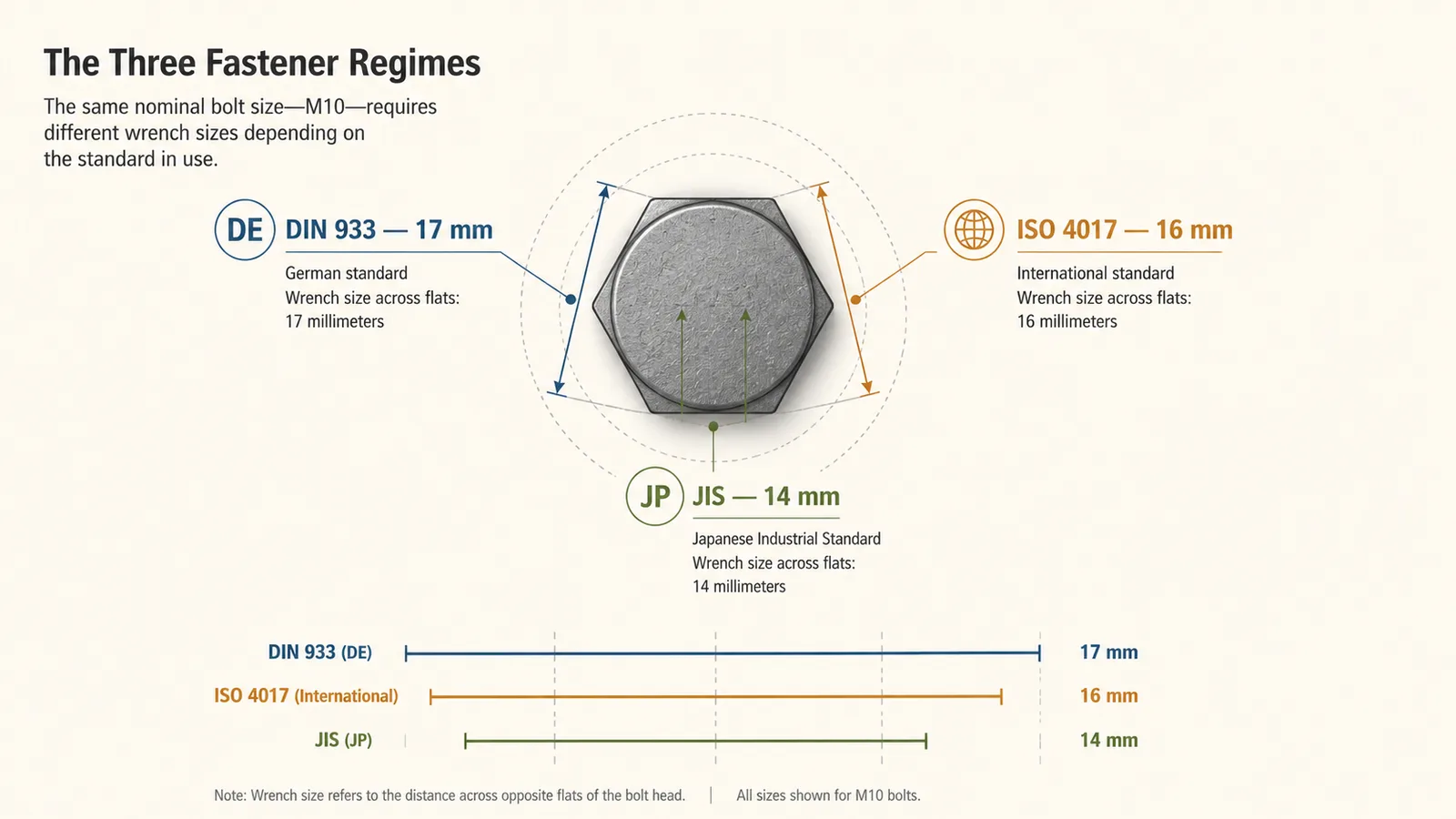
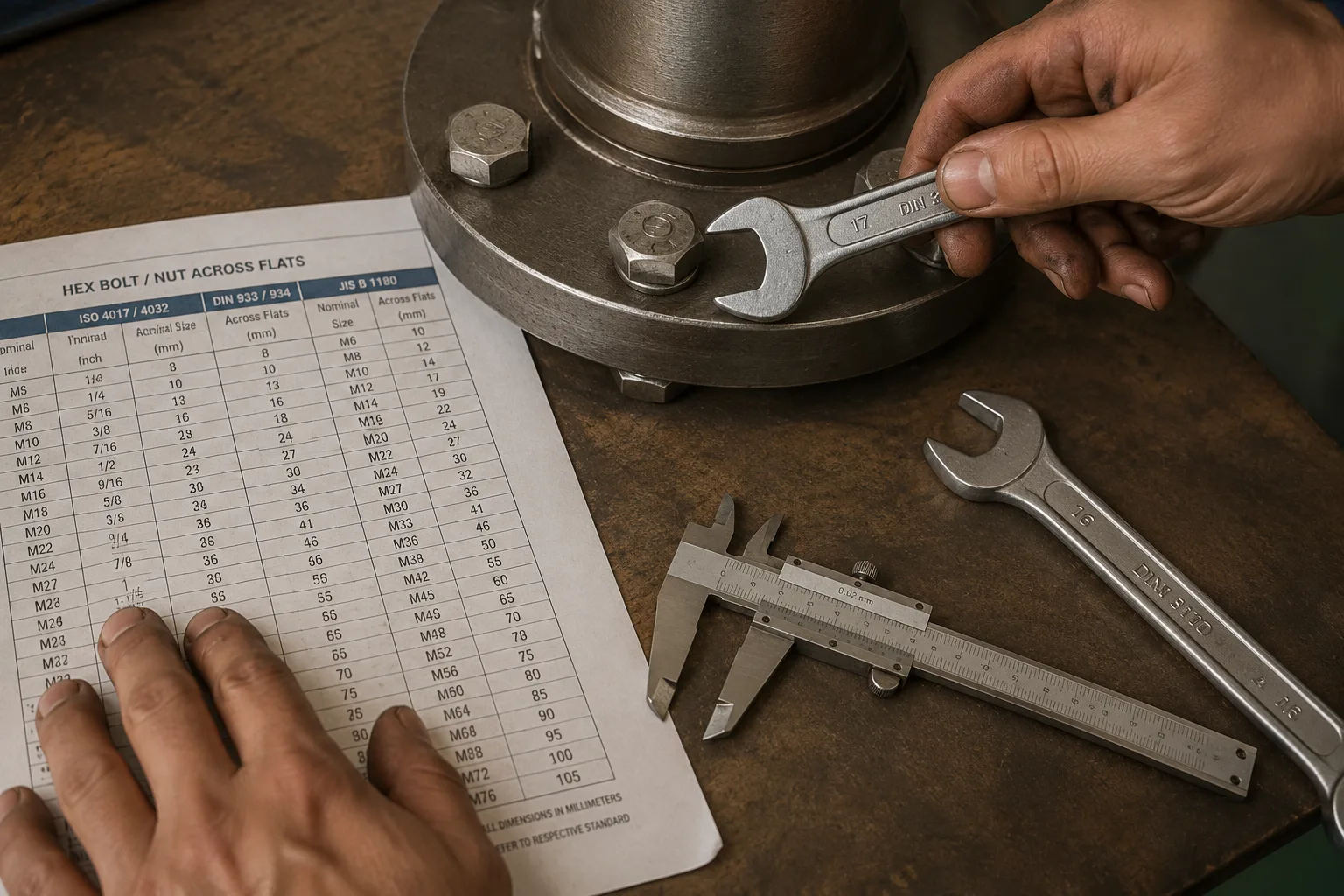
Bolt head sizes vary. For an M10 metric bolt, the German DIN 933 standard specifies a 17mm wrench across the flats. The newer ISO 4017 standard, published in 2011 and now increasingly common in international sourcing, specifies 16mm. The Japanese Industrial Standard specifies 14mm. Similar differences appear at M12, M14, and M22 — while the other bolt sizes are consistent across all three standards. Which series appears on a given ship depends less on where the ship was built than on which components were installed. A main engine licensed from a European manufacturer typically arrives with DIN-specified fasteners regardless of the yard. A Japanese-designed auxiliary generator arrives with JIS fasteners even in a European-built vessel. The result is not one clean spanner series but two or three overlapping series that together cover the fasteners actually installed on board.
Allen keys — the hexagonal socket drivers used on countless internal fittings — come in metric sizes almost everywhere: 2, 2.5, 3, 4, 5, 6, 8, 10, 12 mm. But equipment sourced from American manufacturers, particularly on older vessels, still uses imperial keys measured in fractions of an inch. A 5mm key does not fit a 3/16" socket, though the two are close in size.
Pipe thread systems come in several flavours that don't reconcile cleanly. The American National Pipe Thread (NPT) is tapered. The International Organization for Standardization's ISO 228 is parallel. The British Standard Pipe (BSP) family actually splits into two sub-variants — BSPT, which is tapered, and BSPP, which is parallel. NPT and BSPT are both tapered but use different thread angles (60° for NPT, 55° for BSP), so they cannot cross-mate. BSPP and ISO 228 are close but not identical. A vessel that has been through multiple retrofits or that carries equipment from several national suppliers often carries all these thread types in its piping, with a cabinet of NPT/BSPT/BSPP/ISO adapter fittings maintained specifically to handle the mixed system.
Bolt property classes work differently under different standards. Metric bolts are graded 4.6, 5.8, 8.8, 10.9, 12.9 under ISO 898-1. Imperial bolts are graded 2, 5, 8 under SAE J429. Marine stainless bolts follow yet another system — A2-70 and A4-80 under ISO 3506. The class is stamped on the bolt head, so it can be identified on inspection, but selecting a replacement requires knowing which system the original was specified in.
Pressure gauges read in whichever unit was originally installed. European-sourced equipment tends to use bar. American-sourced equipment uses psi. Modern ISO documentation increasingly uses kilopascals. Older Japanese equipment still uses kilograms per square centimetre. Four units are all in current circulation on the world fleet, and engineers convert between them mentally as they move from one machinery space to another.
Flange dimensions, hose fittings, electrical connectors, cable colour codes for machinery wiring — the list runs on. The pattern is consistent: the deeper you look into the parts inventory of a ship, the more national fingerprints appear. What looks from the outside like a globally standardized industry is, from the inside, still an assembly of national industrial systems held together by cross-references.
Why the split
The line between "standardized" and "not standardized" is not random. It sits precisely where international regulation stops and market forces begin.
Where regulation exists, standards unified. The structural strength of a hull, the containment of dangerous cargo, the design of a lifeboat — these are matters of life and death, or of enormous economic loss. Governments negotiated conventions (SOLAS, MARPOL, Load Lines) and delegated verification to classification societies. IACS members then coordinated their rules through Unified Requirements. This process took about a century, but the result is genuinely global.
Where regulation doesn't exist, national industries persist. A bolt is not a matter of life and death. A pipe fitting is not a matter of international trade. If a German engine manufacturer builds machinery around DIN fasteners and a Japanese manufacturer builds around JIS, and both vessels function safely, there is no regulatory basis to force convergence. And there is no strong commercial imperative either — the industry adapts, the repair yards stock multiple systems, the parts catalogs maintain cross-references.
The economics of standardization go one way. The cost of transition is borne by whoever changes; the benefit of unification is shared by everyone. In categories where the benefit is small — a slightly simpler tool inventory, a slightly cleaner parts catalog — no single party has enough incentive to bear the transition cost. Fragmentation persists indefinitely.
There is a further factor that is rarely spoken aloud. National fastener industries, tool industries, and parts supply chains are economically valuable to the countries that host them. Germany's DIN system supports a large fastener manufacturing sector serving MAN B&W, MTU, and dozens of other engineering firms. Japan's JIS system supports its own supply chain around Mitsubishi, Kawasaki, and Yanmar. Britain's BSP system anchors the pipe fitting industry of the Commonwealth. Forcing full international standardization on these categories would flatten these ecosystems into one dominant system — and quietly destroy industrial diversity in the process. Countries have quietly resisted this outcome, and the international standard-setting bodies have quietly accepted the limit.
How the industry handles it
The fragmentation is not theoretical. It shapes how ships are actually operated and repaired every day.
On board, engine room tool inventories reflect the components installed rather than the location of the yard that assembled them. A vessel built anywhere in Asia but equipped with a MAN B&W two-stroke main engine — MAN Energy Solutions and its network of licensed builders account for the large majority of the world's low-speed marine engine market — arrives with DIN-specified tooling requirements for the main engine, alongside whatever the auxiliary machinery manufacturer specifies. A vessel with Wärtsilä or WinGD engines and matching auxiliary systems tends toward European conventions throughout. A vessel with Mitsubishi UEC main engines and Japanese-designed auxiliaries leans toward JIS conventions. Ships owned by operators with mixed fleets often stock tool sets covering multiple conventions on board. Tool inventories, like the engine room itself, are ship assets — acquired at newbuild in accordance with the equipment manufacturers' specifications and maintained across the life of the vessel.
In repair yards, parallel inventories are the norm. A drydocking yard in Dubai that handles a container ship with MAN B&W engines one week and a bulk carrier with Wärtsilä engines the next has to stock the fasteners, gaskets, and fittings that fit both. Yards use extensive cross-reference tables to substitute equivalent parts where dimensions permit — DIN 933 M10 in place of ISO 4017 M10 with the difference in wrench size noted, JIS bolts substituted for DIN bolts of matching mechanical grade, and so on. When a substitution is made during a class survey, the replacement is recorded and the class surveyor either accepts it as an equivalent or requires the original specification.
In parts procurement, marine chandlers and spare-parts wholesalers maintain cross-reference catalogs as their core professional tool. A supplier that cannot cross-reference DIN, ISO, JIS, and SAE specifications cannot serve a mixed international fleet. This work is invisible but critical; without it, world shipping would grind through daily friction on every routine parts order.
On drydocking, ships that have been through multiple refits over their lifetime often show accumulated hybridization — the original engine's DIN fasteners on the two-stroke main structure, JIS fittings on an auxiliary generator installed during a mid-life refit, American NPT threads on a piece of retrofitted specialized equipment such as a ballast water treatment unit. Chief engineers who have run the same vessel for years carry mental maps of what is where. This knowledge is a real operational asset, and one reason experienced marine engineers are difficult to replace with less experienced staff — the parts hybridization on any given vessel is not fully documented anywhere except in the engineer's head.
The system works. Fragmented at the parts level, but functional. It is held together by cross-reference discipline and by the industry's acceptance that this is simply how global shipping operates.
Bottom line
The world's shipbuilding industry has standardized what needs to be standardized. Steel grades, safety systems, container dimensions, port interfaces — these are unified because they had to be. International trade and passenger safety require it, and international regulation enforced it, over the course of a century.
What sits below that layer — the bolts, the fittings, the tools, the gauges — remains fragmented, and will probably remain fragmented. This is not a failure of the international standardization project. It is the natural landing point. Where regulation had reason to intervene, it did, and unification took hold. Where regulation had no reason to intervene, national industrial ecosystems continued to operate on their own terms, and each ship still carries the fingerprints of the manufacturers that built its engines and supplied its components.
The two different spanner sets on two different ships are not a symptom of an incomplete standardization effort. They are a signature of how far international standardization was ever meant to go — as far as safety and trade required, and no further. The rest was preserved for the industries and craftspeople of individual nations to maintain, at the cost of some manageable inconvenience in the engine room.
A ship is a global asset. The parts inside it are still local craftsmanship. Both facts sit on the same vessel, at the same time. That is what a mature international industry actually looks like.
Sources
- IACS Unified Requirement W11 — Normal and higher strength hull structural steels (Rev.10, 2025)
- International Convention for the Safety of Life at Sea (SOLAS 1974, IMO) — safety equipment and periodic survey requirements
- ISO 4014/4017 (hex bolts, international) vs DIN 931/933 (hex bolts, German) — dimensional comparison of wrench sizes across flats
- JIS B 1180 metric hex bolt specifications — Japanese Standards Association