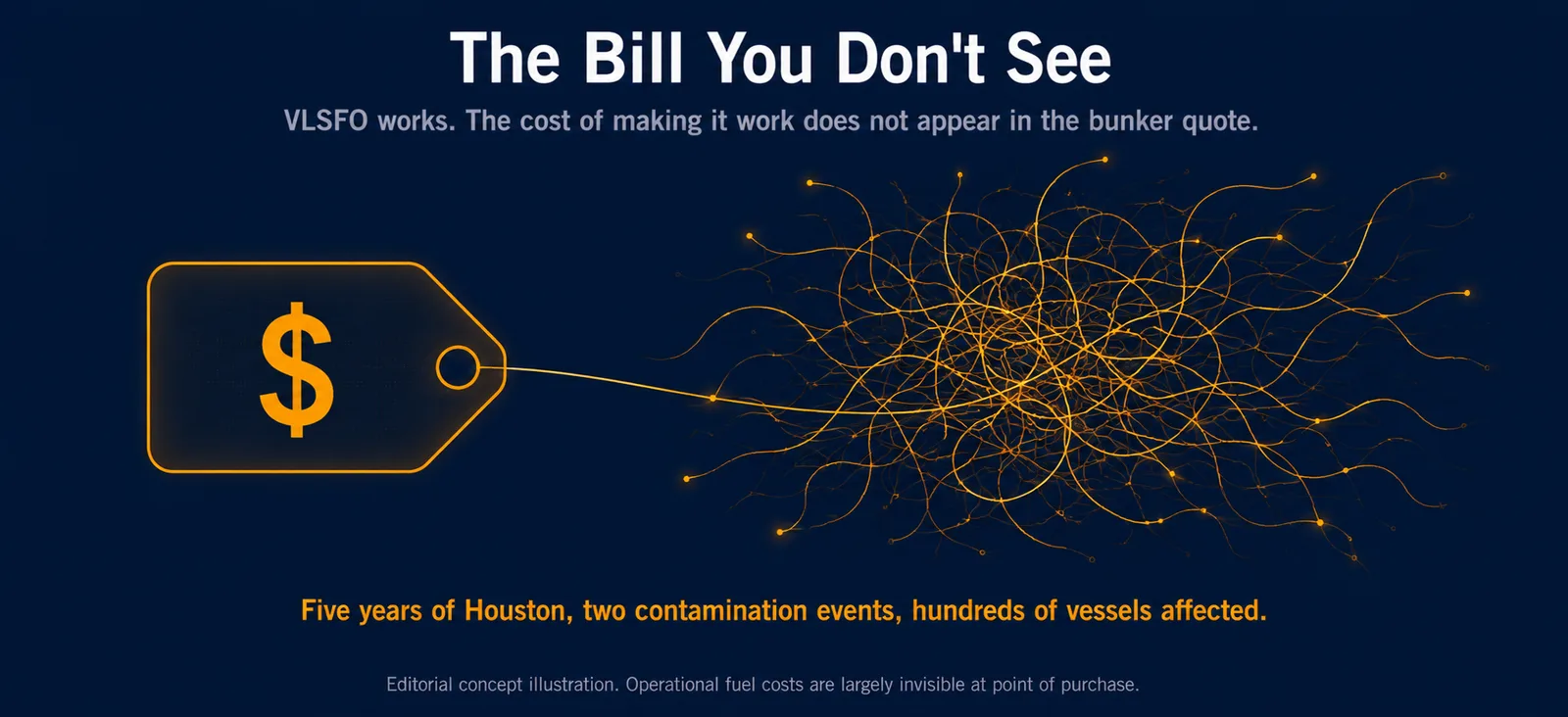
In January 2018, vessels taking bunkers through Houston began reporting fuel pump seizures. Plungers stuck. Injection control units leaked. Auxiliary engines lost output. The contaminants — phenol and styrene derivatives — were not detected by routine bunker quality testing. By May, more than one hundred ships had been affected. Marine insurers began referring to the recurring contamination events delivered through the hub as the Houston pattern.
This was before IMO 2020. The fuel involved was HSFO and IFO380 — high-sulfur residual fuel, the established marine fuel of the time. The chemistry that produced the failures had nothing to do with low-sulfur blending. It came from upstream chemical industry residues co-mingled into bunker fuel through a supply chain gap nobody had been looking at.
Five years later, in March 2023, ships bunkering at the same port began reporting the same symptoms. The contaminant this time was DCPD — dicyclopentadiene and its isomers. The fuel was VLSFO. The detection problem was identical: GC-MS testing required, not part of standard bunker quality protocols. By the time VPS published its second update in August 2023, the figure had grown from the initial eleven vessels to 32 ships across 61,494 metric tonnes of contaminated fuel, with the incident spreading to Singapore.
CMA CGM filed a $5 million lawsuit against GCC Supply & Trading in 2025, claiming 13 of its vessels were damaged by the 2023 deliveries — blackouts, fuel pump seizures, ICU leakages, loss of propulsion. The complaint reads like a copy of the 2018 claims. The contaminant changed. The supply chain gap did not.
These two incidents bracket the operational history of marine bunker fuel through the IMO 2020 transition. They are not the only problems with the fuel. They are the most visible. Between them, MAN B&W, Wärtsilä, and the cylinder oil formulators have published a steady stream of service letters and technical bulletins on cold corrosion, bore polishing, ring scuffing, and asphaltene sludge formation. The fuel has changed twice. The engines and the contracts have caught up partway.
The bunker price quote shows one number. The operational cost of running marine fuel — under either regime — shows up later. In liner inspections, in cylinder oil selection, in purifier cleaning intervals, and in the occasional general average claim. This is the part of decarbonization that nobody puts in the headlines.
The Frankenfuel Reality
VLSFO is not a single fuel. It is a category — a family of blends that meets a 0.50 percent sulfur cap by mass, with chemistry that varies widely between refineries, suppliers, and ports.
Before 2020, the global fleet ran predominantly on HSFO, a residual stream from crude oil distillation. Its characteristics were stable, its compatibility well understood, and its sulfur content was a property of crude composition rather than a specification target. Engine designers, lubricant formulators, and crews had forty years of operating data.
VLSFO is engineered. To hit 0.50 percent sulfur, refiners blend residual streams with distillates, hydrotreated middle distillates, or desulfurized residual fractions. The result varies by refinery, by crude slate, and by season. Three predominant base types exist: paraffinic, naphthenic, and aromatic. A paraffinic VLSFO and an aromatic VLSFO are both compliant on sulfur. They are not chemically compatible with each other.
ISO 8217:2024, published in May 2024, introduced dedicated VLSFO grades for the first time — four new RM grades specifically for ≤0.50% sulfur fuels. The specification gap that defined the early VLSFO years has been closed on paper. Adoption is uneven: as of late 2025, VPS estimated that only around 20 percent of bunker contracts referenced the most recent spec, with much of the market still operating under hybrid testing parameters carried over from the HSFO era.
This is what engineers call a frankenfuel — a working blend that behaves predictably in the bunker barge, less predictably in the settling tank, and least predictably in the cylinder liner.
Cold Corrosion: The Inverted Problem
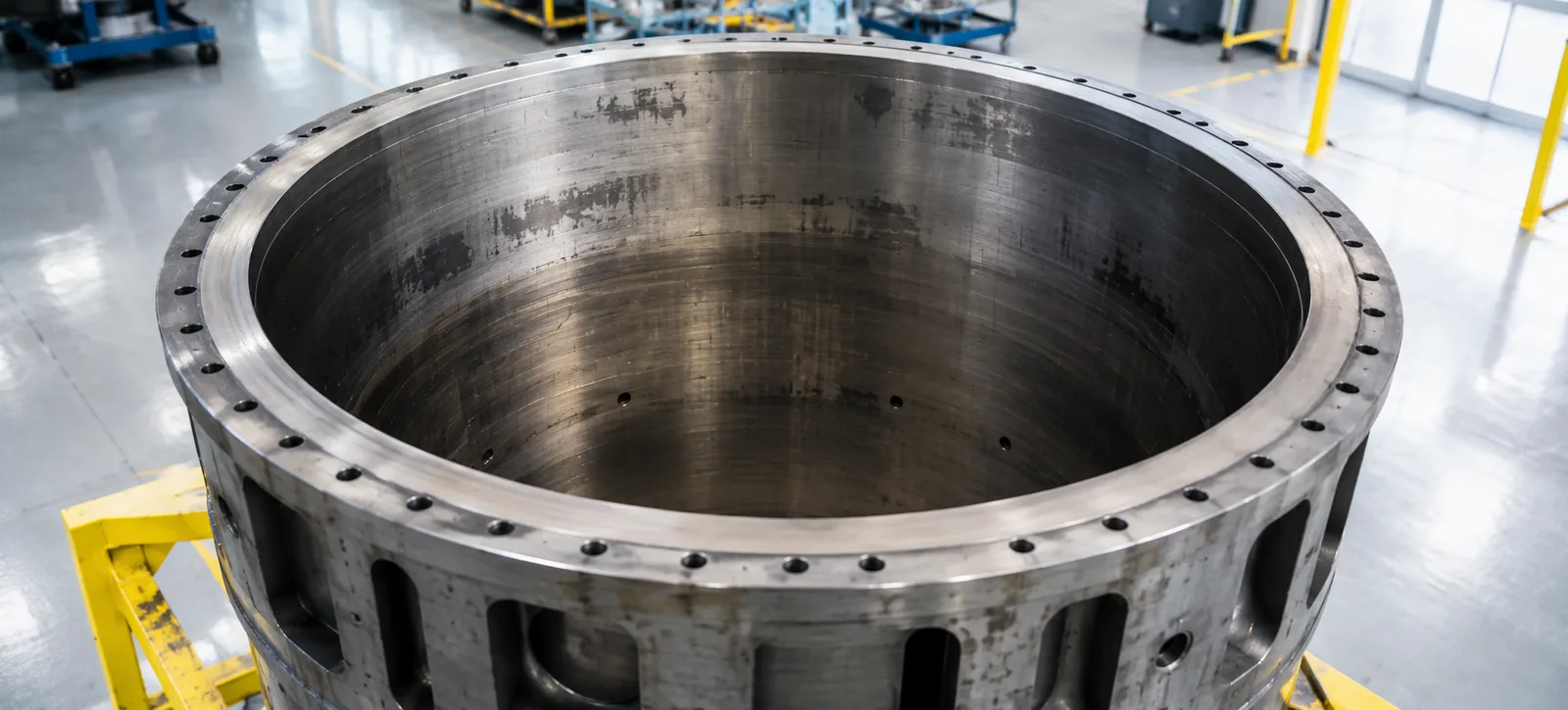
The chemistry of cylinder liner wear is counterintuitive.
Sulfur in fuel combusts into sulfur trioxide, which combines with water vapor to form sulfuric acid. Some acid condenses on the liner surface during the cooler portion of the stroke. Cylinder oil — formulated with alkaline additives measured as Base Number, or BN — neutralizes the acid. The neutralization reaction creates a controlled wear pattern. The liner stays at the right surface roughness, the piston rings seal properly, the cycle works.
The cold corrosion problem actually predates IMO 2020. The Mark 8.1 and higher generations of MAN B&W two-stroke engines were redesigned around BN100 cylinder oil as the new design basis in the early 2010s — driven by higher cylinder pressures from Tier II NOx and EEDI requirements, not by sulfur reduction. CIMAC documented cases of heavy wear within the first 2,000 operating hours when crews used BN70 oil on early Mark 9 engines designed for BN100. The structural problem was high-pressure combustion creating localized cold spots below the acid dew point.
IMO 2020 then inverted the problem. With sulfur dropping from 3.5 percent to 0.5 percent on a fleet-wide basis, BN100 became overprotective for many operating profiles. Operators now blend down to BN40-70 depending on actual fuel sulfur. The challenge is that the certificate of quality may not accurately reflect the actual sulfur in the tank. Cylinder oil selection became a continuous adjustment problem.
Three operational changes followed across the fleet. Scavenge port inspections became routine — the only direct way to see what the liner looks like. Sweep tests (MAN's diagnostic protocol) and quick tests (Wärtsilä's equivalent) became standard for measuring acid presence at the liner surface. Cylinder oil BN selection moved from a fixed annual decision to a per-stem adjustment based on bunker delivery analysis.
For anyone who has stood watch in a two-stroke engine room, the change is visible. Liner inspection intervals dropped from years to months for some operators. Scavenge port photos became part of every voyage report. The work of running a marine engine has shifted, quietly, toward continuous fuel-chemistry management.
The cost shows up in two places. Cylinder oil consumption increases when feed rates have to be raised to compensate for borderline conditions. Liner replacement intervals shorten when cold corrosion goes undetected. A new cylinder liner for a large two-stroke engine costs in the high five-figures to low six-figures per unit. A vessel with eight cylinders represents meaningful capital exposure when liner wear accelerates beyond design assumptions.
The technology works. The operating envelope is narrower than HSFO ever was.
Bore Polishing and Ring Scuffing
There is a second structural problem with low-sulfur combustion that gets less attention than cold corrosion. It shows up later. Once a liner has it, the cost compounds.
Cast iron cylinder liners have a microstructure that depends on controlled wear. The cast iron contains graphite lamellae — flake-like inclusions that hold oil at the liner surface, providing the boundary lubrication that piston rings need. As the liner wears, fresh graphite is exposed, the surface stays receptive to oil, and the ring-liner interface stays sealed.
Bore polishing is the failure mode. When cylinder oil cannot neutralize enough acid — or when there is too little acid to begin with — the liner surface stops wearing in the controlled pattern. It becomes glassy. Polished. The graphite lamellae fill with deposits, the surface loses its oil-retention capability, and piston rings can no longer seal properly.
The result is ring scuffing — abrasive damage to both rings and liner. A scuffed liner has to be machined, sometimes replaced. A scuffed ring pack has to be replaced. The repair sequence often takes a port call or a drydock window the operator did not budget.
MAN B&W's response was a redesigned piston ring pack. Service Letter SL2018-659 introduced cermet-coated piston rings — ceramic-metallic composite coating on the running surface — specifically for operation on low-sulfur fuels including VLSFO, ULSFO (for SECA zones), and low-flashpoint fuels like LNG and methanol. The three-ring CPR configuration became standard on newer ME-C, ME-B, and MC-C engines operating on these fuels. Wärtsilä published parallel guidance for its low-speed two-stroke engines.
The lesson for operators is unforgiving. A liner that has gone polished is not easy to recover. The fix is mechanical — machining the surface to restore the wave-cut pattern, replacing the ring pack, and rechecking feed rates. Done badly, the engine returns to polished condition within months. Done well, the operating envelope holds — until the next bunker delivery arrives with a different fuel chemistry.
Incompatibility: When Stable Fuels Go Unstable
The next problem does not require a defective fuel. It only requires two different fuels.
A bulk carrier loads VLSFO at one port. Three weeks later, it bunkers again at a different port. The two cargoes mix in the settling tank. Both passed quality testing. Both were stable in isolation. The mixture is not.
This is asphaltene incompatibility. Residual fuel components include heavy asphaltic compounds held in solution by lighter aromatic fractions. When the asphalt-aromatic balance shifts — for instance, by adding a paraffinic VLSFO to a naphthenic VLSFO — the asphaltenes drop out. The sludge that forms is mechanical. It is not soluble. The fuel system has to either handle it or stop.
VPS documented a case in 2023. A ship received VLSFO in an Asian port with sediment content of 0.07 percent — well below the 0.10 percent specification limit. The fuel was, on paper, compliant. Within hours of switching to the fuel, the purifier began producing sludge. The cleaning interval collapsed from the normal 250 hours to four hours. The chief engineer eventually ran out of cleaning brushes. The vessel discontinued use of the fuel.
The mechanism is straightforward. The asphaltene precipitates form a hard cake in the purifier bowl. The crew can clean the bowl. They cannot stop the precipitation. The only fix is to stop using the fuel. If the alternative tank holds the same incompatible blend, the fix is debunkering — itself a multi-day, multi-port logistics problem.
For container lines and tanker operators on tight schedules, this is not just an engineering problem. It is a commercial one. Off-spec fuel becomes a delay risk, a port-call risk, a charter party risk. The bunker contract — written in a 1990s style for a fuel that behaved like 1990s HSFO — was not designed for this.
Two Contamination Events, Five Years Apart
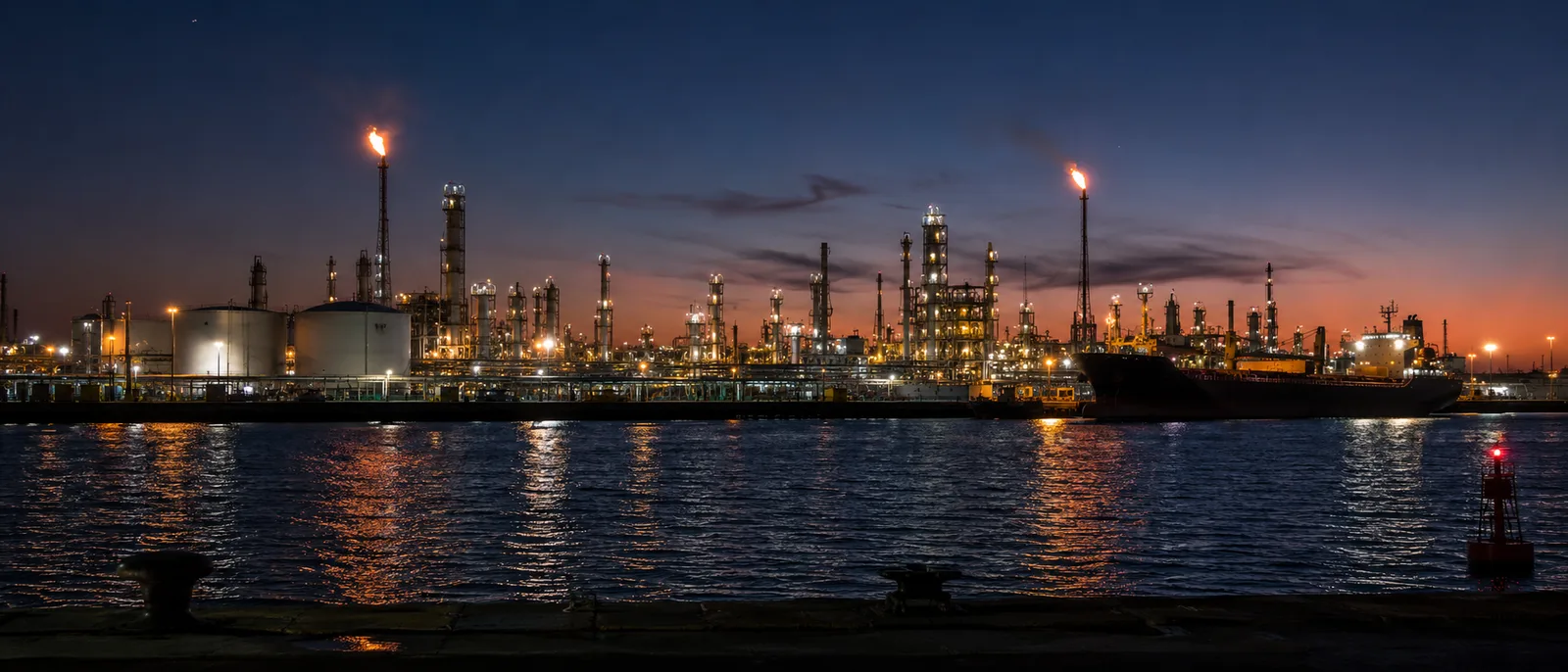
The 2018 Houston contamination — caused by upstream chemical residues co-mingled into bunker blends at supplier and refinery level — was the maritime industry's first collision with the limits of conventional bunker quality testing in the modern era.
Between January and May 2018, more than one hundred vessels reported fuel-related operational issues after taking HSFO and IFO380 from suppliers delivering through the Houston hub. The contaminants — phenol and styrene derivatives, with 4-Cumyl-Phenol (CAS 599-64-4) identified by VPS as the dominant compound at concentrations of 300–1,000 ppm — were not on the standard ISO 8217 test panel. VPS reported eight suppliers and 17 bunker tankers in the affected chain of supply. The contaminants came from chemical industry residues mixed into bunker blends at refinery or terminal level, upstream of the port's commercial operations. The compounds did not trigger standard quality flags. They did seize fuel pumps.
The legal aftermath defined a generation of bunker contracts. Multi-million-dollar arbitration awards followed. P&I clubs absorbed significant claims. Some vessel groundings were directly attributed to the Houston fuel. Maritime law schools added the Houston pattern to their curriculum as a case study in contract drafting and quality attribution.
The 2023 sequel followed a different chemical pathway in a different fuel — VLSFO instead of HSFO — but produced the same operational result. VPS detected DCPD and its hydrogenated isomers at concentrations between 1,000 and 40,000 ppm in VLSFO delivered by a single supplier between March and May 2023. DCPD polymerizes and oxidizes under combustion-adjacent conditions, making the fuel sticky and viscous, jamming fuel pumps and injector spindles.
Eleven vessels reported loss of power and propulsion in the initial reporting. By August 2023, VPS had revised the figure to 32 vessels that had received the contaminated fuel — 14 of those reported direct damage to engines and fuel delivery systems. Two of the contaminated deliveries reached Singapore. Total contaminated volume: 61,494 metric tonnes. One vessel had to switch to LSMGO mid-voyage to reach port safely. Multiple ships exhausted their fuel pump and injector spare inventory before the contaminated fuel was consumed or debunkered.
In 2025, CMA CGM filed a $5,057,902.79 lawsuit against GCC Supply & Trading in the U.S. District Court for the Southern District of Texas (Case No. 4:2025cv01320), alleging that 13 of its vessels were damaged by VLSFO deliveries totaling 33,628 metric tonnes between March and June 2023. The complaint cites fuel pump failures, ICU leakages, loss of engine power, propulsion problems, and complete blackouts in some cases. GCC filed a motion to compel arbitration under BIMCO Bunker Terms 2018, which the court granted in July 2025; the action is stayed pending arbitration. The merits remain to be determined. The pattern is not.
The standard bunker quality tests — flash point, viscosity, density, sulfur content, water content, sediment, cat fines — were not designed to detect chemical contaminants from upstream industrial sources. The ISO 8217 specification has been updated since 2018, with the 2024 edition adding VLSFO-specific RM grades, but the core test panel remains essentially the same. Detection of compounds like DCPD requires gas chromatography-mass spectrometry, which is not part of standard fuel testing protocols and is not contractually required.
The shipowner pays for routine testing. The shipowner does not typically pay for GC-MS forensic testing. The bunker supplier delivers fuel that passes routine testing. The bunker supplier is not contractually liable for contaminants the routine test does not detect. This is the gap that has not closed since 2018.
To be clear: bunker quality risks of this type are not unique to Houston. Singapore — where the 2023 contamination eventually spread, and where a separate large-scale quality incident affected over 200 ships in March 2022 — has its own pattern. Rotterdam, Fujairah, and other major hubs have had isolated incidents over the same period. The pattern named for Houston is named for the locations of the headline events, not for any unique characteristic of the port itself. The Port of Houston Authority operates one of the largest commercial container and bulk terminals in the Americas and continues normal operations; the contamination events occurred at supplier and refinery level, upstream of the port's commercial operations. Any hub operating at this scale becomes a statistical front-runner when a supplier-end supply chain gap surfaces.
What This Costs Operators
The operational cost of marine fuel is real, but unevenly distributed. Some operators pay it through routine maintenance budgets. Some pay it through catastrophic engine room incidents that crystallize into multi-million-dollar claims. The accounting depends on the operator.
Predictable costs include cylinder oil with appropriate BN ratings (a continuous selection problem), more frequent scavenge port inspections, increased spare parts inventory for piston rings and fuel pump components, and shorter intervals between major maintenance items. These are the costs that mature operators have absorbed into their five-year budgets. They are not invisible. They are also not zero.
Unpredictable costs include early liner replacement, scuffing repair campaigns, debunkering of incompatible fuel, off-hire for fuel contamination incidents, P&I premium increases following claims, and arbitration costs. Most of these come in lumpy episodes rather than smooth recurring expenses. A vessel can run for two years without a fuel-related incident, then absorb several hundred thousand dollars of unplanned cost in a single bunker call.
The aggregate industry figure is not published, and probably cannot be. Operators do not aggregate fuel-related operational expenses into a single line item. Insurers see the catastrophic end of the distribution. Engine designers see the mechanical end. Lubricant formulators see the chemistry. No single party sees the full bill.
As of late May 2026, VLSFO prices in major hubs sit in the $735-900 per tonne range (Rotterdam to Fujairah), with MGO in the $1,100-1,500 range. The bunker price discount of VLSFO to MGO is meaningful — typically $300-500 per tonne. But the operational cost differential between VLSFO and the HSFO of the pre-2020 era is not in the bunker price. It is in the equipment, the lubricant, the inspection regime, and the occasional unplanned port call.
Scrubber-equipped vessels — roughly 30 percent of the global fleet — never made the switch. They continue to burn HSFO at a meaningful discount to VLSFO. The scrubber spread that has averaged $100-200 per tonne since 2020 is, structurally, the market's pricing of the VLSFO operational cost — an implicit acknowledgment of the gap between bunker quote and total cost of ownership.
Why It Persists
Three structural reasons explain why the operational problems with marine fuel have not been engineered out of the supply chain.
Bunker contract structure. Most bunker supply contracts are written on standard terms that have evolved only marginally since the 1990s. The supplier delivers fuel meeting ISO 8217 testing parameters. The shipowner accepts the fuel based on sample analysis at delivery. Disputes are channeled into arbitration. The contracts do not require GC-MS testing for chemical contaminants. They do not require compatibility testing between incoming and existing bunkers. They do not allocate liability for known-but-unmonitored contaminants. Industry working groups have produced model clauses. Adoption is voluntary and partial.
ISO 8217 update lag. The 2024 specification update introduced VLSFO-specific grades, but adoption across the market is slow. Most existing bunker contracts still reference earlier editions. The core test parameters have not been expanded to include the contaminants seen in 2018 and 2023. As long as the test panel does not include the chemicals that actually break engines, the test panel will let them through.
Refinery economics. Refiners blend VLSFO from whatever streams produce the most attractive margin. The streams change with crude prices, distillate demand, and seasonal product demand. A refinery producing predominantly paraffinic VLSFO in one quarter may shift to naphthenic blends in another, depending on cracker yields and inventory positions. The fuel that reaches the bunker barge reflects these choices, not a stable engineering specification. The variability is a feature, not a defect — from the refiner's perspective.
The system is not broken. It is operating exactly as designed. The cost of the design is being absorbed by ship operators.
Closing
In maritime decarbonization, the conversation is moving steadily toward alternative fuels — ammonia, methanol, hydrogen, onboard carbon capture. Each has its own infrastructure problem, its own deployment runway, its own headline. Meanwhile, the fuel that nearly every ship in the world actually burns today continues to produce quiet operational casualties — fuel pumps in Houston, polished liners across the Pacific, asphaltene sludge in settling tanks from Singapore to Rotterdam.
The Houston pattern is not a story about a single contaminant. It is a story about specific suppliers operating within bunker contracts that did not require the testing protocols to catch them — in 2018 and again in 2023. The Port of Houston remains the largest bunker hub in the Americas. The contamination events occurred upstream, at supplier and refinery level, and were delivered through a supply chain that the standard contracts did not look into. The contracts that failed the industry in 2018 still failed the industry in 2023. The detection protocols that missed phenol and styrene also missed DCPD. The arbitration cycles that resolved the 2018 cases are now starting over with the 2023 claims.
Quiet Retreat (May 21) noted alternative fuels stalling at infrastructure. OCCS (May 24) noted carbon capture proving while infrastructure does not. The Houston pattern is the third version of the same story: the molecule works, the system around it has not finished catching up.
Ship operators absorb the cost in cylinder oil bills, in inspection labor, in unplanned repairs, in arbitration fees. Some of them have internalized it as part of running a fleet in the IMO 2020 era. Some of them will absorb a Houston-style incident in the next bunker call and call it bad luck. Both are right.
The fuel works. The cost of making it work is the line item that the industry has not yet learned to put on the invoice.