Freight & Chartering

TCE, Worldscale, FFAs, demurrage, charter parties, and the Baltic indices. The numbers that price every voyage.

6 articles

Freight is what shipping sells. Every other number — bunker price, canal toll, port fee, insurance premium — exists in relation to the freight rate. This section covers the frameworks that convert a voyage into a price: TCE (the daily earnings metric that strips out cost structure), Worldscale (the percentage system that standardises tanker fixtures across routes), FFAs (the derivatives that let participants trade freight before the ship sails), demurrage and laytime (the cost of waiting), and charter parties (the contracts that define who pays what).

The Baltic Exchange indices — BDI, BCI, BPI, BSI, BDTI, BCTI — are the settlement benchmarks for these markets. Articles here explain what the indices measure, where they diverge, and why the headline number often tells a different story than the underlying route assessments.
What Are FFAs? — Trading a Voyage That Hasn't Started Yet
Freight & Chartering11 min

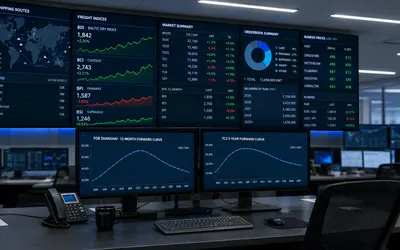
What Are FFAs? — Trading a Voyage That Hasn't Started Yet

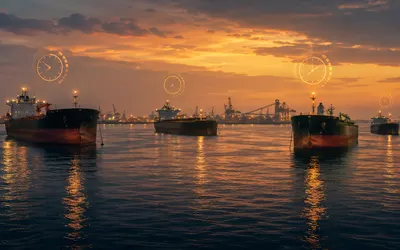
No ship. No cargo. No port. But there is a price. A Forward Freight Agreement lets two parties fix what a shipping route will cost next quarter — and settle the difference in cash when the date arrives. The Baltic Exchange publishes the number. The market trades around it. The BDI you read in the news is yesterday's rate. The FFA is tomorrow's.

June 16, 2026
Demurrage & Laytime — Why Every Hour in Port Has a Price Tag
Freight & Chartering11 min

Demurrage & Laytime — Why Every Hour in Port Has a Price Tag

A Capesize bulker gets 72 hours to load 170,000 tonnes of iron ore. If the terminal takes 96 hours, the charterer owes the shipowner $35,000 for every extra day. If the terminal finishes in 60 hours, the shipowner pays the charterer $17,500 for every day saved. Penalty and bonus in the same contract. The clock starts with one piece of paper.

June 14, 2026
What Is TCE? — The One Number That Tells You If a Voyage Made Money
Freight & Chartering11 min

What Is TCE? — The One Number That Tells You If a Voyage Made Money

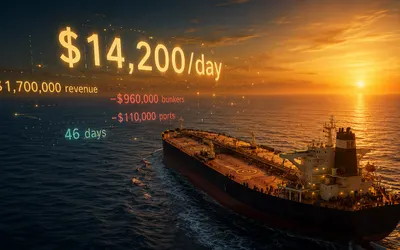
A tanker earns $1.7 million on a 42-day voyage. After bunker costs and port charges, the net is $650,000. Divide by 42 and the ship earned $15,500 a day. That is the Time Charter Equivalent — the number that converts any voyage into a comparable daily rate. Frontline's VLCCs entered Q2 2026 booked at $181,700/day. The old benchmarks no longer apply.

June 13, 2026
Charter Parties — $3M Voyage, $50M Time, $150M Bareboat. Same Ship.
Freight & Chartering12 min

Charter Parties — $3M Voyage, $50M Time, $150M Bareboat. Same Ship.

The same Capesize bulk carrier can earn $3 million on a single voyage, $50 million over five years on a time charter, or $150 million across fifteen years on a bareboat financing structure. Here's how voyage, time, and bareboat charters actually work — and why one private document still sits at the centre of almost every commercial shipping decision.

June 6, 2026
What Is Worldscale? — Why WS 280 Is Not Three Times WS 100
Freight & Chartering11 min

What Is Worldscale? — Why WS 280 Is Not Three Times WS 100

Tanker freight rates are quoted in a strange unit called Worldscale. WS 100 isn't a price. WS 280 isn't "280 dollars" or "280% of the going rate." The system was designed in 1952 to solve a problem the spot market couldn't solve on its own — and it's still in use seventy years later because the alternative is worse.

June 5, 2026
Why the Baltic Dry Index Just Jumped — and What It Actually Measures
Freight & Chartering7 min

Why the Baltic Dry Index Just Jumped — and What It Actually Measures

The BDI hit a two-year high last week, rising 19% in three trading days. Most headlines framed it as a demand recovery. The real driver was something more specific — and it wasn't about more cargo. A plain-English walk through what the BDI actually measures, why it just spiked, and how to read the headlines more carefully than they're written.

May 18, 2026

Run the numbers yourself

Compare Suez, Cape, Panama, and NSR routes across 420+ ports. Free, no signup.

Launch Calculator →