
Think of a parking garage. You get two hours free. After that, you pay by the hour. If you leave early, nobody gives you money back. In shipping, they do.
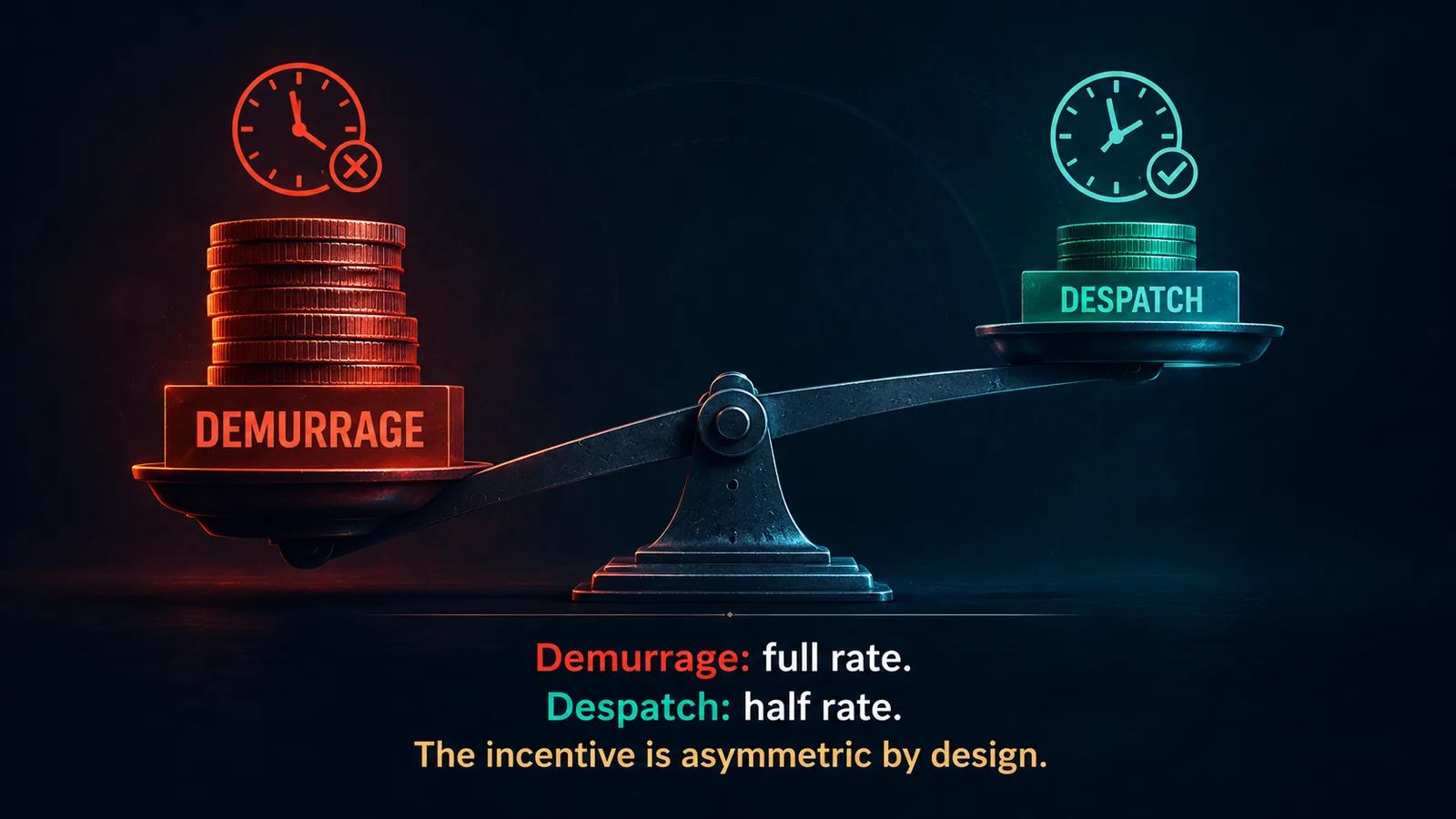
A voyage charter gives the charterer a fixed amount of time to load and discharge cargo. This is laytime — the free hours built into the freight rate. If the cargo operation takes longer than the allowed time, the charterer pays the shipowner a daily penalty called demurrage. If the operation finishes faster, the shipowner pays the charterer a daily credit called despatch.
Penalty and bonus in the same contract. The same piece of paper that defines the freight rate also defines the cost of being slow and the reward for being fast. No other industry structures its contracts this way.
A Capesize bulker loading 170,000 tonnes of iron ore might have 72 hours of laytime. Demurrage at $35,000 per day means every hour over the limit costs the charterer roughly $1,460. Despatch at half rate — $17,500 per day — means every hour saved returns about $730. The terminal operator, the weather, the port authority, the surveyor, and the ship's gear all affect whether the final account shows a demurrage charge or a despatch credit.
The clock starts when the ship's master sends one document to the charterer's agent: the Notice of Readiness.
What is laytime?
BIMCO — the shipping industry's principal standard-form drafting body — defines laytime as:
"The period of time agreed between the parties during which the owner will make and keep the vessel available for loading and discharging without payment additional to the freight."
In plain language: laytime is free time. The shipowner has already priced a certain number of loading and discharging hours into the freight rate. As long as the cargo operation stays within that allowance, no additional charges apply.
Laytime can be expressed in several ways:
Fixed laytime — a specific number of hours or days (e.g. "72 running hours" or "4 weather working days"). This is the most common form.
Customary quick despatch (CQD) — no fixed hours; the ship must be loaded or discharged "as fast as the port customarily does it." This shifts the risk to the shipowner and is less common in modern charters.
Rate of loading/discharging — expressed in tonnes per day (e.g. "10,000 tonnes per weather working day"). The total laytime is then calculated by dividing the cargo quantity by the rate.
The method matters because it determines when demurrage starts. A poorly drafted laytime clause is the single most common source of commercial disputes in voyage chartering.
The Notice of Readiness — when the clock starts

Laytime does not start when the ship arrives. It starts when a valid Notice of Readiness (NOR) has been tendered and accepted.
NOR is the formal notice from the ship's master to the charterer (or their agent) that the vessel has arrived at the port or berth and is ready to load or discharge in all respects — holds clean, equipment operational, documentation in order, free pratique granted.
The charter party specifies the rules:
Where NOR can be tendered — at the berth, at the port, or at the customary waiting area (anchorage or roads). A "port charter" allows NOR at the port limits; a "berth charter" requires the vessel to be at the berth itself. The distinction matters enormously: if the port is congested and the vessel waits at anchorage for three days, a port charter starts laytime on arrival at the anchorage. A berth charter does not start laytime until a berth is available.
When NOR takes effect — many charters specify "NOR to be tendered during office hours" with a time bar (e.g. "if NOR tendered before 12:00, laytime commences at 13:00; if after 12:00, laytime commences at 08:00 next working day"). This single clause can shift the start of laytime by 20 hours.
Notice time — some charters require 6, 12, or 24 hours between NOR tender and laytime commencement, to allow the receiver time to prepare.
A valid NOR requires the vessel to be an "arrived ship" — physically present at the contractual destination and ready in all respects. If the ship tenders NOR but the holds are not clean, or free pratique has not been granted, the NOR is invalid and laytime does not start. Disputes over NOR validity are among the most frequently litigated issues in shipping arbitration.
SHINC, SHEX, and counting the hours
Once laytime starts, the next question is: which hours count?
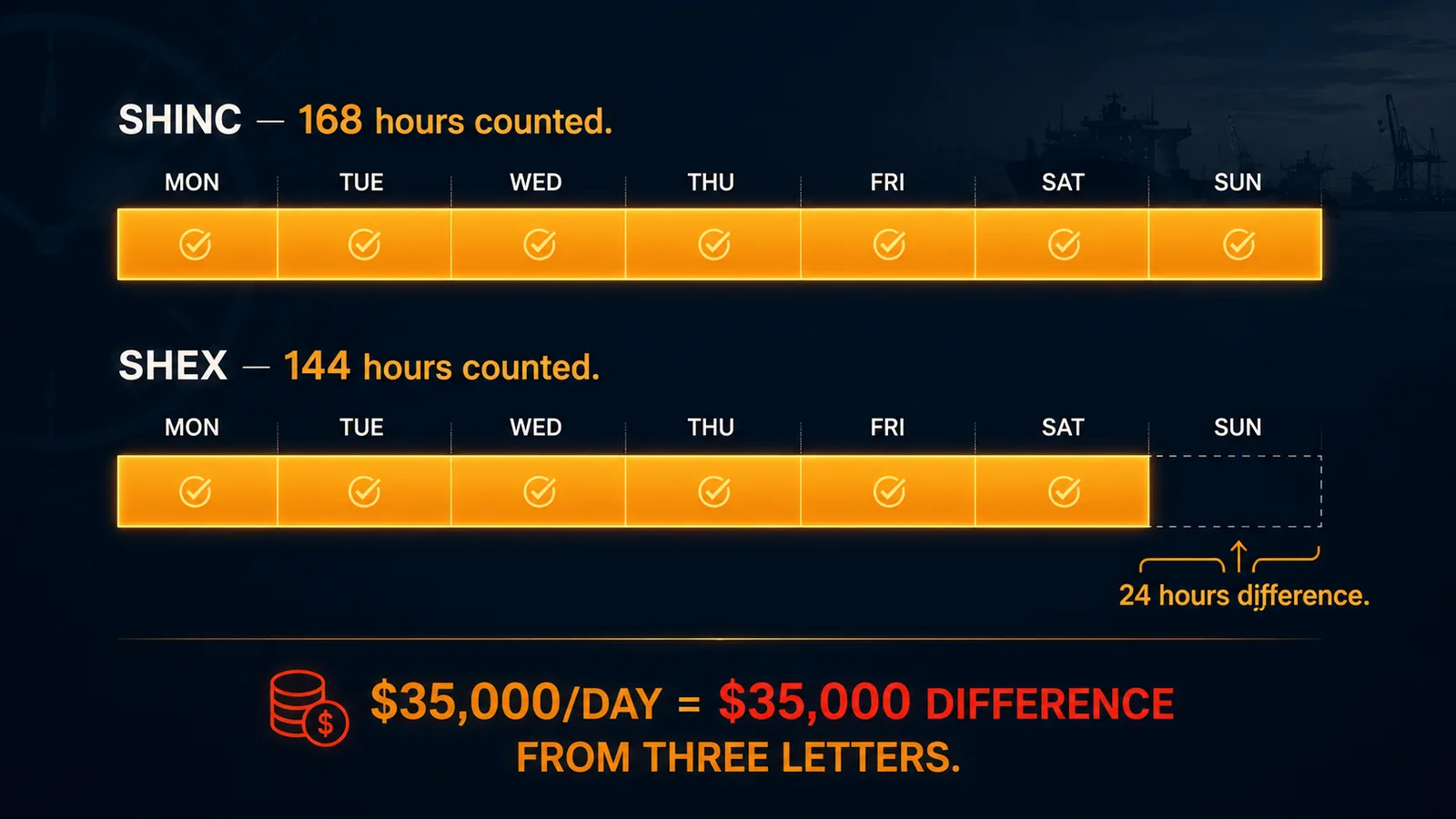
SHINC — Sundays and Holidays Included. Time runs continuously, 24 hours a day, 7 days a week, including weekends and public holidays. The clock never stops. This is the most favourable term for the shipowner.
SHEX — Sundays and Holidays Excluded. Sundays and public holidays at the port do not count toward laytime. If the vessel is loading on Saturday afternoon and Sunday is excluded, laytime pauses at midnight Saturday and resumes at midnight Sunday (or Monday 00:00 depending on the port's definition).
SHEX UU — Sundays and Holidays Excluded Unless Used. If the vessel actually works on a Sunday or holiday, that time counts. If it does not work, the time is excluded. This is the most common modern compromise.
WWD — Weather Working Day. Only the hours when weather permits cargo operations to proceed count toward laytime. Rain, swell, fog, or wind that stops the cranes pauses the laytime clock.
The difference between SHINC and SHEX over a single week is at least 24 hours — one Sunday excluded under SHEX. At a demurrage rate of $35,000/day, that is $35,000 determined by three letters in the charter party.
Demurrage: the cost of delay
BIMCO defines demurrage as:
"An agreed amount payable to the owner in respect of delay to the vessel once the laytime has expired, for which the owner is not responsible."
Key characteristics:
It is a fixed daily rate, agreed in advance in the charter party. It is not negotiated after the fact. A typical clause reads: "Demurrage at USD 35,000 per day or pro rata for part of a day."
It is liquidated damages, not a penalty. The legal distinction matters: liquidated damages are enforceable; penalties may not be. English law — which governs most international voyage charters — treats demurrage as liquidated damages, meaning the contractual rate applies regardless of the shipowner's actual loss.
Once on demurrage, always on demurrage. This is one of the most important principles in laytime law. Once laytime has expired and demurrage starts running, it runs continuously without interruption — weekends, holidays, bad weather, strikes — unless the charter party specifically provides otherwise. The exceptions that applied to laytime (SHEX, WWD) do not automatically apply to demurrage.
Demurrage is not subject to laytime exceptions unless the charter party explicitly says so. This means a charterer who negotiated SHEX for laytime will still pay demurrage on Sundays unless the charter says "demurrage SHEX" — which is unusual.
Demurrage rates vary by vessel class and market conditions:
VLCC (crude tanker): $100,000–$250,000/day in newly negotiated charters as of mid-2026 — reflecting the extreme spot TCE environment where TD3C briefly touched $424,000/day in March 2026. When spot earnings exceed $200,000/day, no shipowner accepts demurrage below the opportunity cost of trading the vessel. The March 2026 spike, driven by the Hormuz closure, saw newly concluded fixtures with demurrage rates above $200,000/day.
Capesize (dry bulk): $25,000–$45,000/day.
Panamax (dry bulk): $15,000–$30,000/day.
Supramax/Handysize: $8,000–$18,000/day.
Demurrage rates are not arbitrary numbers. They are the spot market's opportunity cost made contractual. When Frontline enters Q2 2026 with 82% of VLCC days booked at $181,700/day, no fixture concluded during that period will carry a $50,000 demurrage rate — because the shipowner would prefer to sail the ship and earn three times that amount. The 2026 tanker market has repriced demurrage alongside spot TCE, compressing the gap between what a ship earns at sea and what it earns standing still in port.
These rates are negotiated in each charter party and correlate broadly with the prevailing time charter market — because demurrage compensates the shipowner for the time the vessel could have been earning elsewhere.
Despatch: the reward for speed
Despatch is the mirror image of demurrage. If the charterer completes loading or discharging before laytime expires, the shipowner pays the charterer a daily credit.
The despatch rate is almost always half the demurrage rate. If demurrage is $35,000/day, despatch is $17,500/day. This asymmetry is deliberate: it gives the charterer an incentive to be efficient, but the reward is smaller than the penalty because the shipowner benefits more from an early departure (the ship is free to earn its next freight) than from receiving the despatch payment.
Two calculation methods exist:
Despatch on all time saved — the charterer receives despatch for all the time saved, including weekends and holidays that were excluded from laytime. This is the more generous calculation.
Despatch on all working time saved (or all laytime saved) — despatch is paid only for the laytime-countable time that was saved. Excluded periods (Sundays, holidays under SHEX) do not generate despatch credit.
Not all charter parties include a despatch clause. Some contracts provide for demurrage only, with no despatch payable. Whether despatch applies depends entirely on the negotiated terms.
A worked example
| Vessel | Capesize, 170,000 DWT |
| Cargo | 168,000 MT iron ore |
| Laytime (each port) | 72 running hours SHINC |
| Demurrage | $35,000/day pro rata |
| Despatch | $17,500/day on all time saved |
Loading at Tubarão (Brazil): NOR tendered June 1, 08:00. Laytime commenced June 1, 14:00 (6-hour notice). Loading completed June 4, 18:00. Time used: 76 hours. Allowed: 72 hours. On demurrage: 4 hours. Demurrage: 4/24 × $35,000 = $5,833.
Discharging at Qingdao (China): NOR tendered June 28, 06:00. Laytime commenced June 28, 08:00 (2-hour notice) (Qingdao's charter terms specified a shorter notice period than Tubarão — notice time is negotiated per port in each charter party). Discharging completed June 30, 08:00. Time used: two days. Allowed: 72 hours. Time saved: 24 hours. Despatch: 24/24 × $17,500 = $17,500.
Net result: Demurrage owed by charterer: $5,833. Despatch owed by owner: $17,500. Net payable to charterer: $11,667.
The charterer was slow at loading (4 hours over) but fast at discharging (24 hours under). The net account favours the charterer — but only because Qingdao's terminal was efficient enough to offset the Tubarão delay. If both ports had run 4 hours over, the total demurrage would have been $11,667 with no despatch offset.
Why disputes happen
Laytime and demurrage disputes are the most common commercial disputes in tramp shipping. The amounts at stake are significant — a single voyage can generate $100,000 or more in contested demurrage — and the rules are technical enough that reasonable parties can disagree.
The most common disputes:
NOR validity — was the vessel truly ready in all respects when NOR was tendered? Were the holds clean? Was free pratique granted? If the NOR is invalid, laytime never started, and the entire demurrage calculation shifts.
Port vs berth charter — did laytime start at the anchorage or at the berth? If the ship waited 4 days for a berth, a port charter counts those 4 days against laytime. A berth charter does not.
Weather exclusions — under WWD terms, who decides whether the weather was bad enough to stop operations? The ship's log? The terminal operator? The port authority? The surveyor?
Holiday definitions — under SHEX, which holidays count? The loading port's holidays? The ship's flag state holidays? The charterer's home country holidays? Different charter parties resolve this differently, and the answer can add or remove entire days from the calculation.
Shifting time — if the vessel shifts from one berth to another (to load a second parcel or change draft), does the shifting time count as laytime? Most charters address this, but ambiguous wording generates disputes.
These disputes are resolved through London arbitration (for most international voyage charters) or through the dispute resolution mechanism specified in the charter party. BIMCO's Laytime Definitions 2013 were drafted specifically to reduce these disputes by providing standard definitions — but adoption is voluntary, and many older charter forms do not incorporate them.
- BIMCO, Laytime Definitions for Charter Parties 2013 — standard industry definitions for laytime, demurrage, despatch, NOR, and time-counting terminology (jointly developed with Baltic Exchange, CMI, and FONASBA)
- Schofield, J., Laytime and Demurrage (7th edition, Informa Law) — the leading English-law practitioner text on laytime calculation and dispute resolution
- The Shipowners' Club, Laytime and Demurrage member guidance — practical overview of NOR, SHINC/SHEX, exceptions, and demurrage principles