Open any vessel particulars sheet, charter party, or sale-and-purchase memorandum and one of the first lines you'll see is something like “Class: DNV” or “ABS classed, special survey due 2027.” It sits there as a single short line, usually without explanation, as if everyone already knows what it means.
Most people in adjacent industries — finance, journalism, insurance, logistics — don't, exactly. Class is one of those maritime concepts that gets used constantly without being defined. This piece breaks down what a classification society actually does, why class status decides whether a ship can sail, who the twelve IACS members are, and how class fits alongside flag state and P&I in the structure that keeps commercial shipping running.
What a classification society actually does
A classification society writes the technical rules that govern how a commercial ship is designed, built, equipped, and maintained. These rules cover hull structure, propulsion machinery, electrical systems, firefighting equipment, anchor and mooring arrangements, and every other subsystem that matters for the ship's seaworthiness over a typical 25-to-30-year service life.
Think of class the way a city thinks of structural engineering on a building. A city won't connect utilities, insurers won't write a policy, banks won't lend against the property, and tenants won't sign leases until an independent engineer has certified that the building meets code. The engineer doesn't own the building, doesn't operate it, doesn't even have authority to demolish it. What they have is the certificate everyone else relies on. Take the certificate away and the building still stands — but it can't function commercially. Class works the same way on the water.
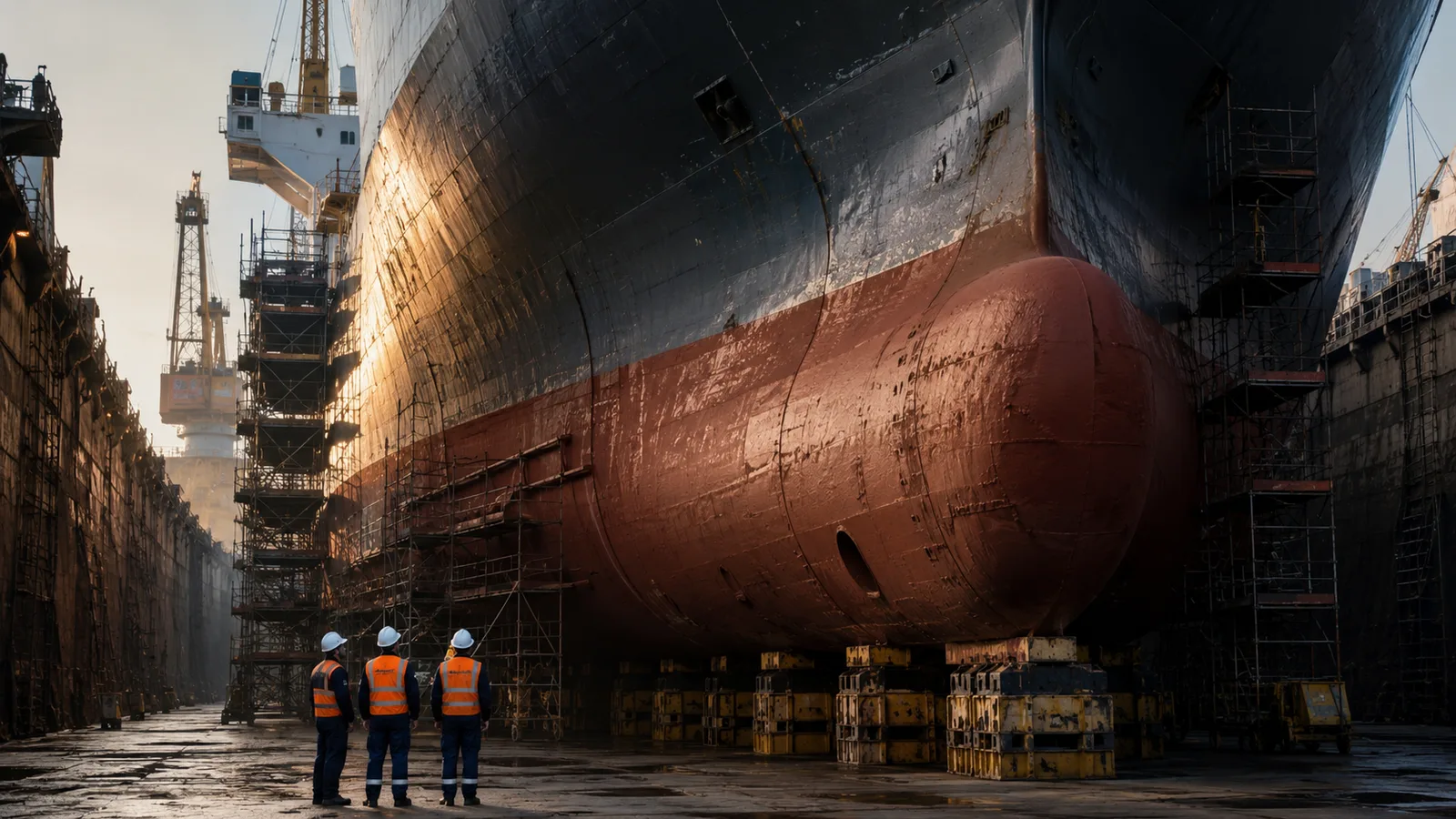
When a ship is built, its design is reviewed against the chosen society's rules. During construction, class surveyors visit the yard to verify that what was approved on paper is actually being built. After delivery, the ship enters a survey cycle — annual surveys, intermediate surveys at 2.5-year intervals, and special surveys every 5 years that are far more thorough — that continues until the vessel is scrapped.
If the ship meets the rules at the time of survey, it remains “in class” with that society. If a deficiency is found, the owner has a defined window to repair it. If serious issues go unaddressed, class is “withdrawn” — formally cancelled. A withdrawn-class ship can still physically sail, but commercially it has nowhere legitimate to go.
The certificate of class is not a government document. The society is a private organization the shipowner pays to perform the work. What gives the certificate weight is that everyone else in the chain — insurers, charterers, flag administrations, port authorities — has agreed to rely on it. That agreement, built over a century and a half, is what makes the system work.
Why class decides if a ship can sail
Three things make class essential in practice.
First, insurance. Protection and Indemnity (P&I) clubs — the mutual pools covering third-party liability for pollution, crew injury, cargo damage, and collision liability — write IACS class as a standard precondition in nearly every policy. Hull and machinery insurers, who cover the ship itself, do the same. Lose IACS class and your coverage lapses, either at the next renewal or, in some wordings, immediately upon withdrawal.
Second, port state control. When a ship enters a foreign port, the local authority may inspect it under one of the regional Memorandums of Understanding — Tokyo MOU for Asia-Pacific, Paris MOU for Europe, the Black Sea MOU, the Indian Ocean MOU, and several others. A current class certificate from a recognized IACS society means the inspection is usually short and routine. A non-IACS classification or a recently lapsed certificate often means delays, additional surveys, or in some cases refused entry.
Third, flag state acceptance. Most major flag states — Panama, Liberia, Marshall Islands, Singapore, Hong Kong, Malta — outsource the technical work of statutory inspection to classification societies under the IMO RO Code. The flag state still issues the SOLAS, MARPOL, and Load Line certificates legally, but it relies on class surveys to justify doing so. A ship without an accepted class society finds it very difficult to get statutory certificates issued at all.
The combined effect is that class is not an optional quality stamp. It's a hard prerequisite for commercial operation.
The country whose laws apply to the vessel. Panama, Liberia, Marshall Islands are the largest. Issues SOLAS, MARPOL, and Load Line certificates. Has jurisdiction over crew, safety management, and any criminal matters.
The private technical body. Writes the rules, conducts surveys, issues the certificate of class. Hired by the owner. No police authority — leverage comes from industry-wide trust in the certificate.
Mutual pool covering third-party liability. Pollution, crew injury, cargo damage, collision claims above hull limits. Requires IACS class as precondition. Twelve clubs in the International Group cover ~90% of world tonnage.
Flag is law. Class is engineering. P&I is liability insurance. All three are required.
The twelve IACS members
The International Association of Classification Societies (IACS) was founded in 1968 in Hamburg to coordinate technical standards among the major societies, prevent regulatory fragmentation, and represent the industry to the International Maritime Organization. It's headquartered in London. As of 2026 it has twelve full members.
The number arrived at twelve through two recent changes. On 11 March 2022, following EU and UK sanctions imposed on Russia after the invasion of Ukraine, the IACS Council voted by the required 75% margin to withdraw the Russian Maritime Register of Shipping's membership with immediate effect, dropping IACS to eleven members. Then on 1 November 2023, after a multi-year compliance process, Türk Loydu was admitted — restoring the count to twelve. Türk Loydu joined initially as a non-voting member, with IACS noting at the time that part of its classed fleet was not yet fully compliant with IACS resolutions and would need to either reach compliance within three years or be removed from class.
The twelve current members:
| Society | Headquarters | Founded |
|---|---|---|
| ABS American Bureau of Shipping | Houston, USA | 1862 |
| BV Bureau Veritas | Paris, France | 1828 |
| CCS China Classification Society | Beijing, China | 1956 |
| CRS Croatian Register of Shipping | Split, Croatia | 1949 |
| DNV | Oslo, Norway | 1864 |
| IRS Indian Register of Shipping | Mumbai, India | 1975 |
| KR Korean Register | Busan, South Korea | 1960 |
| LR Lloyd's Register | London, UK | 1760 (oldest) |
| NK / ClassNK Nippon Kaiji Kyokai | Tokyo, Japan | 1899 |
| PRS Polski Rejestr Statków | Gdańsk, Poland | 1936 |
| RINA Registro Italiano Navale | Genoa, Italy | 1861 |
| TL Türk Loydu | Istanbul, Türkiye | 1962 (joined IACS 2023) |
By gross tonnage in service, the rankings have recently shifted. In late 2025, Lloyd's List reported that ABS overtook DNV to become the largest classification society by classed fleet tonnage in service — a meaningful milestone reflecting both ABS's growth in offshore and US-aligned markets and the broader rebalancing of the global fleet. ClassNK remains a top-three player on the strength of the Japanese-owned merchant fleet. Lloyd's Register sits in the top group as one of the oldest and most diversified. CCS moved into fifth place, ahead of BV, on the strength of Chinese newbuild volume.
Operators rarely choose class purely on size. What matters more is the proximity of survey offices to where the ship trades, sector specialization (LNG carriers, offshore, naval, cruise), language and time-zone alignment with the technical management team, and the historical relationship between the shipyard and the society. A ship built in a Korean yard for a Greek owner trading globally might be classed by KR, DNV, or LR depending on which combination weighs heaviest. Dual-class notation, where a single ship carries the rules of two societies simultaneously, is also common on high-value tonnage.
IACS itself also writes cross-society rules. The Common Structural Rules (CSR), introduced in 2006 for bulk carriers and tankers, harmonized hull strength requirements across all member societies. Before CSR, the same ship could face different scantling requirements depending on which society it was classed with. After CSR, the hull rules are unified. IACS Unified Requirements extend the same principle to anchor windlass capacity, lifeboat release mechanisms, emergency steering, and dozens of other subsystems.
What “in class”, “out of class”, and “withdrawn” actually mean
Class status comes in several gradations that mean different things commercially. The simplest way to picture them is as a status ladder a ship moves up and down depending on how its survey condition is holding up.
Transferred is the benign exit. An owner simply moves the vessel from one IACS society to another. The receiving society conducts its own entry survey, satisfies itself the ship is in acceptable condition, and re-issues certificates under its rules. Transfers are routine and happen for commercial or relationship reasons, not because anything is wrong with the ship.
A withdrawn-class ship typically gets sold for scrap value, or — increasingly in the post-2022 sanctions era — flagged into Russia or another non-IACS registry and absorbed into the shadow fleet that moves sanctioned Russian, Iranian, and Venezuelan oil outside the global insurance and class system. The same vessel that would be uninsurable under IACS class can still find a buyer willing to operate it outside that system, at a steep discount and with much higher operational risk.
When a vessel changes hands inside the mainstream market, the buyer's first technical question is almost always the class status and the timing of the next special survey. A ship with a special survey due within six months trades at a noticeable discount because the buyer is on the hook for that survey cost — which can run into several million dollars for older tonnage and may reveal hidden deficiencies that demand expensive repair.
Class is not flag, and class is not P&I
These three layers cover different things, and treating them as interchangeable is the single most common mistake in adjacent-industry conversations about ships.
Flag state is the country whose laws apply to the vessel and whose flag it flies. Panama, Liberia, the Marshall Islands, Singapore, and Hong Kong are the largest open registries. Flag states issue the statutory certificates (SOLAS for safety, MARPOL for pollution, Load Line for hull loading limits) and hold jurisdiction over the crew, the safety management system, and any criminal matters that arise on board. Most flag states delegate the technical work to a classification society under the IMO RO Code, but the legal authority is the flag's. Flag is law.
Classification society is the private technical inspection body. It writes the rules, conducts the surveys, and issues the certificate of class. Class is hired by the owner; it is not a government body and has no police authority. Its leverage comes from the fact that the rest of the industry relies on its work. Class is engineering.
P&I club is the third-party liability insurer. The twelve mutual clubs in the International Group of P&I Clubs collectively cover roughly 90% of world ocean-going tonnage by gross. P&I clubs handle pollution liability, crew injury claims, cargo damage claims, collision liability above the hull insurance limit, and a dozen other categories. They require IACS class as a precondition. P&I is liability insurance.
The simplest way to keep them straight: flag is law, class is engineering, P&I is liability insurance. All three are required for a ship to operate commercially. None substitutes for any of the others.

The coffee shop, and a phrase you still use
Lloyd's Register traces its origins to a London coffee shop — Edward Lloyd's, on Tower Street, opened around 1688 and later moving to Lombard Street — where ship captains, merchants, and underwriters gathered to share information. By 1760 the regulars had formed a Register Society to systematically inspect ships and publish what they found. By the 1775–76 edition of the Register, they had developed a simple grading system: hulls rated by letter (A being best), equipment rated by number (1 being best). The top grade was “A1.”
That notation, first published 250 years ago, is the origin of the English phrase “A1” or “A-one” — still in everyday use to describe anything of top quality. When someone calls a steak A1, or an investment A1, they're unwittingly referencing the same Lloyd's Register classification that today sits on the side of the largest LNG carriers and the smallest coastal tankers.
One thing worth clearing up: Lloyd's Register and Lloyd's of London are not the same organization, and they aren't even owned by the same people. They both took their name from Edward Lloyd's coffee shop, where insurance underwriters and ship surveyors happened to meet at the same tables, and they split into separate institutions in the eighteenth century. Lloyd's of London became the marine insurance market — the place where Lloyd's underwriters write policies on ships and cargo. Lloyd's Register became the technical classification society, surveying the ships those underwriters were being asked to insure. The press still confuses them constantly. They sit in different buildings, employ different people, and answer different questions: will you insure this ship, and is this ship safe.
The institutional descendants of that coffee shop now class nine out of every ten ships moving cargo across the world's oceans. The names on the certificates have evolved, the rules have grown vastly more technical, and the geography has spread from London to Tokyo to Houston to Beijing. The underlying need — independent technical verification of a hazardous, high-value asset — hasn't.
The 30-second version
- A classification society writes technical rules for ship construction and maintenance, surveys ships against those rules, and issues the certificate of compliance.
- Twelve societies (IACS members) class about 90% of world tonnage. ABS recently overtook DNV as the largest by gross tonnage in service; ClassNK, LR, and CCS round out the rest of the top five.
- Class status decides whether a ship can be insured, chartered, or accepted at major ports. Lose class, and the ship sits.
- Class is engineering. Flag is law. P&I is liability insurance. All three are required, none substitutes for the others.
- The class society line on any vessel document is one of the first things to check — and a change in that line is rarely a formality.
For related reading, our explainers on ship tonnage (which class certificates also document), ice class rules (a specialized class notation for polar trading), and EU ETS compliance all build on the same hull and machinery records that class surveys produce.