Until 1988, the largest container ship in the world carried about 4,300 TEU. That ship — the President Truman, operated by American President Lines — was considered enormous at the time. It pushed the limits of what ports could handle, what canals could accommodate, what the industry believed was practical. The President Truman was also the first container ship deliberately built wider than the original Panama Canal locks — a bet that the Pacific trade alone would justify the size. The bet paid off. Every megamax sailing today follows that decision.
In 2026, a vessel that size would sit on the top deck of a Megamax-24. The current record holder, MSC Irina, carries 24,346 TEU in a ship roughly the length of four soccer fields placed end to end. That is more than five times what the 1988 record-holder carried.
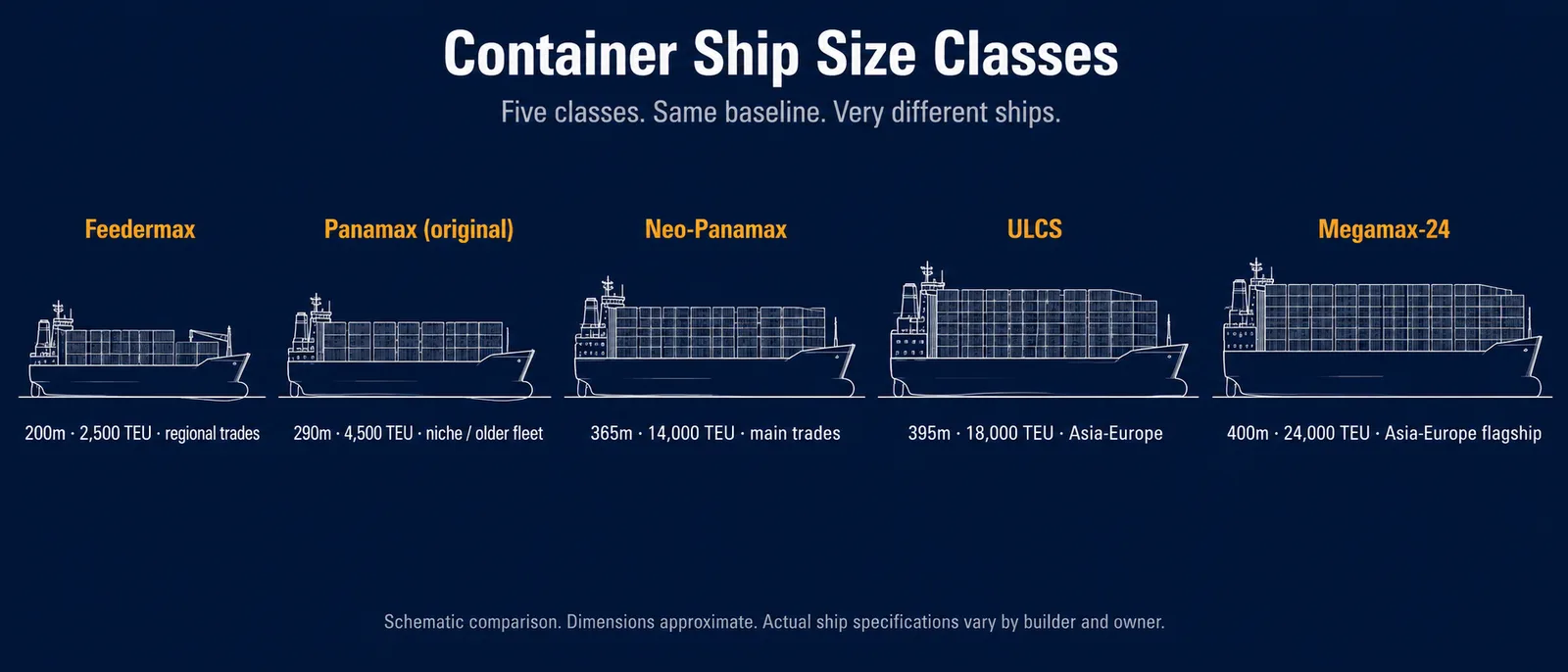
The growth was not gradual. It came in step changes, and each step is named after the constraint it broke through. Panamax for the original Panama Canal locks. Neo-Panamax for the expanded locks that opened in 2016. ULCS — Ultra Large Container Ship — for vessels large enough that no single physical constraint defined them anymore. Megamax-24 for the current top of the fleet.
Each of these names is shorthand for something specific: a route a ship can sail, a port it can call, a trade it dominates. Once you know what the labels mean, a container shipping headline becomes much easier to read.
What is a TEU?
Before the size classes, the unit. TEU stands for Twenty-foot Equivalent Unit. It is the standardized measure of container ship capacity, based on a 20-foot ISO shipping container — roughly 6 metres long, 2.4 metres wide, 2.6 metres tall.
A standard 40-foot container counts as 2 TEU, sometimes written as 1 FEU (Forty-foot Equivalent Unit). Most cargo in 2026 actually moves in 40-foot or 40-foot High Cube containers, which means a ship's nominal TEU capacity overstates the physical box count by roughly half. A 20,000-TEU ship is, in practice, carrying maybe 10,000 to 12,000 actual containers depending on the mix.
The number matters because it is the only universally accepted way to compare ships of vastly different sizes. A small feeder might carry 500 TEU. A Megamax-24 carries 24,346. Both numbers are quoted in the same unit, which makes them comparable in a way that “tonnes of cargo” never quite captures for boxed freight.
A future explainer will cover the container types themselves — Standard, Reefer, Open Top, Flat Rack, ISO Tank — and when each is used. This one is about the ships that carry them.
Feeder and Feedermax
The smallest ocean-going container ships are feeders. The class runs from roughly 300 TEU at the smallest end to about 3,000 TEU at the largest, with Feedermax typically reserved for the top of that range (1,000 to 3,000 TEU).
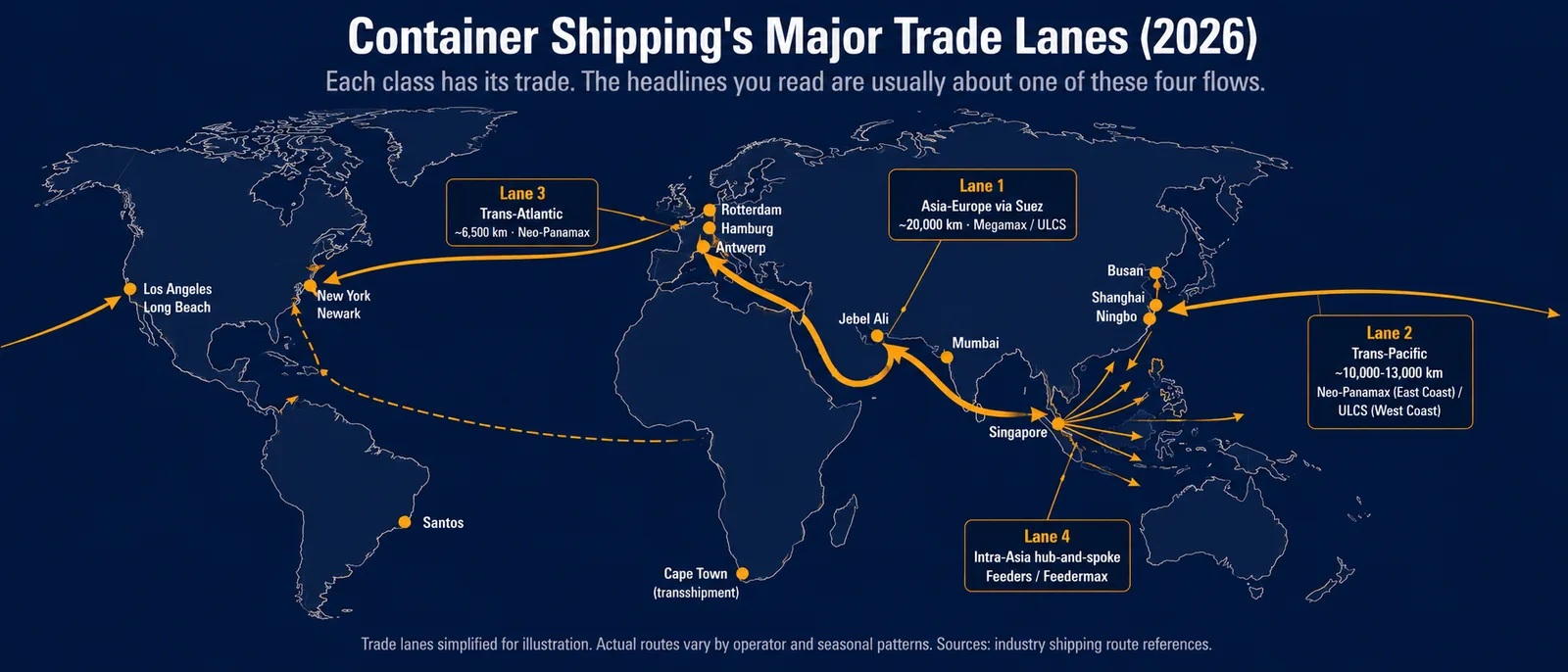
Feeders are the regional connectors of container shipping. They do not cross oceans. They move boxes from secondary ports to major hubs where the large ships call. A box loaded in a small Vietnamese port might first travel by feeder to Singapore, then transfer to a Megamax for the long haul to Rotterdam. The feeder leg is invisible in the headline trade statistics but essential to how container shipping actually works.
Most feeders are geared — they carry their own cargo cranes on deck — because the smaller ports they call at often lack shore-side crane infrastructure. They draw less water, fit narrower channels, and turn around in less time at port. They are the workhorses of intra-regional trade in Southeast Asia, the Caribbean, the Baltic, and the Mediterranean.
Feeders rarely appear in headlines. When they do, the story is usually about a regional port disruption or a hub-and-spoke route change.
Panamax (the Original)
Panamax container ships run from roughly 3,000 to 5,100 TEU.
The name is direct: a Panamax was originally the largest container ship that could fit through the locks of the original Panama Canal. The constraint was beam — the original locks were 33.5 metres wide, which set the maximum ship beam at 32.31 metres. Length was capped at 294 metres. Draft was limited by the canal's freshwater depth.
For about 50 years, Panamax was the optimal size for a container ship designed to operate globally. It could transit Panama, fit most major ports, and economically handle the dominant trades of the 20th century.
Then 2016 happened. The Panama Canal expansion added a new set of locks dimensioned for much larger ships. Almost overnight, the Panamax class lost its primary economic justification. New ships in that size range stopped being ordered. The existing Panamax fleet began aging out, mostly being deployed on niche regional routes or intra-Caribbean trades.
A Panamax container ship in 2026 is a legacy asset. The class name persists because the ships do — there are still hundreds of them in service, and brokers still use the term as shorthand for “ship that fits the old locks.” But almost no one orders a new one anymore.
Neo-Panamax (the Commercial Sweet Spot)
Neo-Panamax container ships run from roughly 5,000 to 15,000 TEU. This is the workhorse of modern intercontinental container shipping.
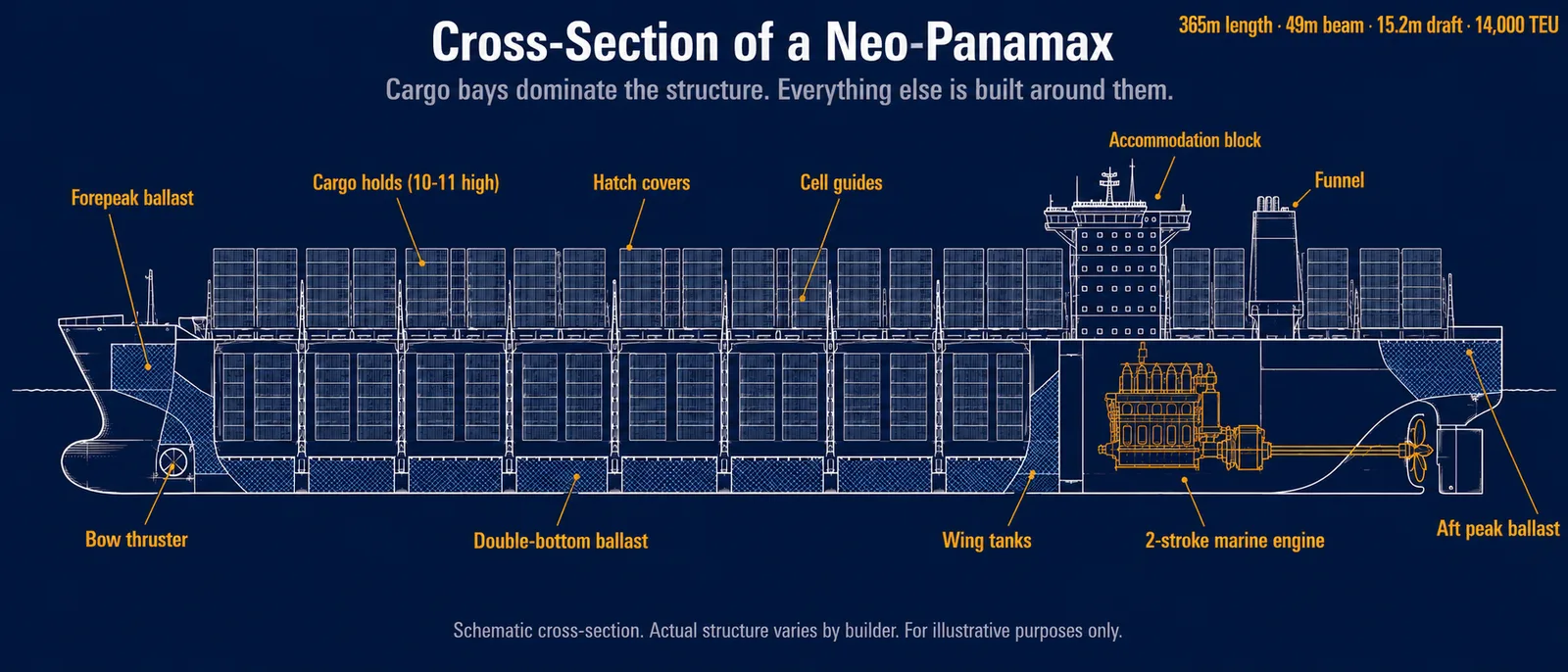
The name comes from the 2016 Panama Canal expansion. The new locks accommodate ships up to 49 metres beam, 366 metres length, and 15.2 metres draft. A “Neo-Panamax” or “New Panamax” container ship is one designed to maximize cargo within those constraints. Typical dimensions: around 14,000 TEU, 366 metres long, 49 metres beam.
Neo-Panamax ships dominate two major trade flows. The first is trans-Pacific from Asia to the US East Coast via the expanded canal — a route that became newly economical for big ships in 2016 and shifted significant cargo away from US West Coast ports. The second is North-South trade between East Asia and South America, where Panama Canal transit avoids the long Cape Horn detour.
A Neo-Panamax can also call at most major Asian and European ports, which gives it operational flexibility that the even-larger classes lack. It is large enough to be economical on long voyages, small enough to access more ports than a ULCS. The class represents the practical optimum for most modern container trades.
If a port can take a Neo-Panamax, the trade will usually run Neo-Panamax. That is why this class continues to receive the largest share of new container ship orders by vessel count in 2026.
ULCS and Megamax (the Giants)
Above roughly 15,000 TEU, container ships enter the Ultra Large Container Ship category — ULCS. Different industry analysts draw the dividing line slightly differently; Alphaliner currently treats ULCS as anything above 15,000 TEU, with the largest subclass — Megamax-24 — reaching 24,000 TEU and above. A handful of vessels at this size now form the top of the global container fleet, operated by the largest carriers: MSC, Maersk, CMA CGM, COSCO, Hapag-Lloyd, Evergreen, ONE, and HMM.
The dimensions are hard to picture. A Megamax-24 is around 400 metres long — close to four soccer fields placed end to end. 61 metres wide. Draft of about 17 metres when fully loaded. Carrying capacity of up to 24,346 TEU (MSC Irina, 2023), with the largest stacks of containers reaching eight or nine high above deck and ten or eleven deep below.
These ships were built for one trade above all others: Asia to Europe. The route runs from Shanghai, Ningbo, Busan, or Singapore to Rotterdam, Hamburg, or Antwerp via the Suez Canal — about 20,000 kilometres each way. That trade lane is dominated by ULCS and Megamax vessels because the per-TEU cost of moving cargo at that scale is dramatically lower than smaller alternatives.
The trade-off is access. A Megamax cannot transit the original Panama Canal at all. Even the expanded Neo-Panamax locks are too small for some Megamax-class vessels. They are limited to deep-water ports — Shanghai's Yangshan, Singapore, Rotterdam, Hamburg, Antwerp, Busan New Port, Jebel Ali — which means roughly 30-40 ports worldwide can fully accommodate them, according to industry estimates. The rest of the world's container ports get served by the cascade.
The Cascade Effect
There is one feature of container shipping fleet growth that does not show up in size charts but shapes everything else.
When a major line orders a 24,000-TEU Megamax, the order does not simply add 24,000 TEU of new capacity to global supply. It pushes a 14,000-TEU Neo-Panamax — previously deployed on the Asia-Europe trade — down to a slightly less prestigious route, like trans-Pacific or Asia-Mediterranean. That ship, in turn, displaces a 9,000-TEU vessel to a regional trade. That vessel pushes a 5,000-TEU Panamax to a feeder route or, eventually, to a demolition yard.
The visible top of the fleet — the newest, largest ships — reshapes the entire fleet below it. A new Megamax delivery in Korea or China sends ripples through every container trade lane in the world over the following 18 months.
Cascade is also why the global container fleet has roughly tripled in average ship size over 25 years, even though no individual ship gets bigger. The fleet ages upward. The fleet at any given size class is mostly the previous generation of ships, displaced from larger trades by even bigger newcomers.
When a maritime headline mentions “fleet overcapacity” or “freight rate collapse,” cascade is usually somewhere in the background. New Megamax deliveries depress freight rates on the trades they enter — and then again on every smaller trade that absorbs the displaced ships.
Why the Names Persist
Container ship classifications carry a small irony. Many of the size class names are anchored to constraints that have already changed.
Panamax was named for canal locks superseded in 2016. The new locks accommodate ships well above the original Panamax design, but the size class name remains. Neo-Panamax is now itself becoming a legacy name as Megamax ships exceed even the expanded locks. The Suez Canal — the only practical waterway for the Asia-Europe trade that Megamax ships were built around — has been deepened since the original constraints were set.
The names persist because chartering desks, brokers, and analysts use them as shorthand for a particular operational profile: how much cargo the ship carries, where it can sail, what trade it usually does. A new name would require relearning a set of associations that everyone in the industry already understands.
So the labels stay, even as the underlying constraints shift. The 2016 Panama Canal expansion happened ten years ago, but most container ship analyses still call the original Panamax class by its original name. Renaming would lose more clarity than it would gain.
Reading the News With This in Mind
When a maritime article mentions a specific container ship class, the class is doing work in the sentence — telling you something about the trade, the route, and often the kind of story being told.
A headline about ULCS or Megamax is almost always about the Asia-Europe trade lane or a major canal event. A story about Neo-Panamax fixtures is usually about trans-Pacific or transatlantic flows. Panamax stories tend to be about fleet aging or specific niche regional trades. Feeder coverage usually points to hub disruption or short-sea connectivity.
When the generic phrase “container shipping rates” appears, check the context. The Shanghai Containerized Freight Index (SCFI) and other trade-route indices are usually quoting ULCS and Neo-Panamax rates on mainline trades. Regional rates — North-South Caribbean, Mediterranean feeders, intra-Asia routes — sit on different indices and respond to different drivers. For the parallel benchmark story in dry bulk, see our companion piece on Bulk Carrier Sizes; for crude tankers, see Tanker Sizes.
Closing
Container ship size classes are one of those bits of industry shorthand that look forbidding from outside and turn out to be straightforward once you see the logic. They encode physical constraints — canal locks, port depths, route economics — and they organize a fleet of thousands of ships into a handful of operational categories.
Most maritime headlines about container shipping mention a class by name, and that name carries information. Knowing whether you are reading about a Megamax or a Feedermax tells you which trade lane is moving, which freight index is responding, and roughly how big the cargo flow at stake actually is.
The next time you see “container shipping rates surge” or “Megamax order” in a headline, you will already know more than the headline says.