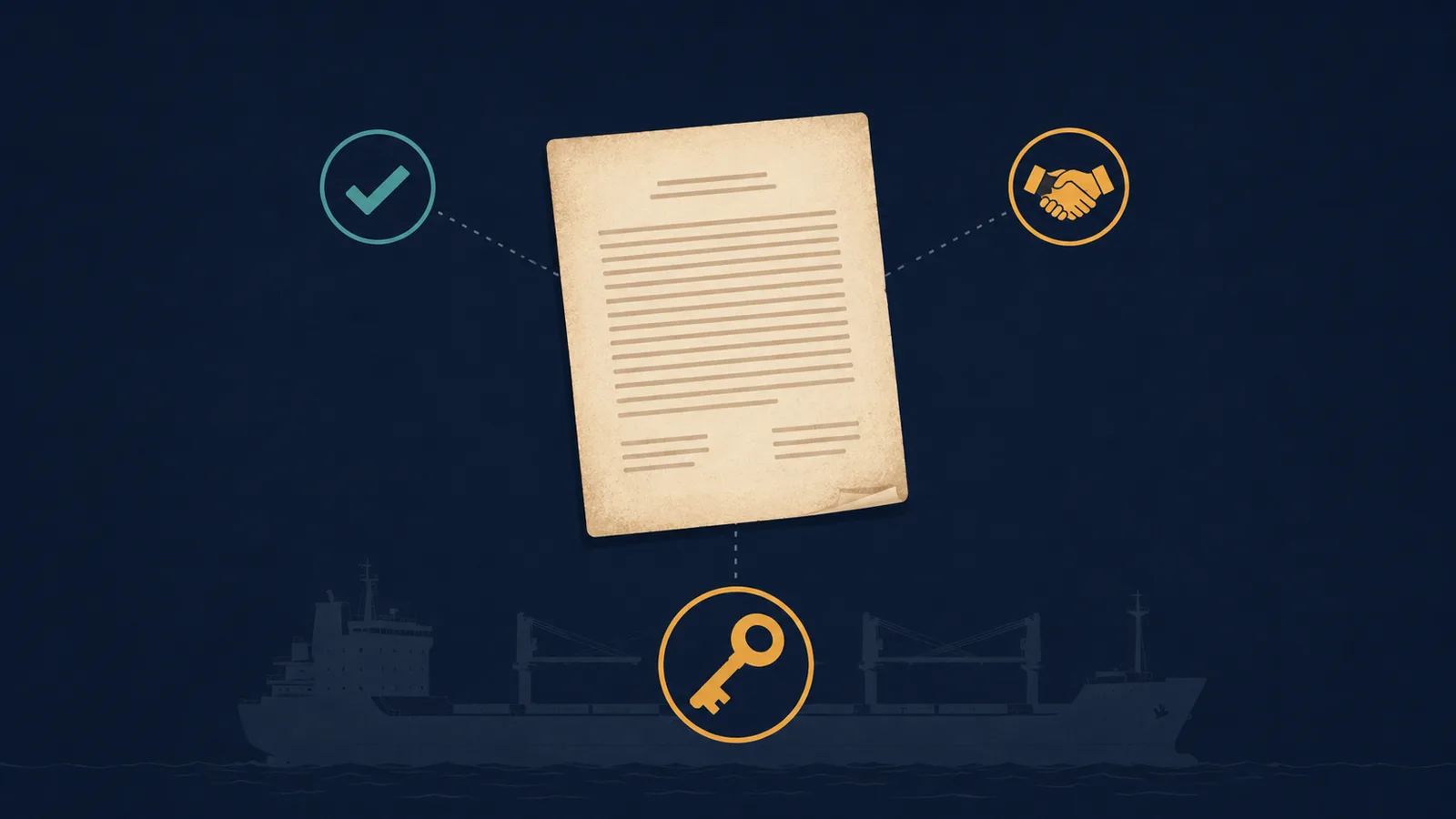
In most industries, a receipt is a receipt, a contract is a contract, and a proof of ownership is a proof of ownership. Three different documents, three different purposes, three different pieces of paper.
In shipping, one document does all three.
A bill of lading — abbreviated B/L — is a single piece of paper that simultaneously proves the carrier received the cargo, records the terms under which it will be transported, and serves as legal proof of who owns the goods. That last function is the one that makes the bill of lading unlike anything else in commercial life. The holder of the bill of lading is, in law, the owner of the cargo — even if the cargo is on a ship in the middle of the Indian Ocean and the holder is sitting in an office in Geneva.
Think of it as a house key, a rental agreement, and a property deed — combined into a single document. Hand it over, and you hand over everything.
The bill of lading has worked this way since roughly the fourteenth century, when merchants stopped travelling with their goods and needed a document that could stand in for physical possession. The system that is gradually replacing it — the electronic bill of lading — has gone from under 1% adoption in 2021 to about 11% by late 2025, a steady climb that still leaves the paper original as the default for nearly nine out of ten shipments.
Let's walk through what it actually does, why it matters, and why the transition is taking this long.
The three functions
The bill of lading is issued by the carrier (or the carrier's agent) to the shipper after the cargo has been loaded onto the vessel. It typically comes in a set of three originals — though some modern practice uses two or one — and each has equal legal force.
Function 1: Receipt. The bill of lading is a formal acknowledgement that the carrier has received the described cargo in the described condition. If the bill says "1,200 steel coils, apparent good order and condition," that statement becomes the baseline. If the cargo arrives at the discharge port with 50 coils damaged, the bill of lading is the document the cargo insurer will read first.
Function 2: Evidence of the contract of carriage. The terms printed on the reverse of the bill set out the carrier's obligations, the limits of liability, the time bars for claims, and the applicable legal regime. The bill of lading is not the contract itself (that is usually the booking confirmation or the charter party), but it is the primary evidence of the contract's terms once the cargo is on board.
Function 3: Document of title. This is the function that elevates the bill of lading from a logistics document to a financial instrument. Whoever holds the original bill of lading has constructive possession of the cargo. The bill can be endorsed — signed on the back and handed to someone else — and that endorsement transfers ownership. The cargo does not need to move. The ship does not need to arrive. The goods can change hands while they are still at sea, simply by passing the paper from one hand to another.
No other transport document — not an air waybill, not a rail consignment note, not a trucking delivery order — does this. The bill of lading is the only document in the transport sector that acts as a negotiable instrument of title. That is why banks accept it. That is why trade finance works.
Why the document exists
The bill of lading exists because merchants stopped sailing with their cargo.
In the early centuries of Mediterranean sea trade, the merchant was often the shipmaster, or at least travelled on the ship alongside the goods. As trade volumes grew and merchants stayed onshore, a practical problem emerged. The person who sent the cargo needed proof that the carrier had received it. The person waiting at the destination needed proof that the arriving cargo belonged to them. And the carrier needed a record of what was on board.
The earliest surviving bills of lading date to the fourteenth century — including records associated with the Italian merchant Francesco Datini around 1390. By 1564, the document was in regular use across Italian trade. By 1591, the law of the Hanseatic cities in northern Europe mentioned it by its modern name. By the eighteenth century, English courts had recognized the bill of lading as a document of title — meaning it could transfer ownership of goods in transit, not just prove receipt.
The document that started as a simple cargo list became, over four centuries, the central instrument of international trade finance. The form has changed. The function has not.
Types of bill of lading
Straight bill of lading (non-negotiable). The consignee is named. Only that person or company can collect the cargo. The document cannot be endorsed to someone else. Used in intra-company transfers or long-standing trade relationships where no bank is involved.
Order bill of lading (negotiable). Made out "to order" or "to the order of" a named party. Can be endorsed and transferred. This is the type that trade finance depends on. When a bank opens a letter of credit, it almost always requires an order B/L, because the bank needs to hold title to the cargo as security until the buyer pays.
Seaway bill (sea waybill). Not technically a bill of lading. A non-negotiable transport document — not a document of title. The named consignee collects the cargo at the destination with proof of identity, no original document needed. Faster and simpler, increasingly common on short-sea routes and established trade lanes.
Two other distinctions matter in practice. A clean bill of lading means the carrier received the cargo in apparent good order with no remarks about damage, shortage, or defects. A clean bill is what the bank requires under a letter of credit. A claused (also known as "foul") bill of lading means the carrier noted a problem. Banks will typically refuse it, which means the shipper does not get paid until the issue is resolved. The difference between "clean" and "claused" is the difference between getting paid on time and not getting paid at all.
The bill of lading and the letter of credit
The connection between the bill of lading and the letter of credit is the mechanism that makes most international trade possible. Without it, a seller in one country would have to trust that a buyer in another country will pay after receiving the goods.
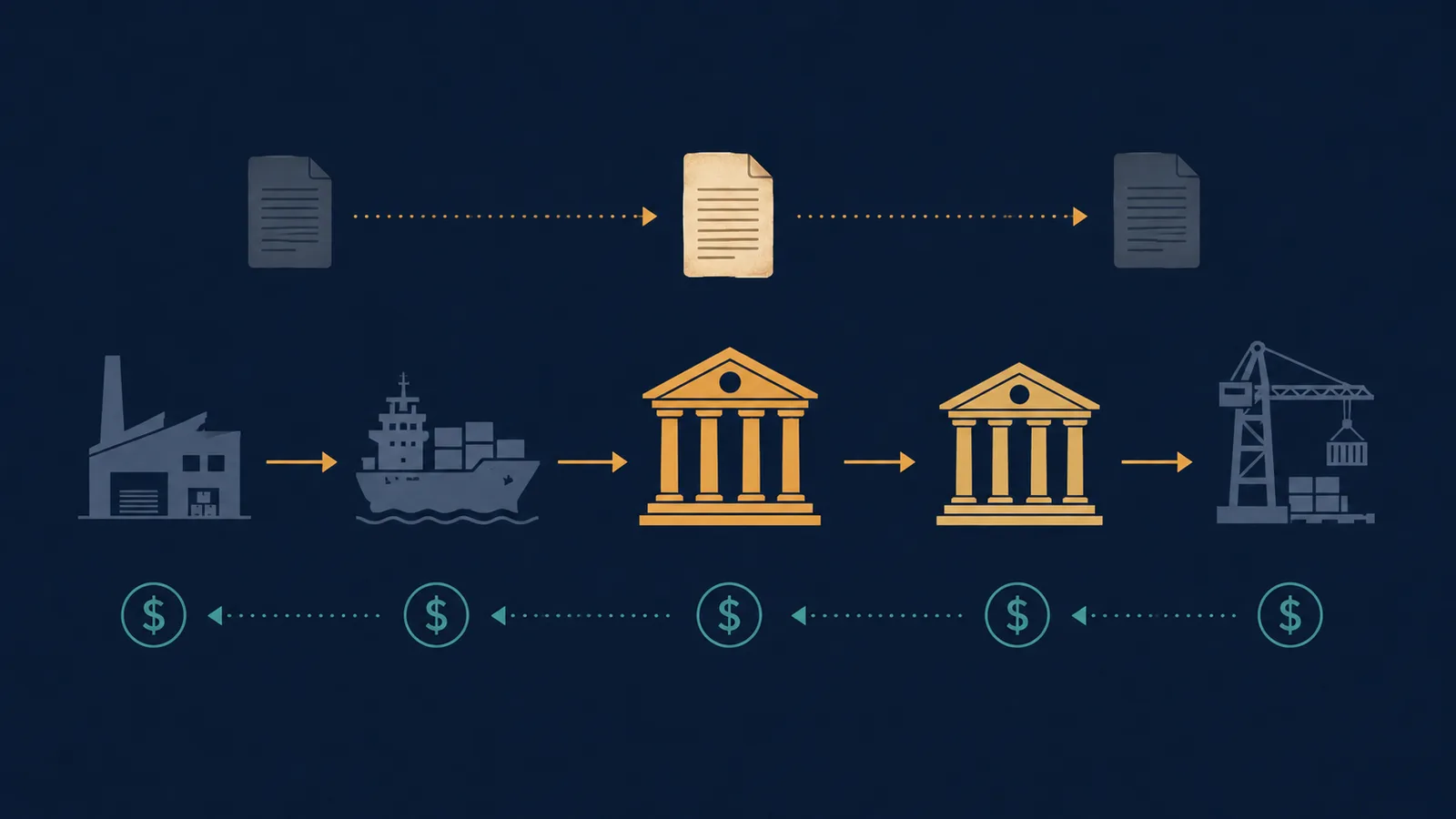
The buyer's bank issues a letter of credit promising to pay the seller once a set of documents is presented — typically a clean on-board bill of lading, a commercial invoice, a packing list, and an insurance certificate. The seller ships the cargo, gets the B/L from the carrier, and presents it to the bank. If everything matches, the bank pays. The buyer then pays the bank, receives the original B/L, and presents it at the port to collect the cargo.
The entire chain depends on one thing: the bill of lading is a document of title. The bank holds it as security because holding the bill means holding the cargo. If the buyer doesn't pay, the bank still has the paper, and the paper is the goods.
Not every trade uses a letter of credit
The B/L-plus-L/C structure described above applies primarily to large-value ocean shipments — crude oil, LNG, bulk commodities, heavy machinery — where the transaction value justifies the cost of bank intermediation, or where the parties do not yet have sufficient trust for direct payment.
For most regular container trade between established partners, the payment method is a direct bank transfer — known in trade finance as T/T (telegraphic transfer). In a T/T transaction, the seller ships the cargo, the carrier issues the B/L, and the seller sends the original B/L directly to the buyer. No bank intermediary, no L/C, no document-against-payment mechanism. Payment is settled separately — either before shipment (advance T/T) or after arrival (deferred T/T). The bill of lading still functions as a receipt and a document of title, but the bank never touches it.
The distinction matters because the L/C chain is the most complex use case for a bill of lading, not the most common one. Most international trade runs on trust and wire transfers. The B/L still travels — it just travels directly.
The legal framework
The Hague Rules (1924) established the first international standard for carrier liability. The Hague-Visby Rules (1968) updated them with higher liability limits and clearer provisions for containerized cargo — they are the most widely applied regime today. The Hamburg Rules (1978) shifted the balance toward the cargo owner. The Rotterdam Rules (2009) aimed to modernize the entire framework, including provisions for electronic transport documents, but have not received enough ratifications to enter into force.
In 2023, the United Kingdom passed the Electronic Trade Documents Act, giving electronic bills of lading the same legal status as paper originals. Singapore, Bahrain, the UAE, and India (with its Bills of Lading Bill 2025) have followed with similar frameworks aligned to the UNCITRAL Model Law on Electronic Transferable Records (MLETR).
The paper problem — and how it is changing
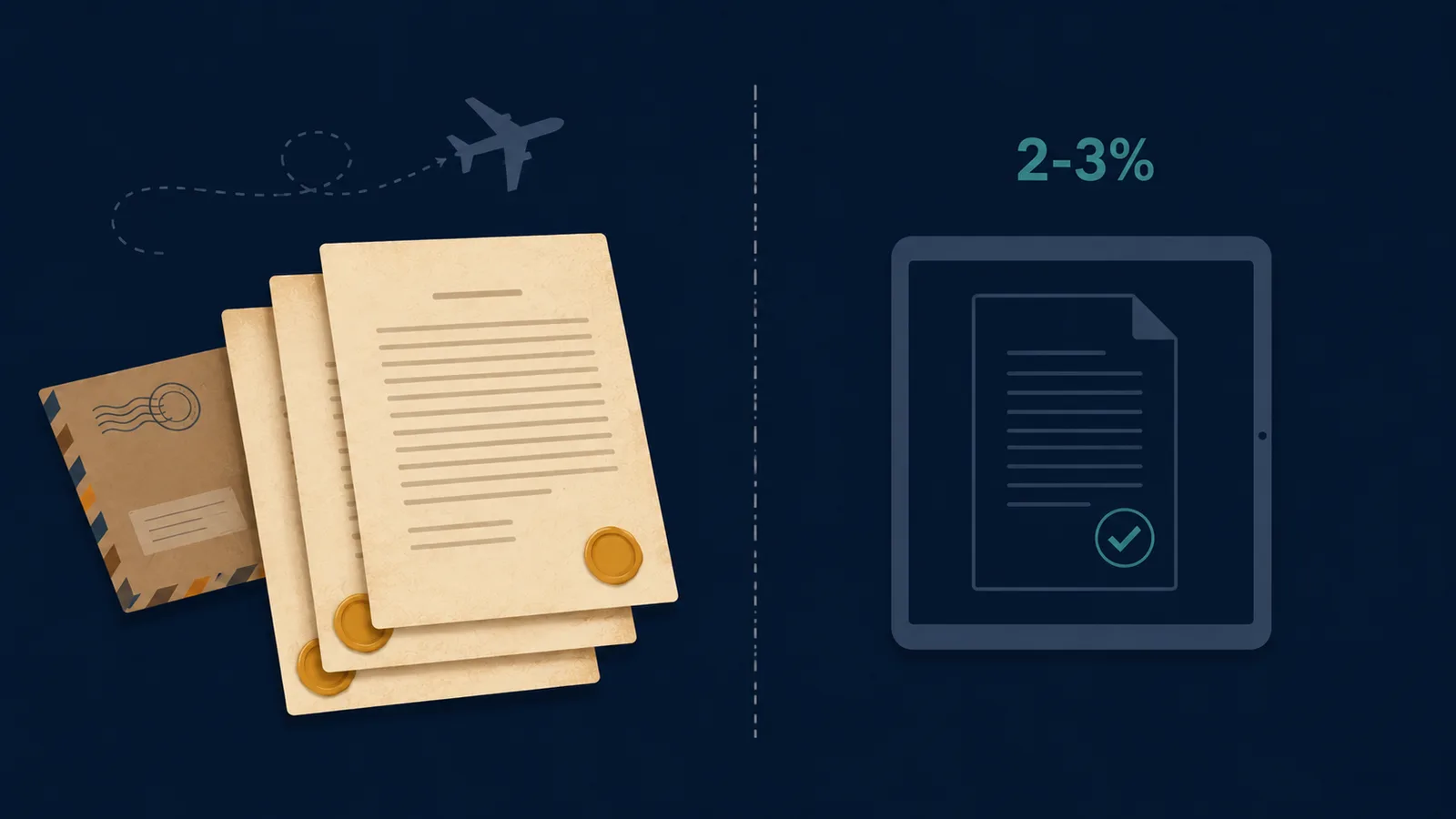
In 2021, roughly 1% of all bills of lading issued globally were electronic. By early 2025, the figure had risen to about 5.7%. By August 2025, it reached approximately 11%. In the container sector specifically, estimates for 2026 put the figure at 10 to 15%. In May 2026, the platform provider IQAX announced it had processed over one million electronic bills of lading — a 250% surge in eighteen months.
The adoption curve is steepening, but the paper original is still the default for the majority of global trade. The reason is structural, not technological. The bill of lading sits at the intersection of five different parties — shipper, carrier, consignee, bank, and insurer — and all five need to be on a compatible electronic platform for the digital version to function. If any one of them insists on paper, the whole chain reverts to paper.
The platform fragmentation problem is being addressed. In May 2025, the Digital Container Shipping Association completed the first standards-based interoperable eBL transaction — an electronic bill issued by HMM that moved between two different platform providers (CargoX and edoxOnline) during a live commercial shipment. The transaction used a shared Control Tracking Registry to log which platform held the document at each stage. For the first time, an eBL transferred across platforms without breaking the chain of title.
DCSA's nine member carriers — Maersk, MSC, CMA CGM, Hapag-Lloyd, ONE, Evergreen, HMM, Yang Ming, and ZIM, collectively covering about 70% of global container trade — have committed to 50% eBL adoption by 2027 and 100% by 2030. In the bulk trades, BIMCO's "25 by 25" initiative surpassed its target ahead of schedule, with iron ore eBL usage reaching 25.1% by mid-2024.
The paper bill of lading — issued in triplicate, couriered across continents, presented at a bank counter, carried by hand to a port authority office — is still the default in 2026. But the curve has started to bend. The document that has not fundamentally changed since the fourteenth century is, for the first time, facing a credible replacement timeline.
Reading the document
For anyone encountering a bill of lading for the first time: shipper is who sends the cargo. Consignee is who receives it — in an order B/L, this field often reads "to order" or "to the order of [bank name]." Notify party is who gets told when the cargo arrives (often the buyer), but does not hold title. "Shipped on board" date is critical for letter of credit compliance — one day late and the bank rejects the documents. And "clean on board" — meaning the cargo has been loaded onto the vessel with no remarks about damage or shortage — are the most commercially important words on the document.
One document. Three functions. Still mostly paper in 2026 — but the replacement has a deadline.
For more on the commercial documents and systems that sit alongside the bill of lading, see our companion pieces on Charter Parties Explained, What Is Worldscale?, and Classification Societies Explained.